Young Americans

The remainder of Chapter VIII of And Keep Your Powder Dry is absolutely fascinating. Margaret Mead discusses the formation of the conscience, the American experience of adolescence, and how they form America’s drive toward Progress.

I am skipping her discussion of conscience-development for a couple of reasons. As intriguing as it is, I am not sure how an anthropologist’s explanation in 1942 compares to the understanding of modern day social scientists and psychologists, and I feel like her descriptions of child-rearing in other cultures could prove not only inaccurate by modern understanding, but plain offensive. That said, you should definitely get the book just to read it!

Here, we are going to trust the veracity of her claims as understood in 1942, and then turn our attention to American adolescence. Before we dive-in, though, I want to bring your attention to the quote that I put on the homepage of this blog. The further along the book goes, the more relevant it becomes. Please, keep these words of hers in mind:

“…when I talk about what Americans must do if they are to use the full resources of their character structure, I will be making highly technical statements, and they will often sound exactly like a Sunday-school lesson.”

(Berghahn Books 2000)

Remember, this is a puritanical country. Our culture couches things in moral terms. Now, buckle up—we are going to talk about the American teenager!
(Berghahn Books 2000)

First, let me tell you as a present-day parent of two American teenagers that the stress and strain she describes is still very much a part of our experience, even for non-religious households.
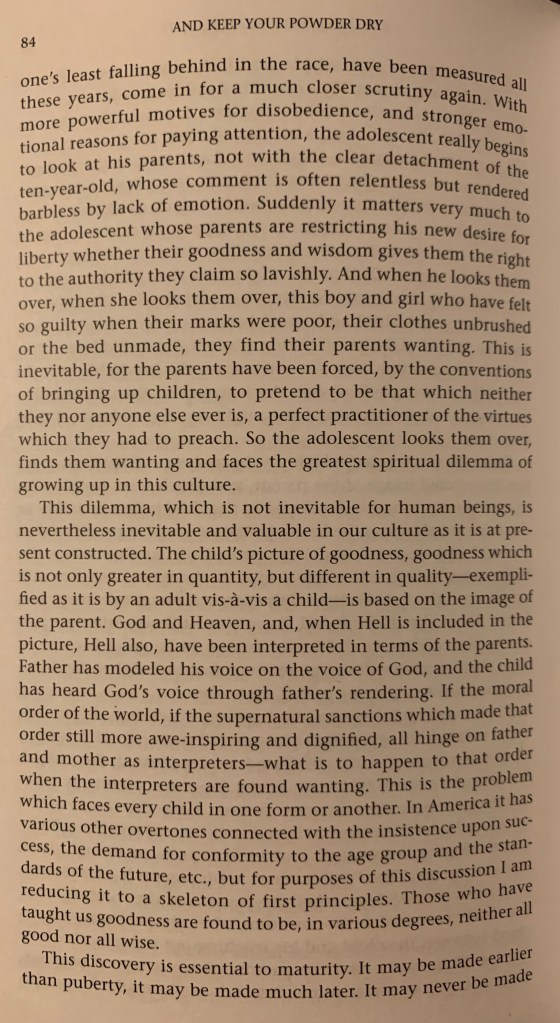
“Suddenly it matters very much to the adolescent whose parents are restricting his new desire for liberty whether their goodness and wisdom give them the right to the authority they so lavishly claim.”

(Berghahn Books 2000)

How many parents of American teenagers do you think can relate to having a teen question whether or not they even have the right to tell them what to do?

All of them.

The answer is that all parents have been found wanting. This is still very much how things go in American adolescence.
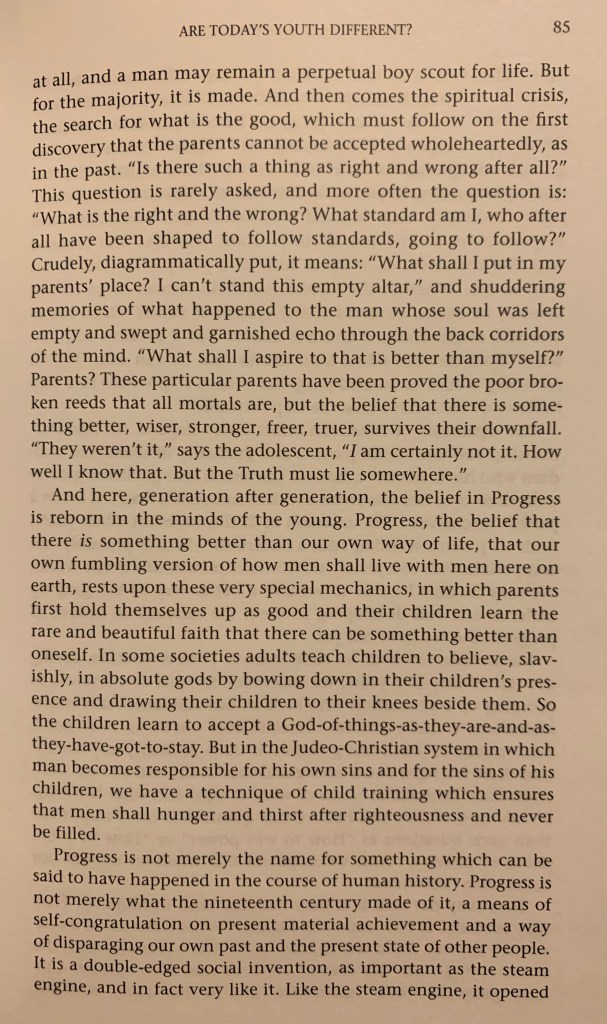
“These particular parents have been proved the poor broken reeds that all mortals are, but the belief that there is something better, wiser, stronger, freer, truer, survives their downfall.”

(Berghahn Books 2000)

I hope it brings some small comfort to parents to know that this does serve some patriotic purpose!

It might be making readers uncomfortable that she is explicitly lauding Judeo-Christian ethics for raising up people committed to progress and always doing better, or that might be completely evident to you. Either way, she warned us it would be like Sunday School up in here. Please, keep reading.
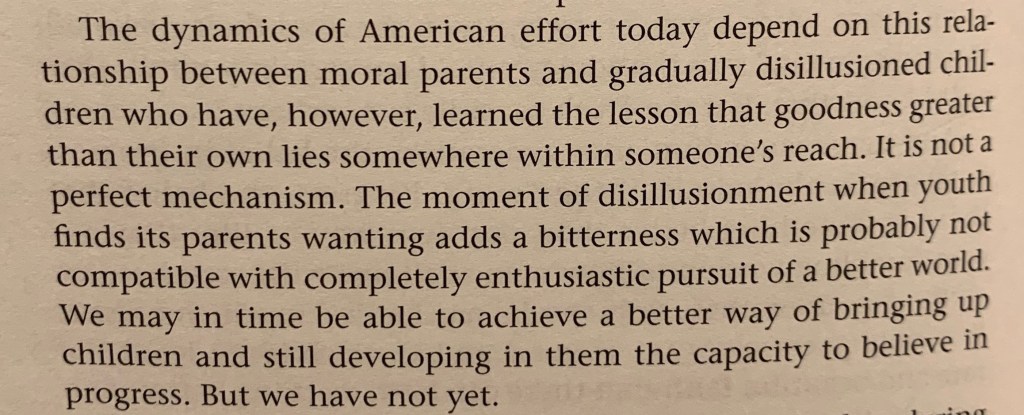
“The moment of disillusionment when youth finds its parents wanting adds a bitterness which is probably not compatible with completely enthusiastic pursuit of a better world.”

(Berghahn Books 2000)

As I was saying, this is still the way we do it. Eighty years on and less religion in our homes generally, and still, we do it this way.
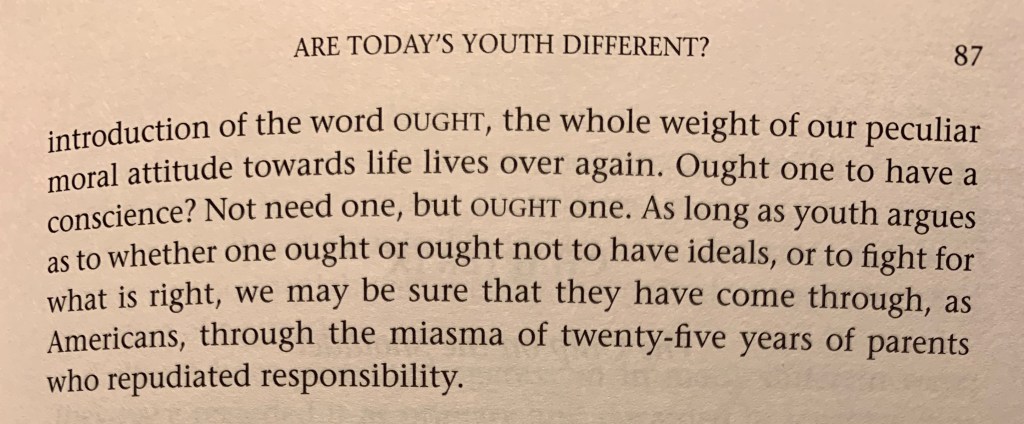
“As long as youth argues as to whether one ought or ought not to have ideals, or to fight for what is right, we may be sure that they have come through, as Americans, through the miasma of twenty-five years of parents who repudiated responsibility.”

(Berghahn Books 2000)

And, these are the kids we have.

American teenagers, for all their cynicism and existential dread, still are talking about what we should be doing. Even with their long reputation of not caring much, young Americans still protest, march, and rant that their elders can and, more importantly, should do better.

Mead makes me believe that this our hope, always.
We Have Been Through Hard Times Before

Even before our current crisis, a friend of mine, who is a professional historian, reminded a room full of people that we have been through hard times before. He then spoke of the era that Margaret Mead describes in Chapter VIII of And Keep Your Powder Dry. She describes that time as a betrayal of our values by an entire generation.

“Are Today’s Youth Different?” is the chapter’s title. In it, Mead first takes aim at the parents of the young adults of the time. Those young adults would come to be known as The Greatest Generation. Now, we take aim at their children with “ok, Boomer” much the way their parents were targets in ‘42.

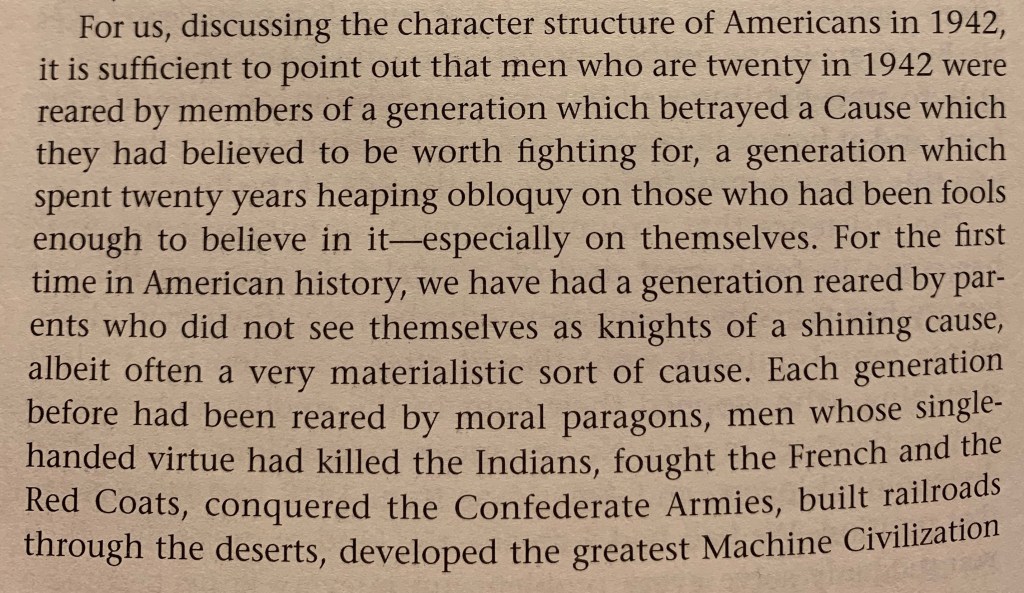
“For the first time in American history, we have had a generation reared by parents who did not see themselves as knights of a shining cause, albeit often a very materialistic sort of cause.”

(Berghahn Books 2000)

We are reminded that American Exceptionalism was alive and well in Mead’s time when reading the words “…whose single-handed virtue has killed the Indians…” (2000). It is one of those statements likely to make many modern Americans cringe. What does this mean for us now, when the destruction of indigenous cultures and peoples is recognized as genocide? Ask yourself that question, but stick with her.

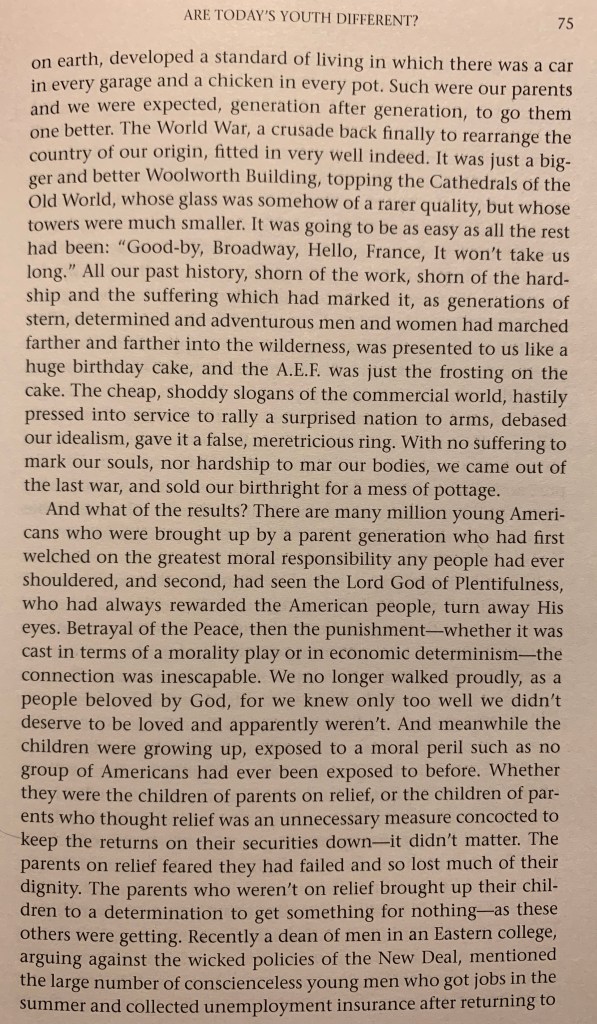
“With no suffering to mark our souls, nor hardship to mar our bodies, we came out of the last war, and sold our birthright for a mess of pottage.”

(Berghahn Books 2000)

The framing of the betrayal in terms of favor and punishment from God might seem out-of-date now. This sentiment, that our fathers put money first and squandered the future of their children, though, feels fresh. Aren’t our children, who prepare for shootings perpetrated by classmates at school and who have a computer with access to free porn at home, “exposed to a moral peril such as no group of Americans has ever been exposed to before,” (2000) too? The specific anxieties are different, but the worry is the same today as yesterday: we aren’t prepared for this. These kids aren’t prepared for this.

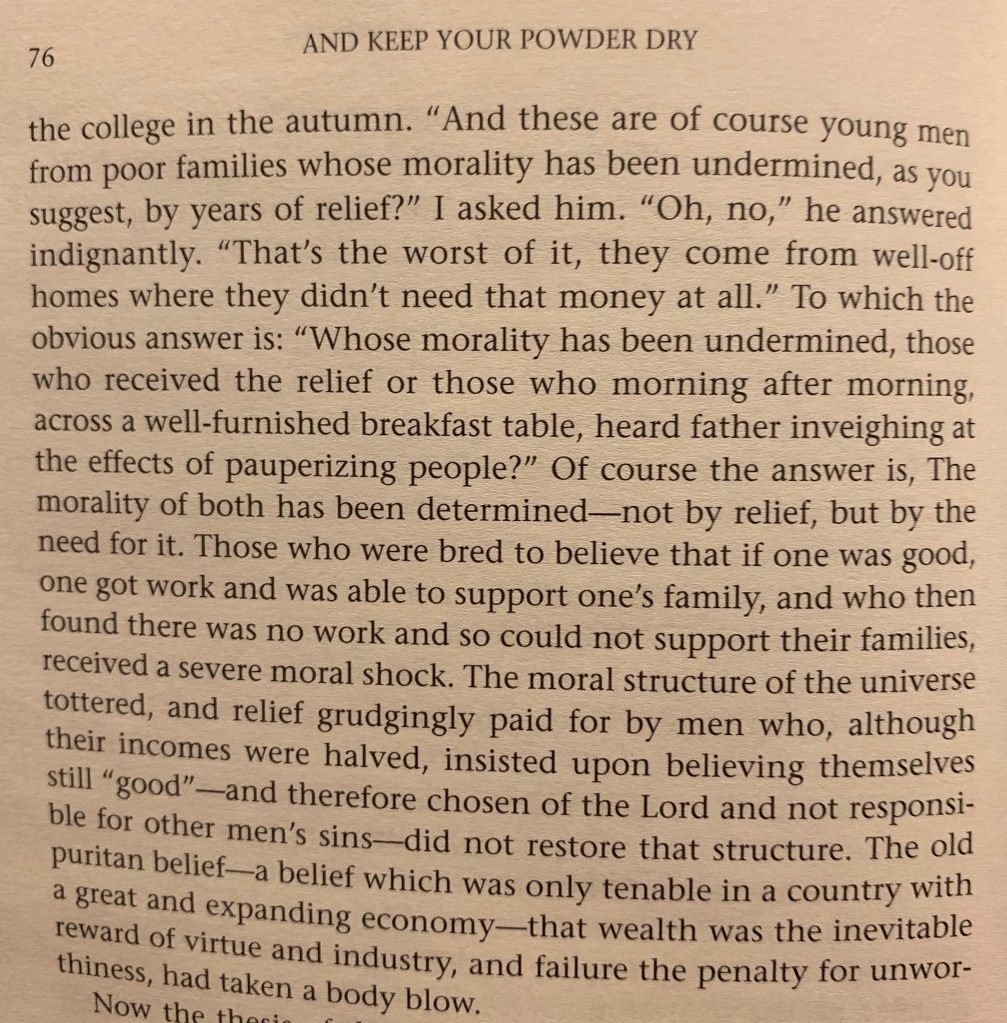
Mead wasn’t considered a conservative as far as I can tell, but calling the New Deal wicked is the sort of description likely to make conservative readers smile and liberal readers scoff. Her description of relief/aid makes it clear that she sees it as contrary to good character. That’s not the whole story of the need for relief, though, and she understands that. One thing I really admire about Mead is how seamlessly she moves from a scathing criticism to obvious understanding of the other side, like in this next passage.

“The old puritan belief— a belief which was only tenable in a country with a great and expanding economy—that wealth was the inevitable reward of virtue and industry, and failure the penalty for unworthiness, had taken a body blow.”

(Berghahn Books 2000)

Mead explains how our aversion to relief comes from our puritanical roots. She blames a generation of Americans for losing God’s favor and lambastes the country for even needing relief programs, but then she easily acknowledges that “wealth was the inevitable reward of virtue” (2000) doesn’t really hold water in a financial collapse (or, say, a quarantine).

This does not come across as hypocrisy. She simply displays a keen awareness that, sometimes, a thing lends itself to the opposite thing. Our modern dialogue would benefit from that kind of nuance and clear-eyed look at the country and its people.

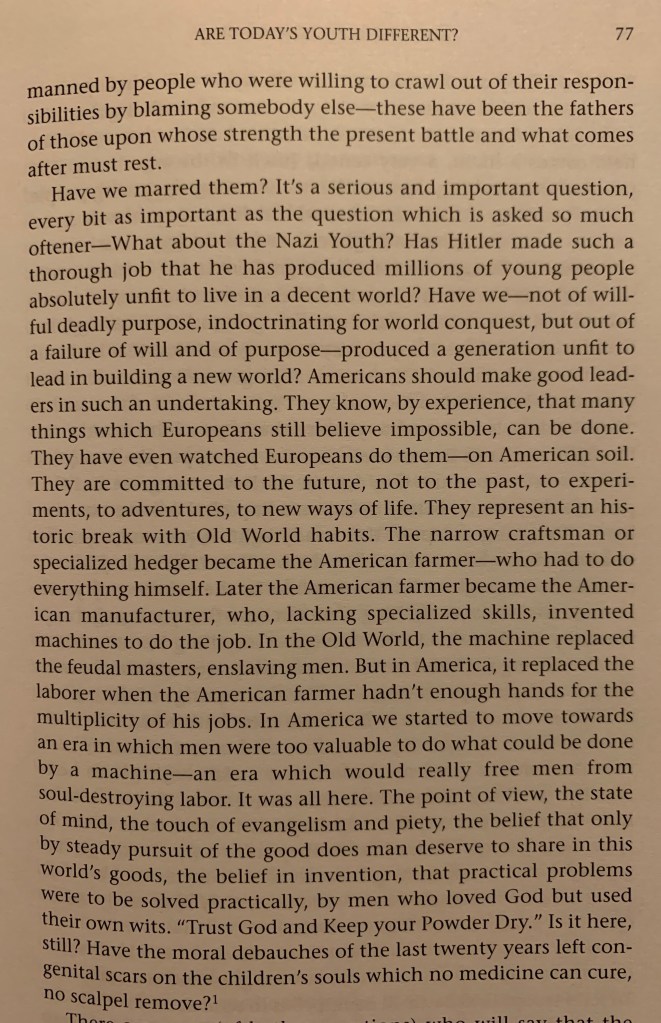
“Have the moral debauches of the last twenty years left congenital scars on the children’s souls which no medicine can cure, no scalpel can remove?”

(Berghahn Books 2000)

After she demands America wrestle with its mistakes, she asks her readers if their failure of will and purpose could produce a generation of Americans unfit to build a new world, when building new worlds is supposed to be what Americans are uniquely fit to do. Did we already cause so much damage that American kids these days aren’t ready for the future?

She was expressing that anxiety about The Greatest Generation.

Mead and her fellow Americans had the fortune of being certain in their way forward: beat the Nazis. By 1942 (though just years after a Nazi gathering in Madison Square Garden), Americans were unified around that cause. They shared a common cause in the defeat of fascism.

Our shining cause isn’t so clear, though it feels more obvious now than it did about four weeks ago. We’ve definitely learned a lot about preparation, and keeping our powder dry!

What have we learned, though, about leading in the future?

And, are these kids prepared for that?

“But he had it easy from the start.”

In And Keep Your Powder Dry, Margaret Mead slowly shifts her attention from American parents to good, ole American sibling rivalry in Chapter VII, “Brothers and Sisters and Success.” I’ve been looking forward to sharing this one with you!

The relevance of these words feels crazy in a world of avocado toast and standardized testing.

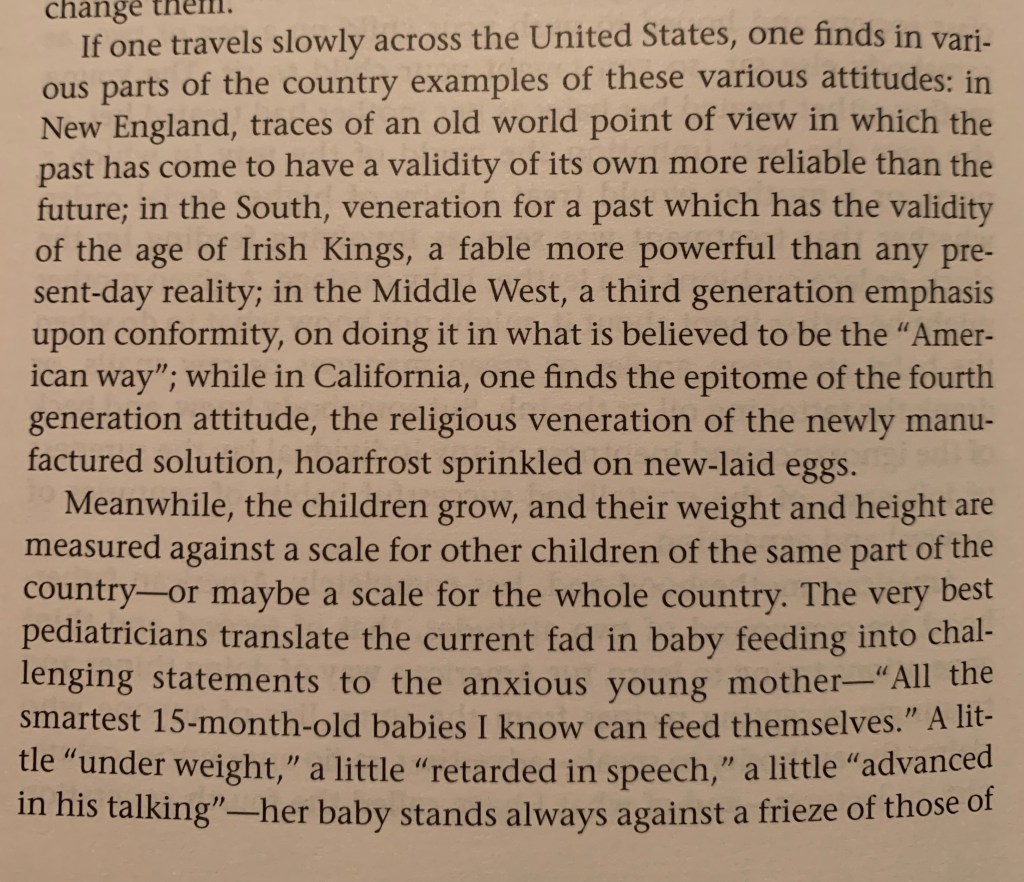
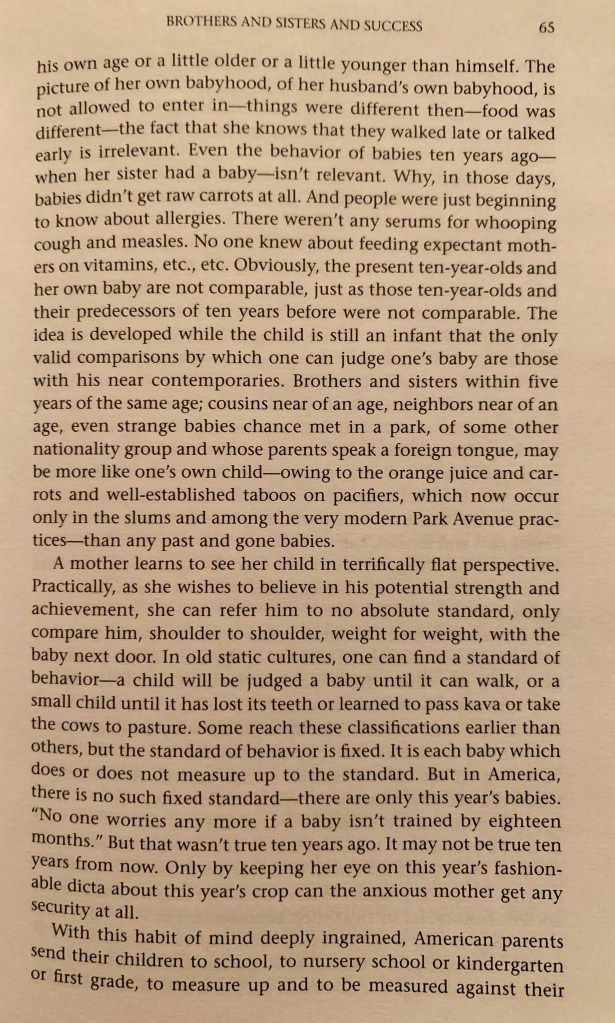
“Meanwhile, the children grow, and their weight and height are measured against a scale for other children of the same part of the country—or maybe a scale for the whole country.”

(Berghahn Books 2000)

“Breast is best.” “Fed is best.” “95th percentile.” I don’t think you’d find a modern pediatrician talking about the “smartest 15-month-old babies they know,” (2000) thank goodness, but it doesn’t make modern moms any less anxious about the growth charts and milestones and how clearly the other babies are talking. SAT scores, GPAs, scholarships. The measurements don’t stop, and every child doing well is the cause of panic in ten mothers whose kid isn’t. The focus is always new, but the stress, Mead tells us, has always been the same. For American moms, the persistent worry is: can my kid measure up?

“But in America, there is no such fixed standard—there are only this year’s babies.”

(Berghahn Books 2000)

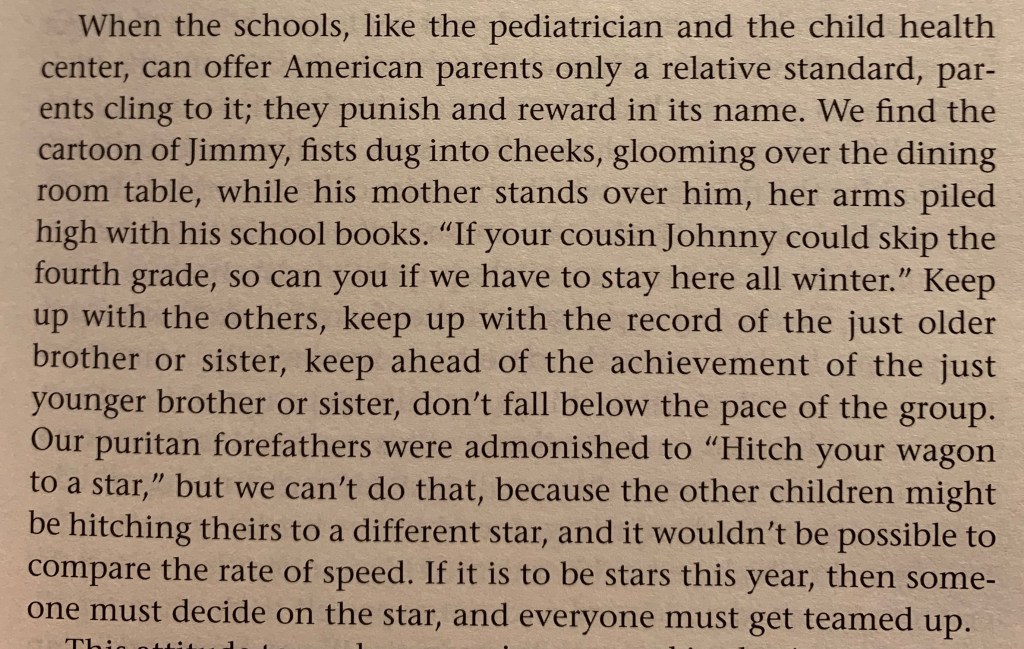
Oh, she makes me laugh as she explains some important things. In American families, Mead asserts, this focus on comparing kids who are roughly the same age means comparisons of siblings that sets up a particularly American flavor of sibling rivalry. Try to catch the older sister; don’t get outpaced by the younger. The message is one of relentless competition.

(Berghahn Books 2000)

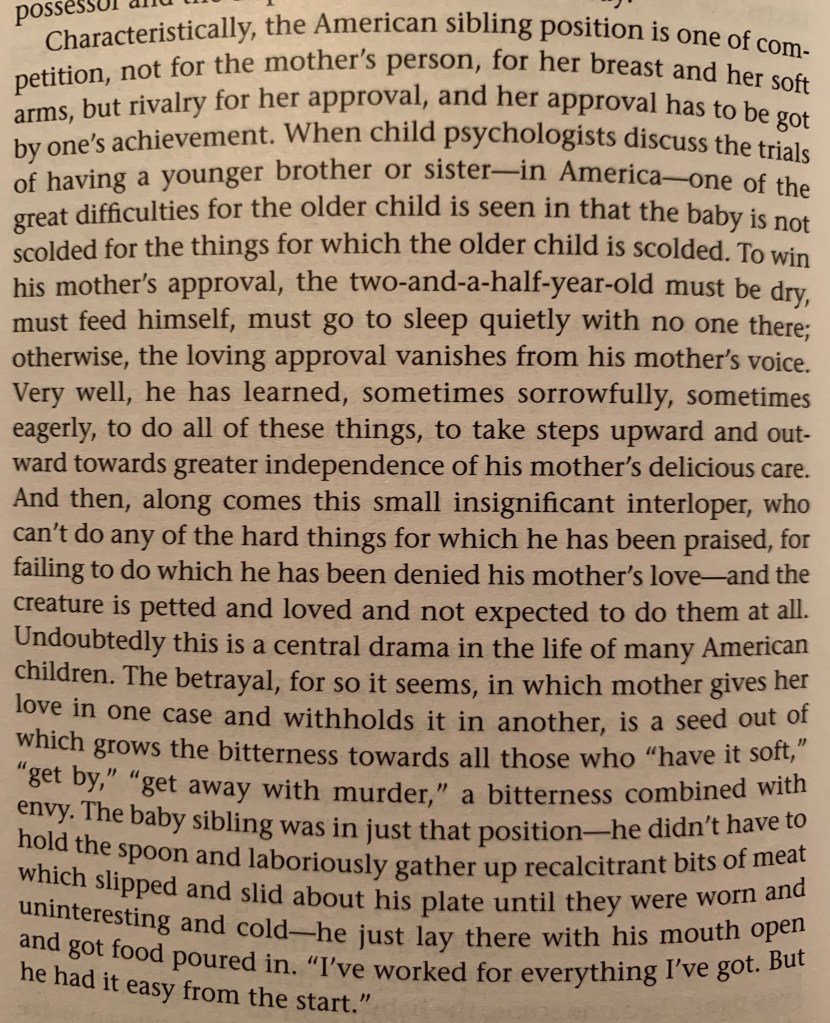
But here is the real gem, when Mead threads the needle to explain how this American family dynamic plays out in our worldview. You’ll recognize some Americans more than others in this!

“And then, along comes this small insignificant interloper, who can’t do any of the hard things for which he has been praised… and the creature is petted and loved and not expected to do them at all.”

(Berghahn Books 2000)

The baby sibling was in just that position—he didn’t have to hold the spoon and laboriously gather up recalcitrant bits of meat which slipped and slid around his plate until they were worn and uninteresting and cold—he just lay there with his mouth open and had food poured in.”

‘I’ve worked for everything I’ve got. But he had it easy from the start.’

(Berghahn Books 2000)

Is this relevant in 2020?

Do you hear this bitterness combined with envy in our current political debates? I do. I hear it all the time. I cannot read a comment thread on the Internet without hearing this sentiment spoken like truth. It’s a crux of the American character that creates a lot of our polarization. When it’s not part of your worldview, making an injustice of it is. Of course, you might yell, we just pour the milk into the baby!

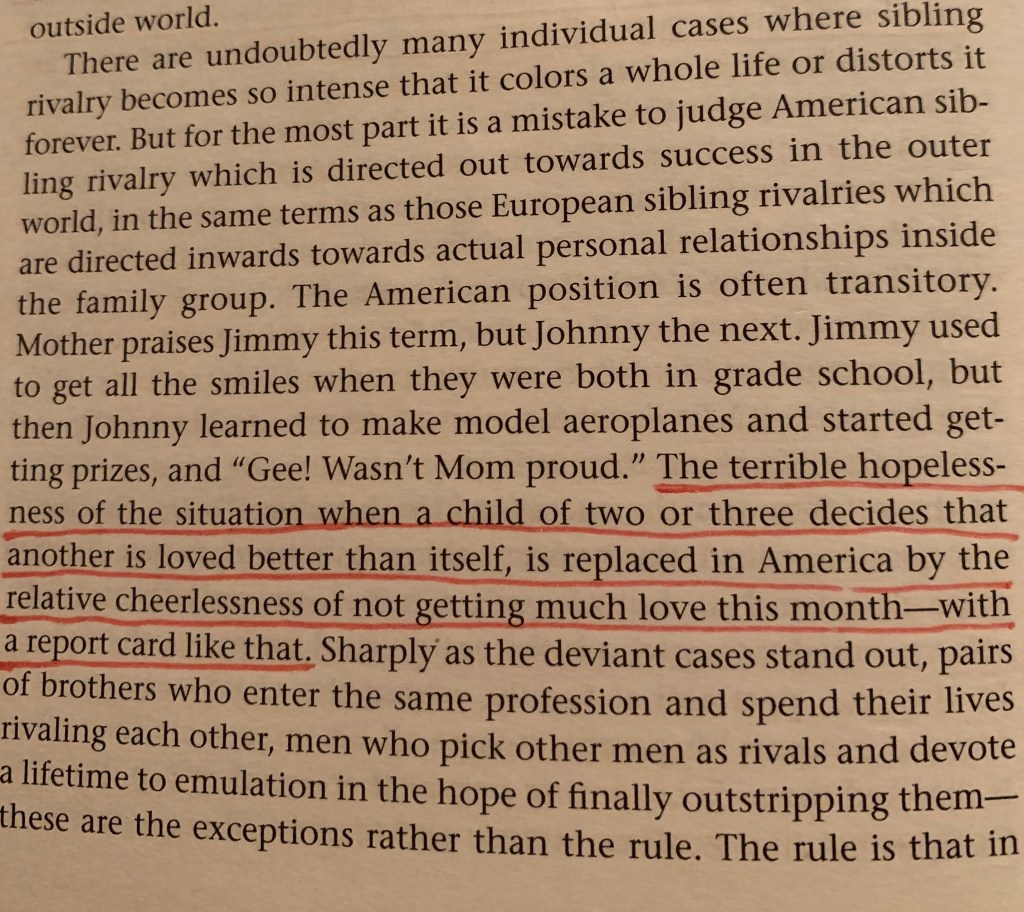
Finally, Mead explains how our parenting toward success creates a sibling rivalry that can look bitter, but is transitory, so not hopeless. I’m mostly including it, because it’s Mead, like so much in this chapter, in fine form.

(Berghahn Books 2000)

1942

Chapter I is “The Introduction” of And Keep Your Powder Dry as written in 1942. On page 2, Margaret Mead writes:

“The obligation of the scientist to examine his material dispassionately is combined with the obligation of the citizen to participate responsibly in his society. To the investigation of social materials to the end that we may know more —here—now—in America towards fighting the war in a way that will leave us with the moral and physical resources to attack the problem of reorganizing the world.”

(Berghahn Books 2000)

When reading And Keep Your Powder Dry, the time and purpose must stay on the surface. Mead was writing for people in a different century, with a very particular goal in mind. When she writes about the enemy, there’s no ambiguity who she is talking about and she isn’t talking about any present-day enemies. When she says we need to reorganize the world, she means it literally—the world as it was organized in 1942 was not going to survive the end of Nazi Germany. When she speaks of black Americans, the language is archaic. You wouldn’t know unless you are familiar with her story that she was respected by James Baldwin. Mead would not know what an ableist is. Mead was not a time-traveler.

It might not seem like I’m making the case to read this book, but hang in there with me…

“But I never completely lose a still further point of reference—the awareness that my audience wears clothes, and several layers of them…”

(Berghahn Books 2000)

Despite the distance Mead has from modern Americans (she was born 99 years before my oldest daughter), she has a clear understanding of what makes our culture unique in the world, because she understood what made other cultures unique. Her ability to contrast and compare us to other cultures allows us to see an American character structure that still very much exists in some very recognizable and surprising ways. Also, she is funny. I hope you keep coming back for the descriptions like, “…civil servants with clothes that look like uniforms or clothes that aggressively do not look like uniforms…” (2000).

“These people are completely clothed.”

(Berghahn Books 2000)

Despite the seriousness of the subject matter, Mead brings a humor and wit that I hope you will find as engaging as I do. She also brings a strong understanding of the concepts she is teaching, able to present them with nuance and clarity, simultaneously. She understands not only the strengths and weaknesses of the American character, but the challenges and criticisms of the work she is undertaking. With And Keep Your Powder Dry, Mead gives us a framework for understanding the American character, and, despite some clear limitations brought by her position in the world and the time she was writing, she gives us a role model for how to talk about it.

She has a lot to offer, and presents it with understanding, humor, and self-reflection. I hope you’ll agree in the weeks to come. Thanks for reading with me.

March 3, 2020

Today marks Super Tuesday of what promises to be a long, trying election year.

It will be said that November’s election will decide many things, and it probably won’t about innumerable policy issues. It will tell us something, though, of who we think we are. I think a challenge we have, and it’s not new to us, is that we don’t exactly know the answer to “who are we?” We have some impressive documents to guide us, but they don’t change that we have wildly different thoughts on what the answer is or should be.

It’s hard to answer, because our country has changed so dramatically, and has helped dramatically change the world, in the centuries it has existed. We are supposed to innovate, adapt, and chart new courses in unimagined places. In this country, we can look back, know the history books left out the stories of many Americans, and demand a rewrite that takes them into account. Add to that, we are a nation of individuals, so we are not beholden to the perceived shared values of one another. Every election, like this election, our shared values are up for debate.

The difficulty of the question doesn’t mean we can’t answer it, though.

We will and must answer “who are we?” at the polls and in our homes, whether we like it or not, so this blog is my effort to lead a discussion about it, by reading a book about it with you. That book is And Keep Your Powder Dry by Margaret Mead.

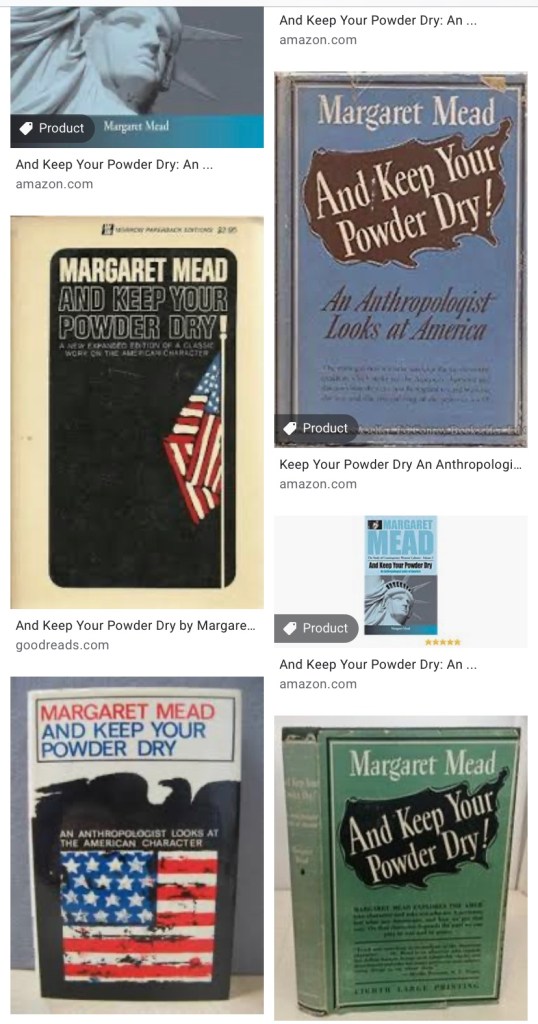
Originally published in 1942 and most recently in 2000 by Berghahn Books, the book was Mead’s attempt to use her skill as a social scientist to help Americans understand their collective strengths and weaknesses in an effort to win the war and the peace. Needless to say, this leaves room for debate and disagreement. I don’t recommend this book as some inarguable truth nor do I claim Mead or her ideas are somehow beyond reproach. I present it, because she thought a lot about the question and wrote one of the most studied, articulate answers to it.

Any American reading And Keep Your Powder Dry in 2020 is likely to see some of it as clearly wrong, misguided, or just plain puzzling. They are also likely to laugh loudly at times, struck by how right she could get it about present day Americans from way back in the 1940s. Mostly, and the reason I’ve been moved to write this blog, I think anyone who reads this book in this election year will think about the American character and our place in the world in a way that they haven’t, and in a way that we haven’t as a nation, in a long time. She will move you.

Please, find a copy or just read along with me. I am so excited to share this book with you now!

(You can learn more about Mead and 1942 in the Background Links page of the website.)