Blog

Young Americans

The remainder of Chapter VIII of And Keep Your Powder Dry is absolutely fascinating. Margaret Mead discusses the formation of the conscience, the American experience of adolescence, and how they form America’s drive toward Progress.

I am skipping her discussion of conscience-development for a couple of reasons. As intriguing as it is, I am not sure how an anthropologist’s explanation in 1942 compares to the understanding of modern day social scientists and psychologists, and I feel like her descriptions of child-rearing in other cultures could prove not only inaccurate by modern understanding, but plain offensive. That said, you should definitely get the book just to read it!

Here, we are going to trust the veracity of her claims as understood in 1942, and then turn our attention to American adolescence. Before we dive-in, though, I want to bring your attention to the quote that I put on the homepage of this blog. The further along the book goes, the more relevant it becomes. Please, keep these words of hers in mind:

“…when I talk about what Americans must do if they are to use the full resources of their character structure, I will be making highly technical statements, and they will often sound exactly like a Sunday-school lesson.”

(Berghahn Books 2000)

Remember, this is a puritanical country. Our culture couches things in moral terms. Now, buckle up—we are going to talk about the American teenager!
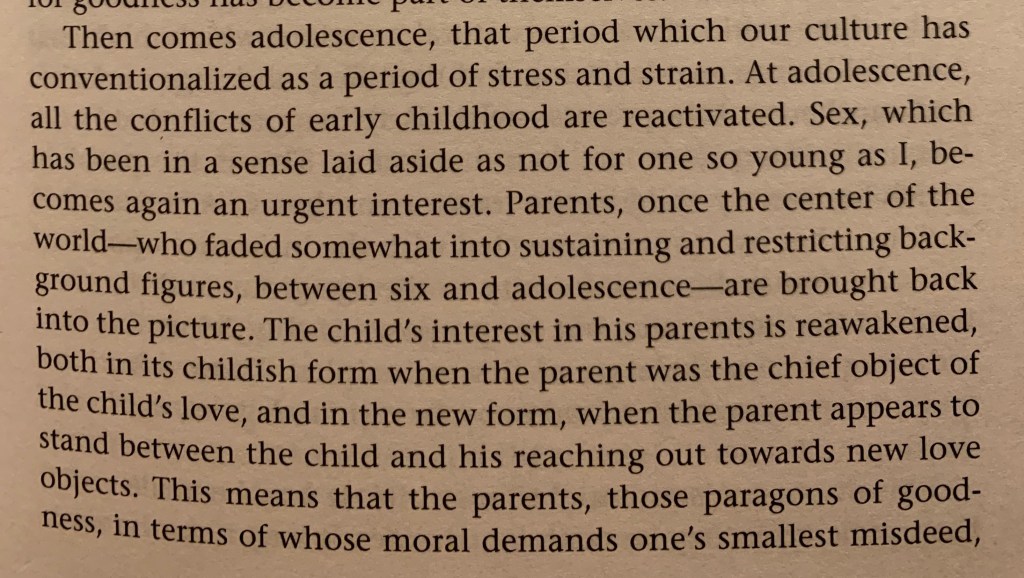
(Berghahn Books 2000)

First, let me tell you as a present-day parent of two American teenagers that the stress and strain she describes is still very much a part of our experience, even for non-religious households.
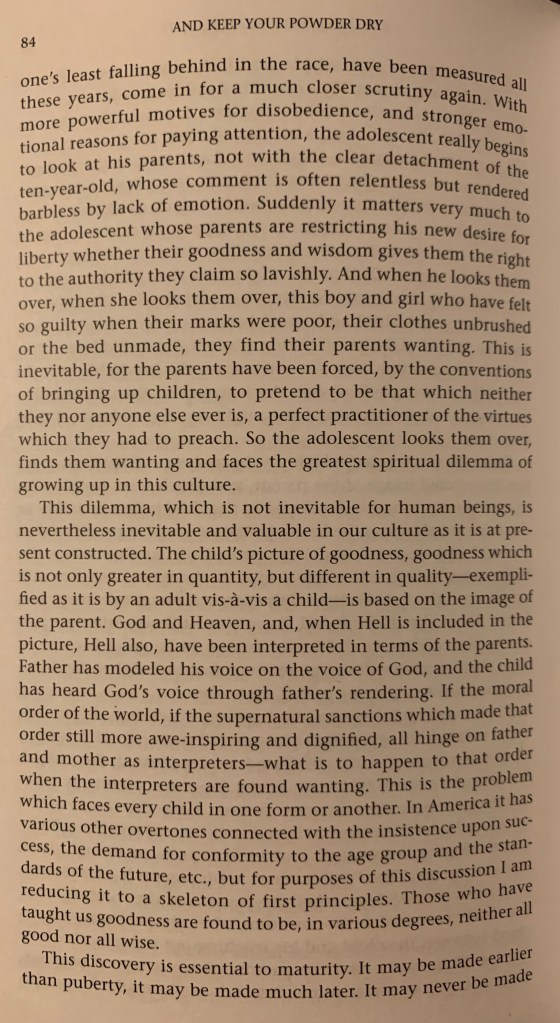
“Suddenly it matters very much to the adolescent whose parents are restricting his new desire for liberty whether their goodness and wisdom give them the right to the authority they so lavishly claim.”

(Berghahn Books 2000)

How many parents of American teenagers do you think can relate to having a teen question whether or not they even have the right to tell them what to do?

All of them.

The answer is that all parents have been found wanting. This is still very much how things go in American adolescence.
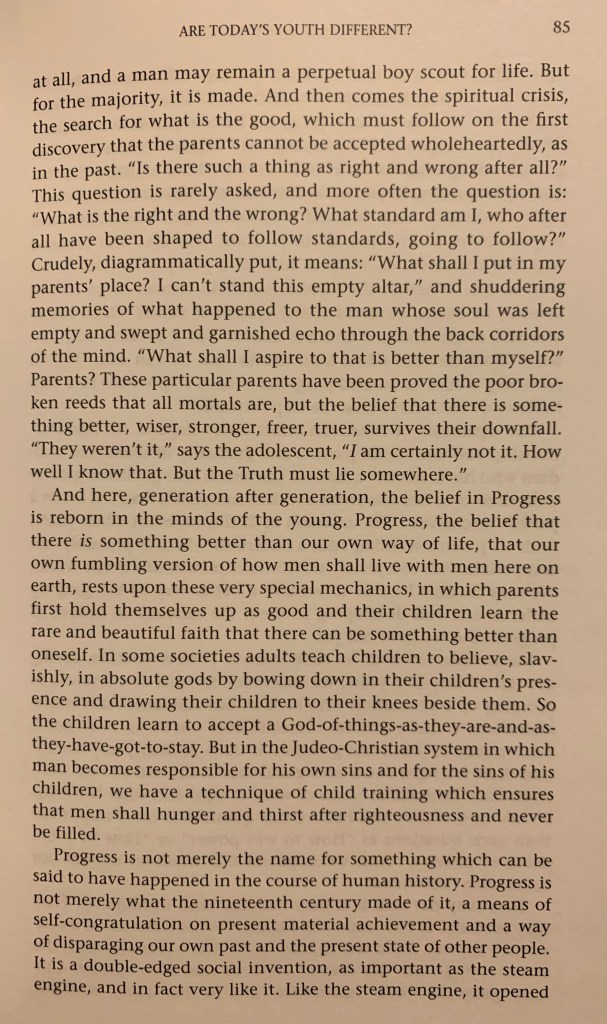
“These particular parents have been proved the poor broken reeds that all mortals are, but the belief that there is something better, wiser, stronger, freer, truer, survives their downfall.”

(Berghahn Books 2000)

I hope it brings some small comfort to parents to know that this does serve some patriotic purpose!

It might be making readers uncomfortable that she is explicitly lauding Judeo-Christian ethics for raising up people committed to progress and always doing better, or that might be completely evident to you. Either way, she warned us it would be like Sunday School up in here. Please, keep reading.
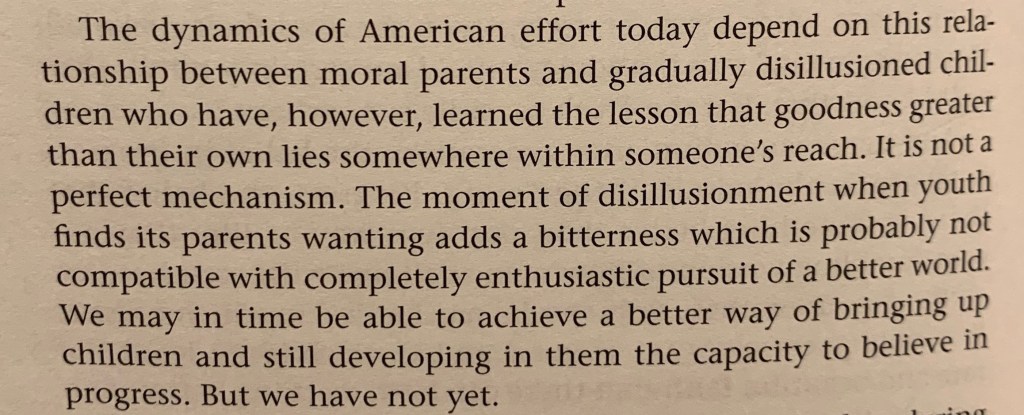
“The moment of disillusionment when youth finds its parents wanting adds a bitterness which is probably not compatible with completely enthusiastic pursuit of a better world.”

(Berghahn Books 2000)

As I was saying, this is still the way we do it. Eighty years on and less religion in our homes generally, and still, we do it this way.
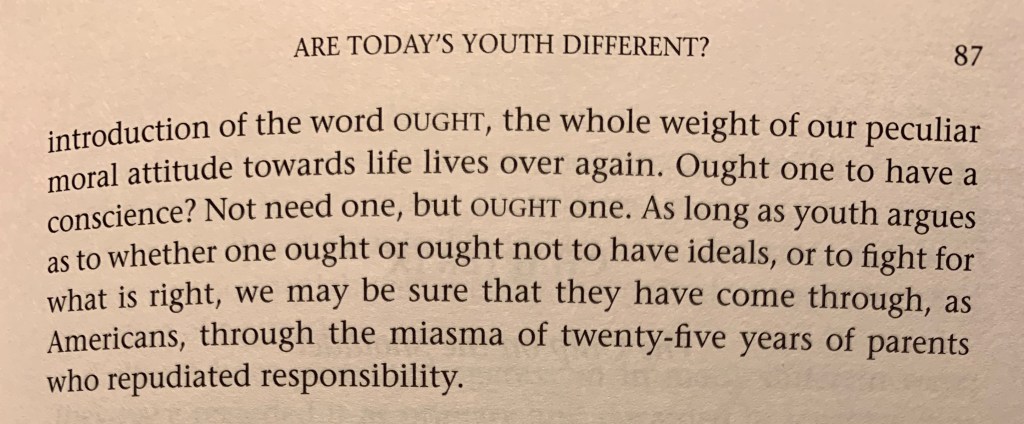
“As long as youth argues as to whether one ought or ought not to have ideals, or to fight for what is right, we may be sure that they have come through, as Americans, through the miasma of twenty-five years of parents who repudiated responsibility.”

(Berghahn Books 2000)

And, these are the kids we have.

American teenagers, for all their cynicism and existential dread, still are talking about what we should be doing. Even with their long reputation of not caring much, young Americans still protest, march, and rant that their elders can and, more importantly, should do better.

Mead makes me believe that this our hope, always.
We Have Been Through Hard Times Before

Even before our current crisis, a friend of mine, who is a professional historian, reminded a room full of people that we have been through hard times before. He then spoke of the era that Margaret Mead describes in Chapter VIII of And Keep Your Powder Dry. She describes that time as a betrayal of our values by an entire generation.

“Are Today’s Youth Different?” is the chapter’s title. In it, Mead first takes aim at the parents of the young adults of the time. Those young adults would come to be known as The Greatest Generation. Now, we take aim at their children with “ok, Boomer” much the way their parents were targets in ‘42.

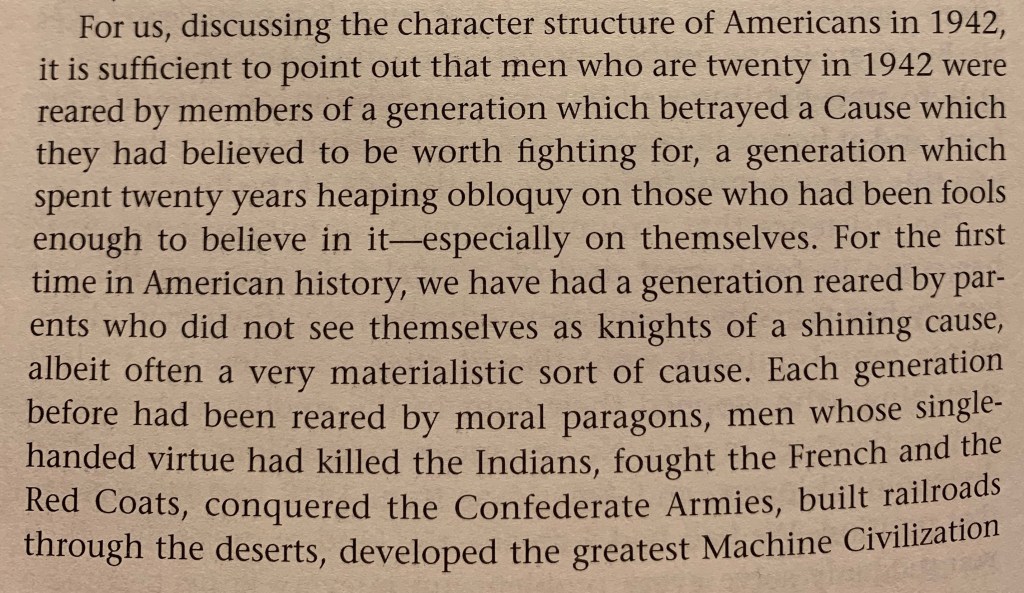
“For the first time in American history, we have had a generation reared by parents who did not see themselves as knights of a shining cause, albeit often a very materialistic sort of cause.”

(Berghahn Books 2000)

We are reminded that American Exceptionalism was alive and well in Mead’s time when reading the words “…whose single-handed virtue has killed the Indians…” (2000). It is one of those statements likely to make many modern Americans cringe. What does this mean for us now, when the destruction of indigenous cultures and peoples is recognized as genocide? Ask yourself that question, but stick with her.

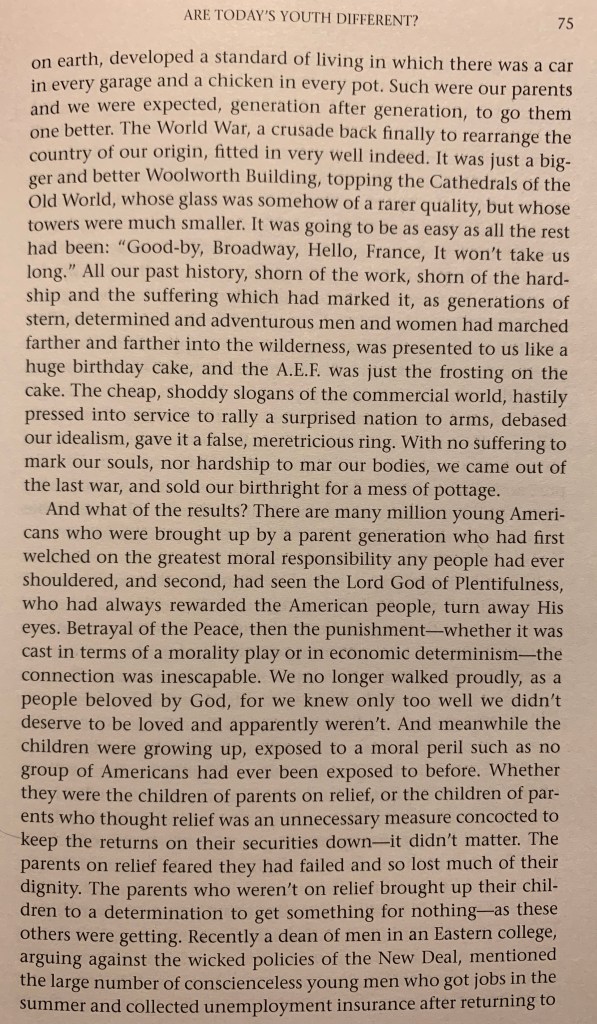
“With no suffering to mark our souls, nor hardship to mar our bodies, we came out of the last war, and sold our birthright for a mess of pottage.”

(Berghahn Books 2000)

The framing of the betrayal in terms of favor and punishment from God might seem out-of-date now. This sentiment, that our fathers put money first and squandered the future of their children, though, feels fresh. Aren’t our children, who prepare for shootings perpetrated by classmates at school and who have a computer with access to free porn at home, “exposed to a moral peril such as no group of Americans has ever been exposed to before,” (2000) too? The specific anxieties are different, but the worry is the same today as yesterday: we aren’t prepared for this. These kids aren’t prepared for this.

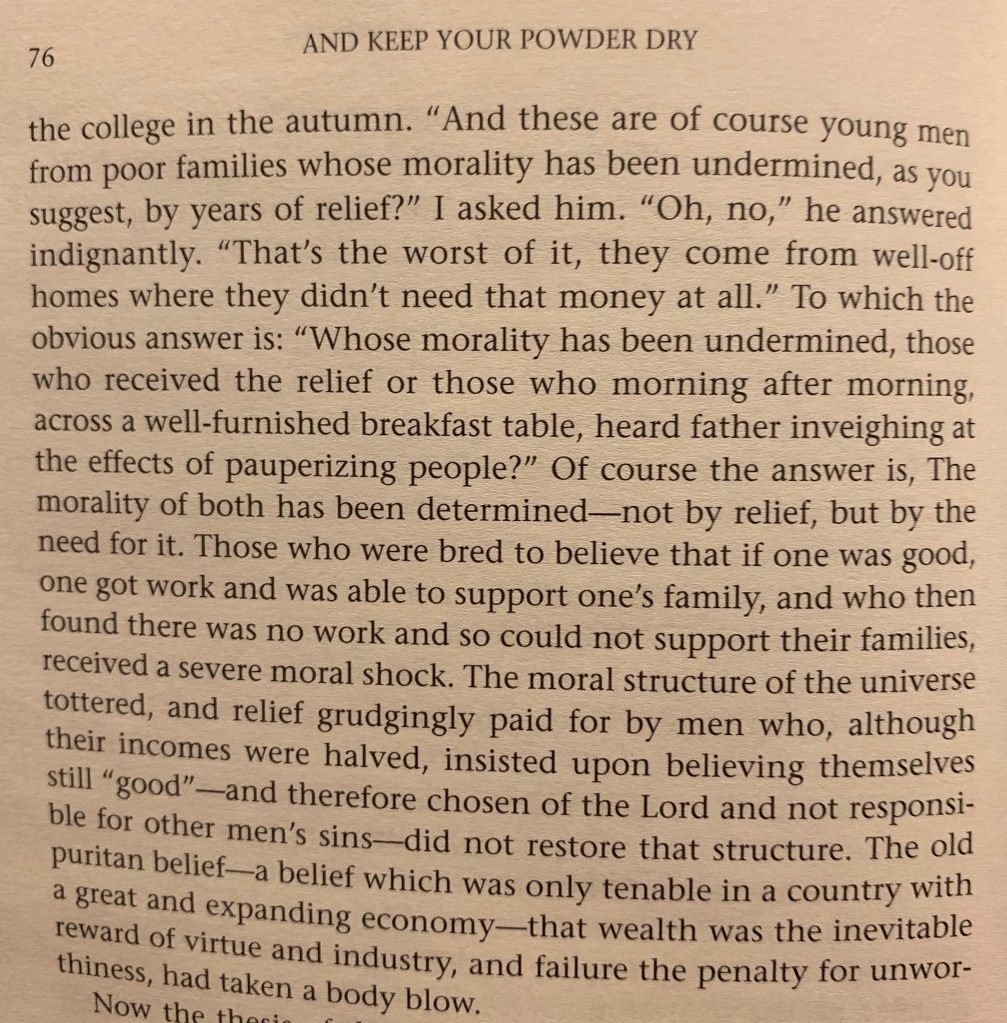
Mead wasn’t considered a conservative as far as I can tell, but calling the New Deal wicked is the sort of description likely to make conservative readers smile and liberal readers scoff. Her description of relief/aid makes it clear that she sees it as contrary to good character. That’s not the whole story of the need for relief, though, and she understands that. One thing I really admire about Mead is how seamlessly she moves from a scathing criticism to obvious understanding of the other side, like in this next passage.

“The old puritan belief— a belief which was only tenable in a country with a great and expanding economy—that wealth was the inevitable reward of virtue and industry, and failure the penalty for unworthiness, had taken a body blow.”

(Berghahn Books 2000)

Mead explains how our aversion to relief comes from our puritanical roots. She blames a generation of Americans for losing God’s favor and lambastes the country for even needing relief programs, but then she easily acknowledges that “wealth was the inevitable reward of virtue” (2000) doesn’t really hold water in a financial collapse (or, say, a quarantine).

This does not come across as hypocrisy. She simply displays a keen awareness that, sometimes, a thing lends itself to the opposite thing. Our modern dialogue would benefit from that kind of nuance and clear-eyed look at the country and its people.

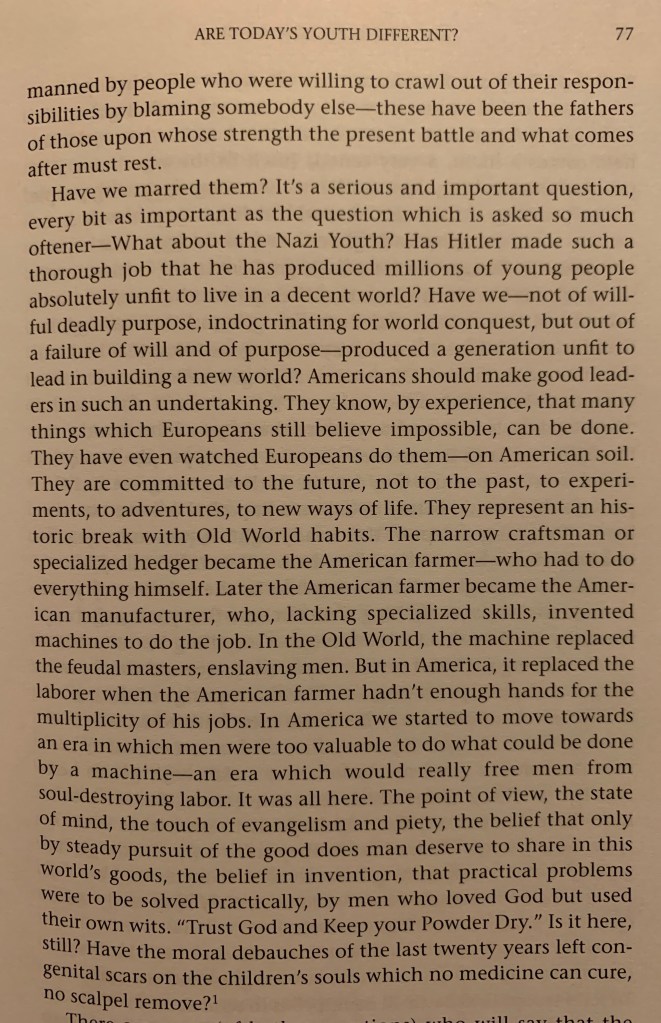
“Have the moral debauches of the last twenty years left congenital scars on the children’s souls which no medicine can cure, no scalpel can remove?”

(Berghahn Books 2000)

After she demands America wrestle with its mistakes, she asks her readers if their failure of will and purpose could produce a generation of Americans unfit to build a new world, when building new worlds is supposed to be what Americans are uniquely fit to do. Did we already cause so much damage that American kids these days aren’t ready for the future?

She was expressing that anxiety about The Greatest Generation.

Mead and her fellow Americans had the fortune of being certain in their way forward: beat the Nazis. By 1942 (though just years after a Nazi gathering in Madison Square Garden), Americans were unified around that cause. They shared a common cause in the defeat of fascism.

Our shining cause isn’t so clear, though it feels more obvious now than it did about four weeks ago. We’ve definitely learned a lot about preparation, and keeping our powder dry!

What have we learned, though, about leading in the future?

And, are these kids prepared for that?

“But he had it easy from the start.”

In And Keep Your Powder Dry, Margaret Mead slowly shifts her attention from American parents to good, ole American sibling rivalry in Chapter VII, “Brothers and Sisters and Success.” I’ve been looking forward to sharing this one with you!

The relevance of these words feels crazy in a world of avocado toast and standardized testing.

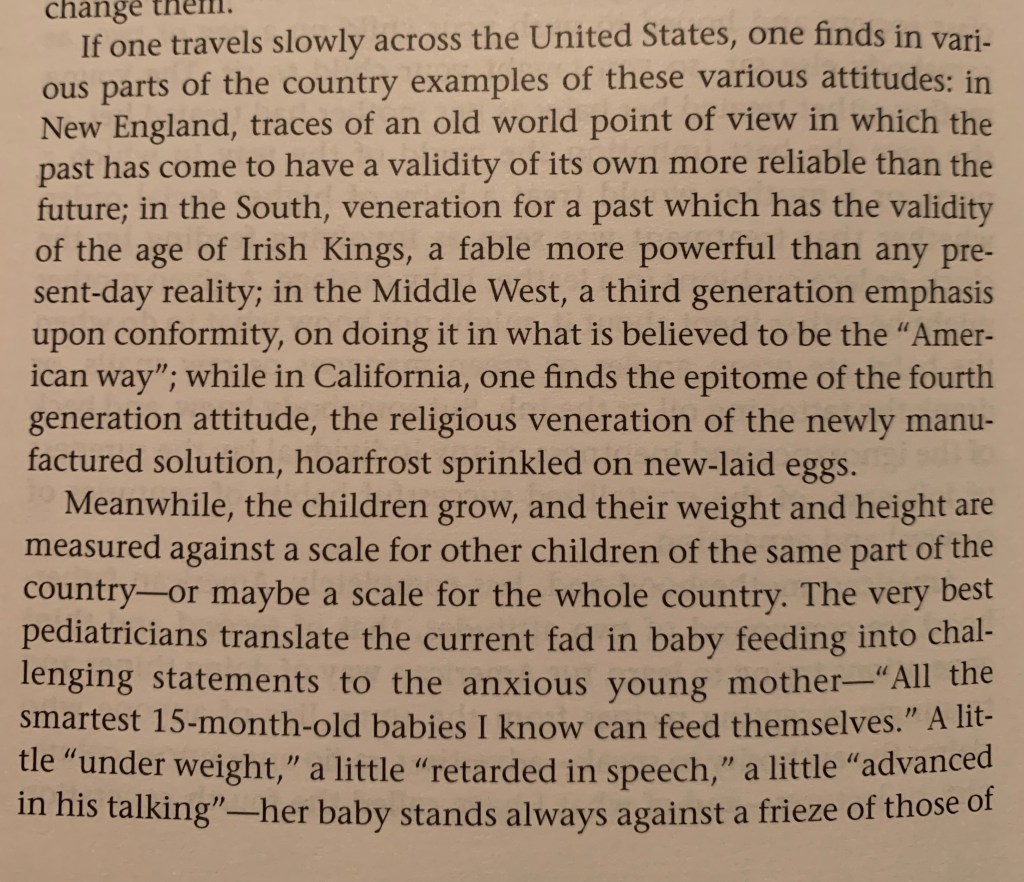
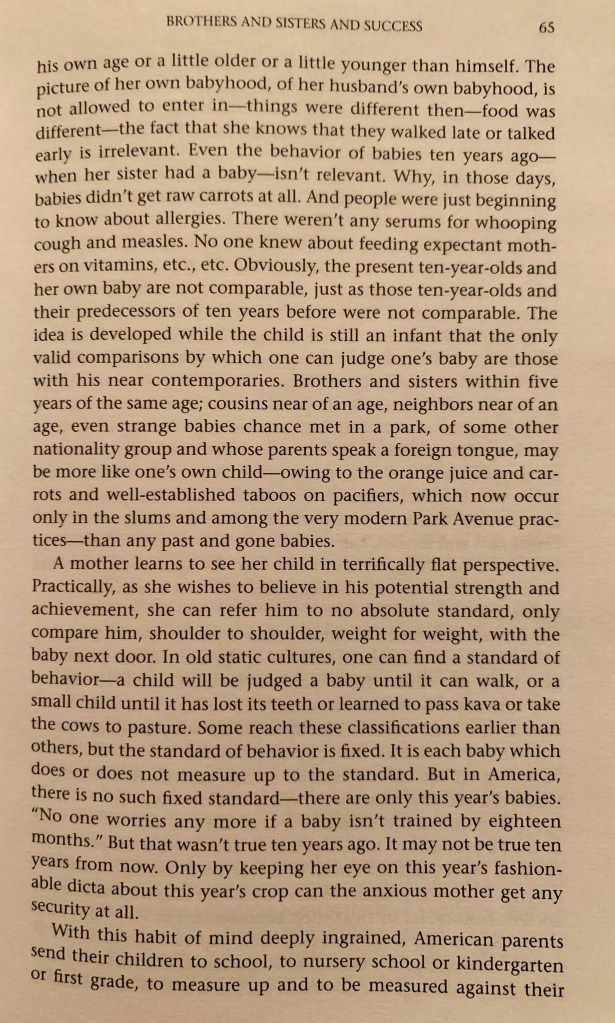
“Meanwhile, the children grow, and their weight and height are measured against a scale for other children of the same part of the country—or maybe a scale for the whole country.”

(Berghahn Books 2000)

“Breast is best.” “Fed is best.” “95th percentile.” I don’t think you’d find a modern pediatrician talking about the “smartest 15-month-old babies they know,” (2000) thank goodness, but it doesn’t make modern moms any less anxious about the growth charts and milestones and how clearly the other babies are talking. SAT scores, GPAs, scholarships. The measurements don’t stop, and every child doing well is the cause of panic in ten mothers whose kid isn’t. The focus is always new, but the stress, Mead tells us, has always been the same. For American moms, the persistent worry is: can my kid measure up?

“But in America, there is no such fixed standard—there are only this year’s babies.”

(Berghahn Books 2000)

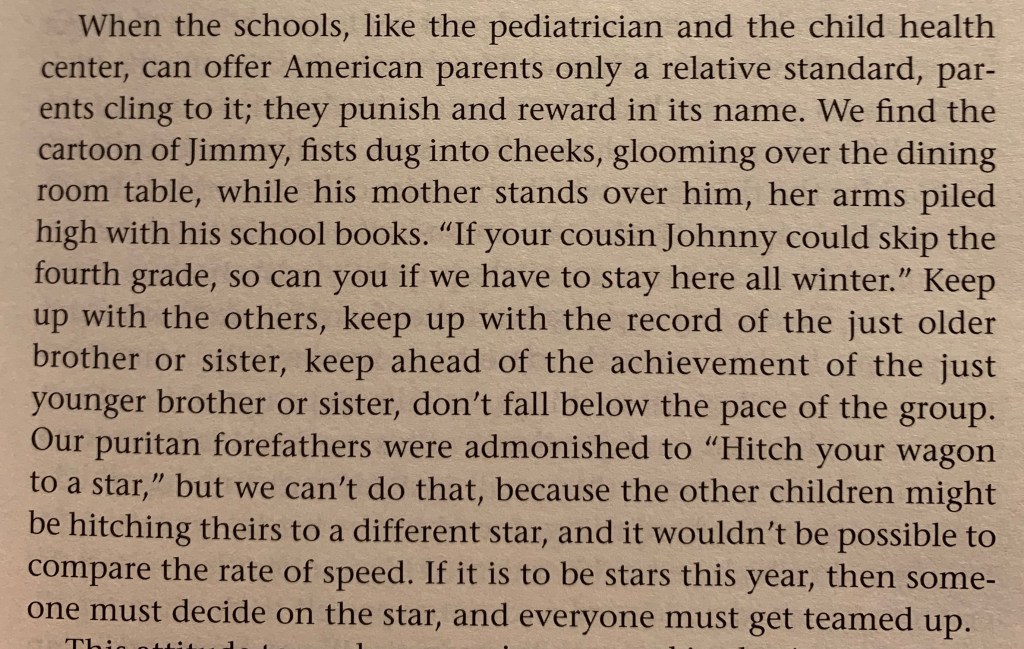
Oh, she makes me laugh as she explains some important things. In American families, Mead asserts, this focus on comparing kids who are roughly the same age means comparisons of siblings that sets up a particularly American flavor of sibling rivalry. Try to catch the older sister; don’t get outpaced by the younger. The message is one of relentless competition.

(Berghahn Books 2000)

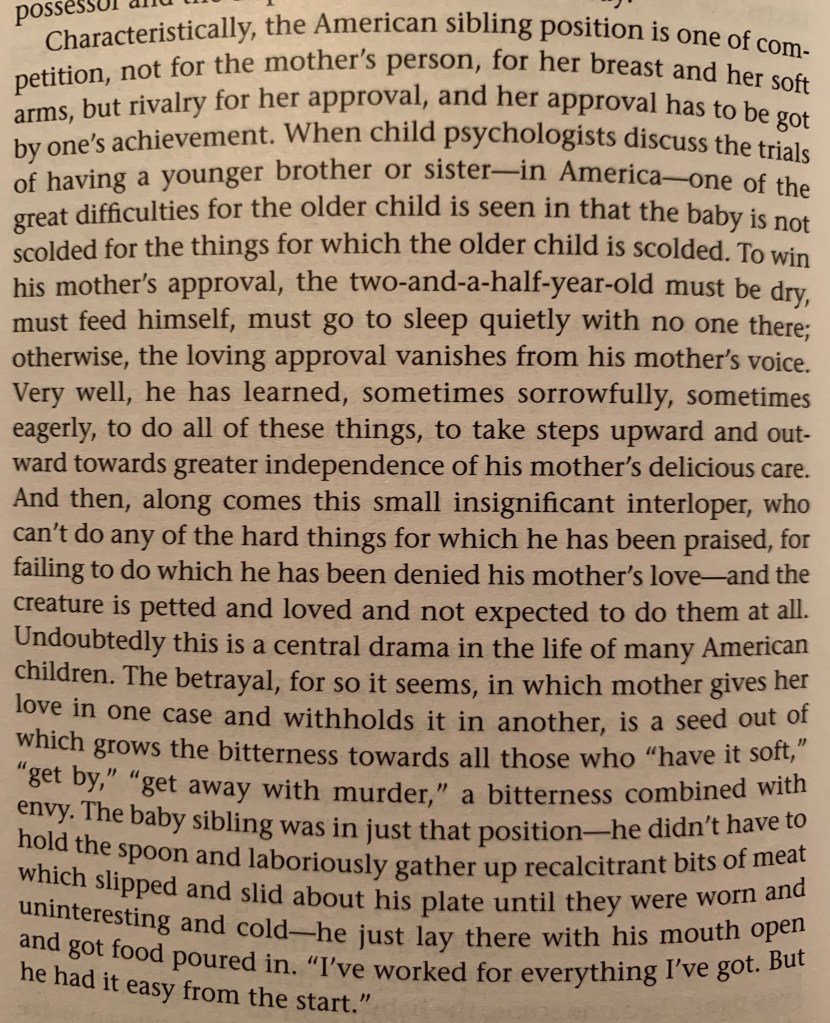
But here is the real gem, when Mead threads the needle to explain how this American family dynamic plays out in our worldview. You’ll recognize some Americans more than others in this!

“And then, along comes this small insignificant interloper, who can’t do any of the hard things for which he has been praised… and the creature is petted and loved and not expected to do them at all.”

(Berghahn Books 2000)

The baby sibling was in just that position—he didn’t have to hold the spoon and laboriously gather up recalcitrant bits of meat which slipped and slid around his plate until they were worn and uninteresting and cold—he just lay there with his mouth open and had food poured in.”

‘I’ve worked for everything I’ve got. But he had it easy from the start.’

(Berghahn Books 2000)

Is this relevant in 2020?

Do you hear this bitterness combined with envy in our current political debates? I do. I hear it all the time. I cannot read a comment thread on the Internet without hearing this sentiment spoken like truth. It’s a crux of the American character that creates a lot of our polarization. When it’s not part of your worldview, making an injustice of it is. Of course, you might yell, we just pour the milk into the baby!

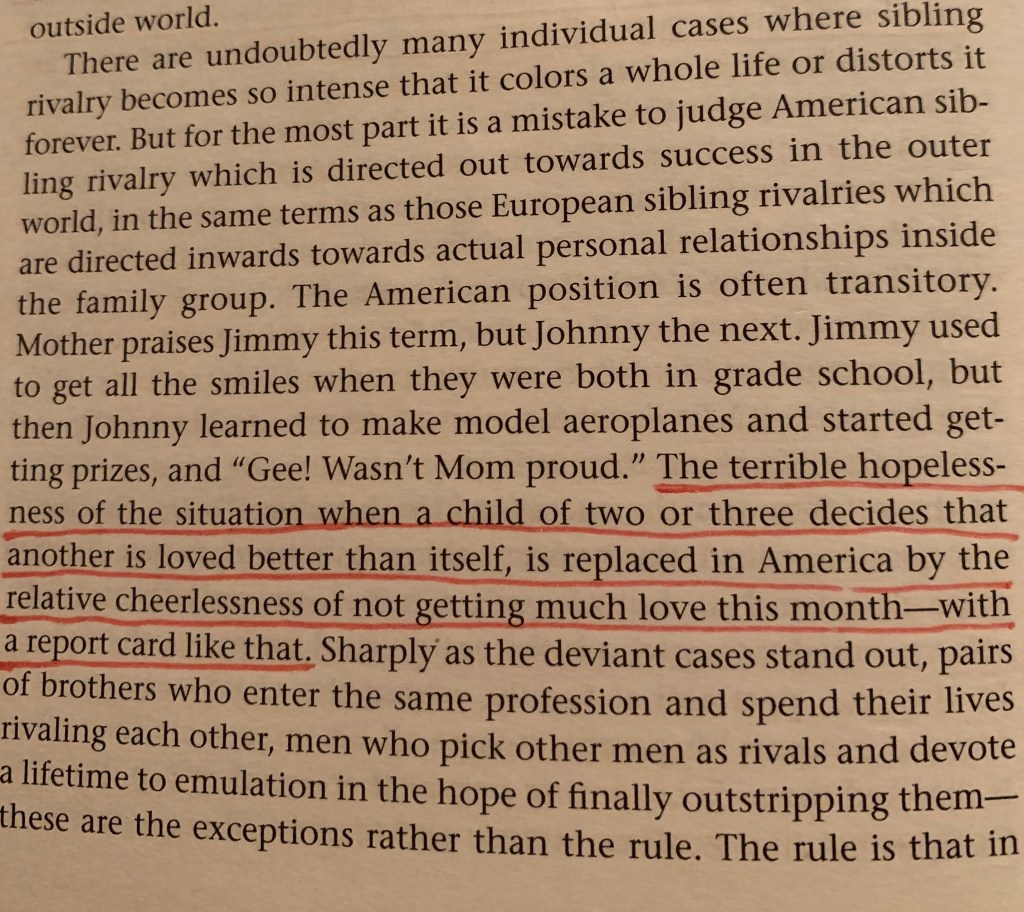
Finally, Mead explains how our parenting toward success creates a sibling rivalry that can look bitter, but is transitory, so not hopeless. I’m mostly including it, because it’s Mead, like so much in this chapter, in fine form.

(Berghahn Books 2000)

Parents and Teachers in America

Chapter VI of Margaret Mead’s And Keep Your Powder Dry is titled “Parents, Children and Achievement.”

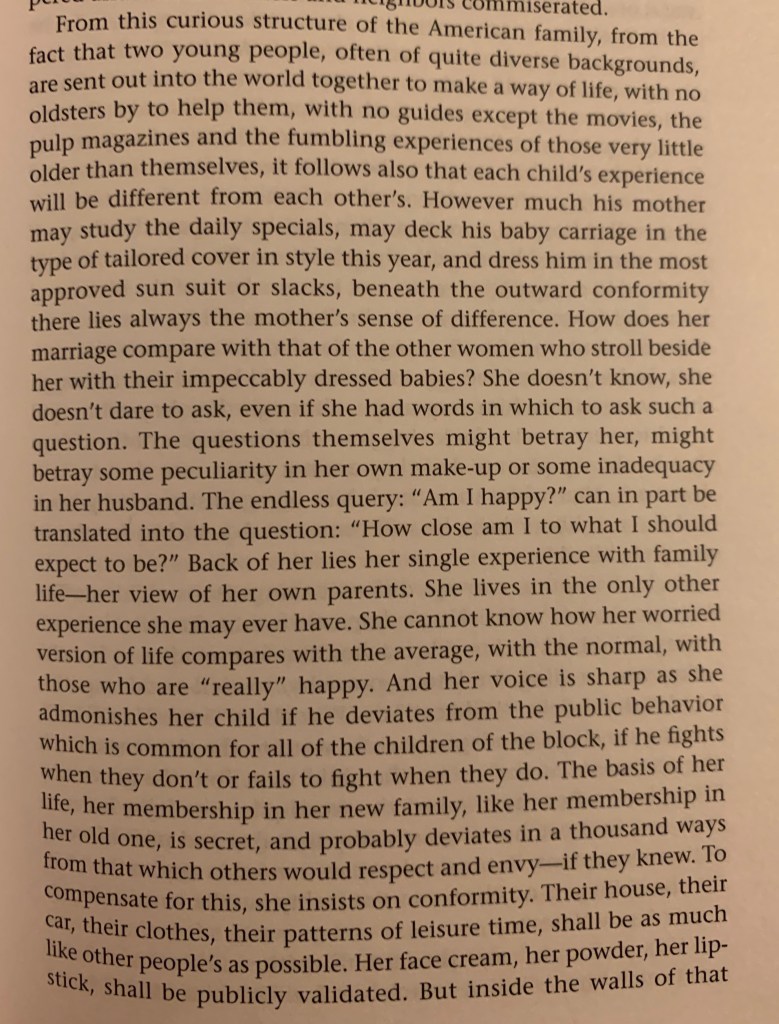
“She cannot know how her worried version of life compares with the average, with the normal, with those who are ‘really’ happy.”

(Berghahn Books 2000)
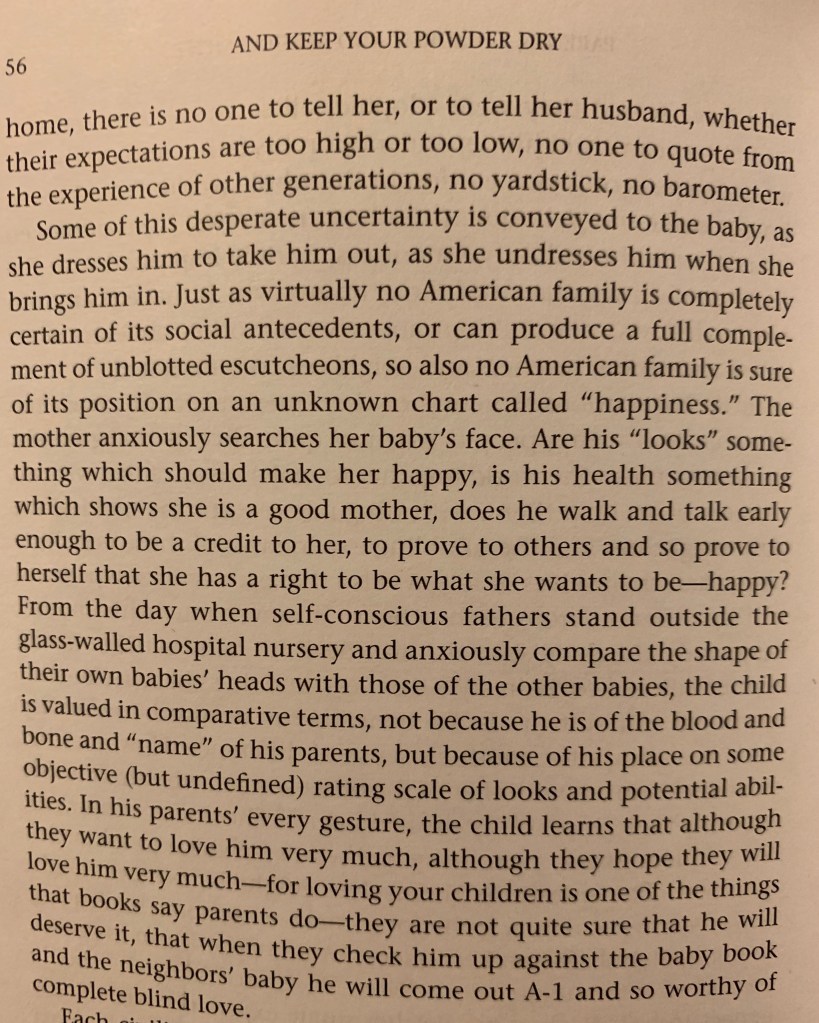
“…loving your children is one of the things that books say parents do…”

(Berghahn Books 2000)

I don’t know about you, but I was born in the 1970s, and every day after school from 1985 until graduation day, I watched The Oprah Winfrey Show. This idea that mothers are always in search of happiness and parenting is something you learn from books is not new to me. Oprah also made the point, in other words and by example, that your value isn’t in your blood or family name, but in how you compare to your peers and contemporaries. Her message was one of rising above your circumstances. She taught pretty explicitly that we are always moving on, with that hope of moving up.

Oprah seemed innovative at the time, but reading Mead, it’s clear that markets for the latest parenting research and fads for American mothers didn’t emerge with Oprah Winfrey lauding the latest expert. Turning to professionals to learn about your baby and happiness, instead of your mom, aunts, cousins, and grandmothers, has been an American tradition for a long time.

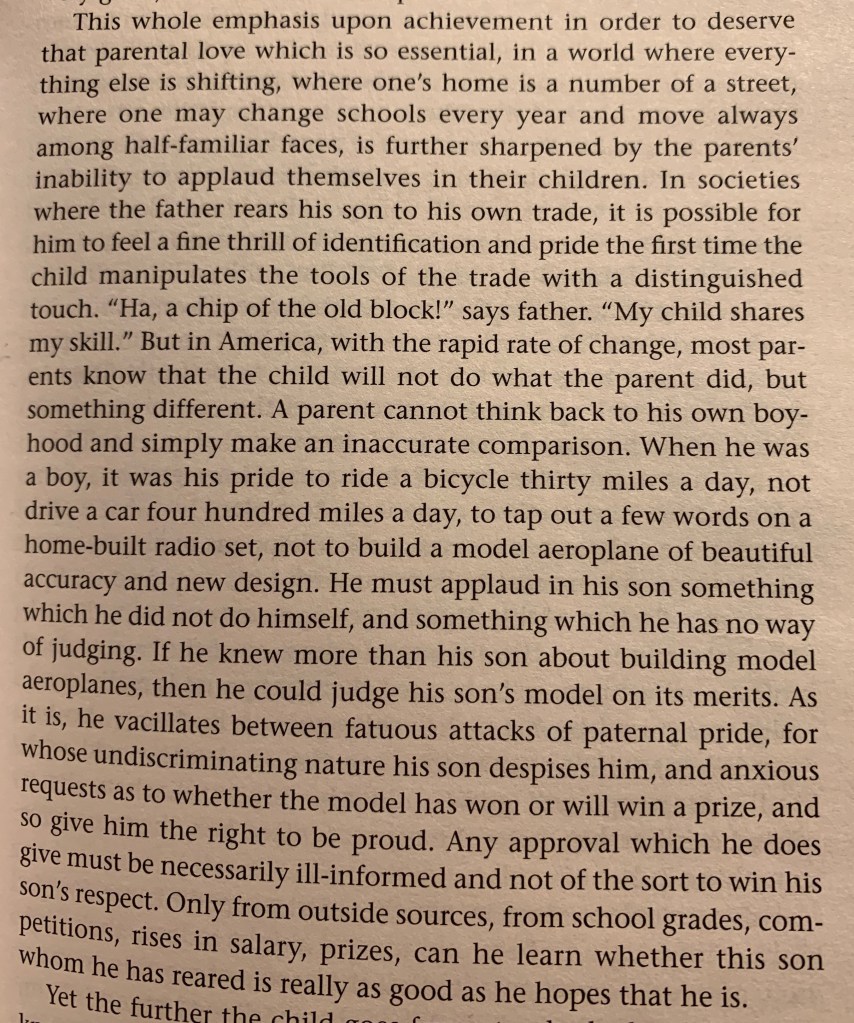
“Only from outside sources, from school grades, competitions, rises in salary, prizes, can he learn whether this som whom he has reared is really as good as he hopes that he is.”

(Berghahn Books 2000)

How many American parents and kids feel this way? There are probably thousands of social media groups of thousands of mothers each devoted to asking if their kid has the right GPA, AP courses, leadership positions, and sports wins to qualify for this or that school, or why the right GPA, AP courses, leadership positions, and sports wins didn’t qualify their kid for this or that school. They will ask if the honors their kids do get “count.” “Will Michigan care that my son doesn’t want to be in National Honor Society?” “Will the National Young Leaders Conference look good on the college application?” They might include “did your kid personally get anything out of this opportunity or experience?” but it’s usually secondary to “will this help my kid look accomplished?”

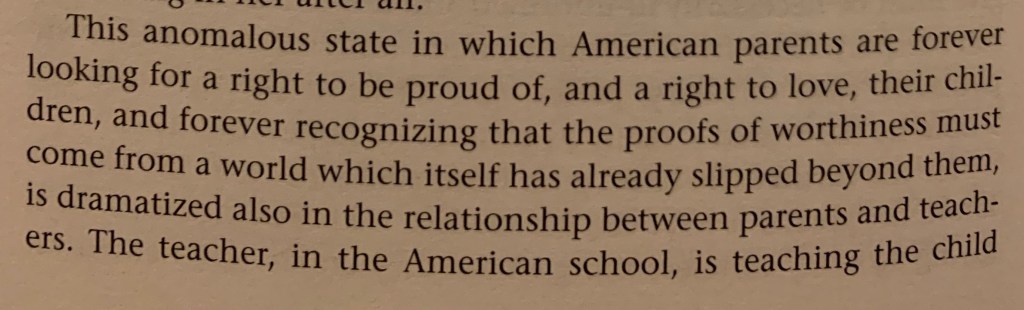
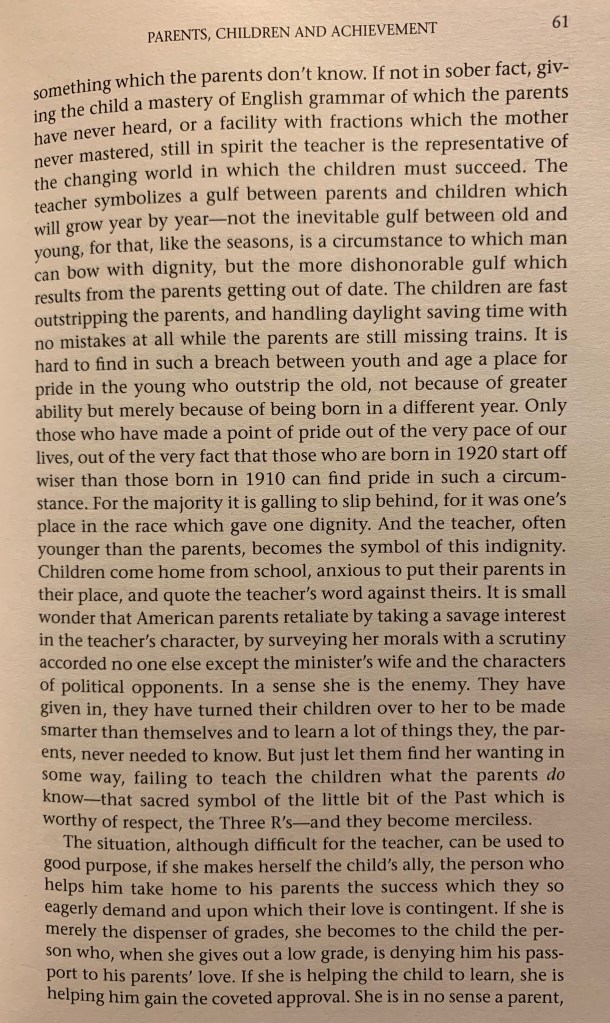
American parents are obsessed with achievement. Mead, then, explains what the relationship between parenting and achievement means for American teachers.

(Berghahn Books 2000)
“The children are fast outstripping the parents, and handling daylight savings time with no mistakes at all while the parents are still missing trains.”

(Berghahn Books 2000)

Think of students learning to code, creating videos on green screens in classrooms, and principal-led flash mobs. How out of date do you feel in a modern American school?

Even now, when public school teachers aren’t held to the same moral scrutiny that they were in the past, we see this taking a “savage interest” in the teacher.

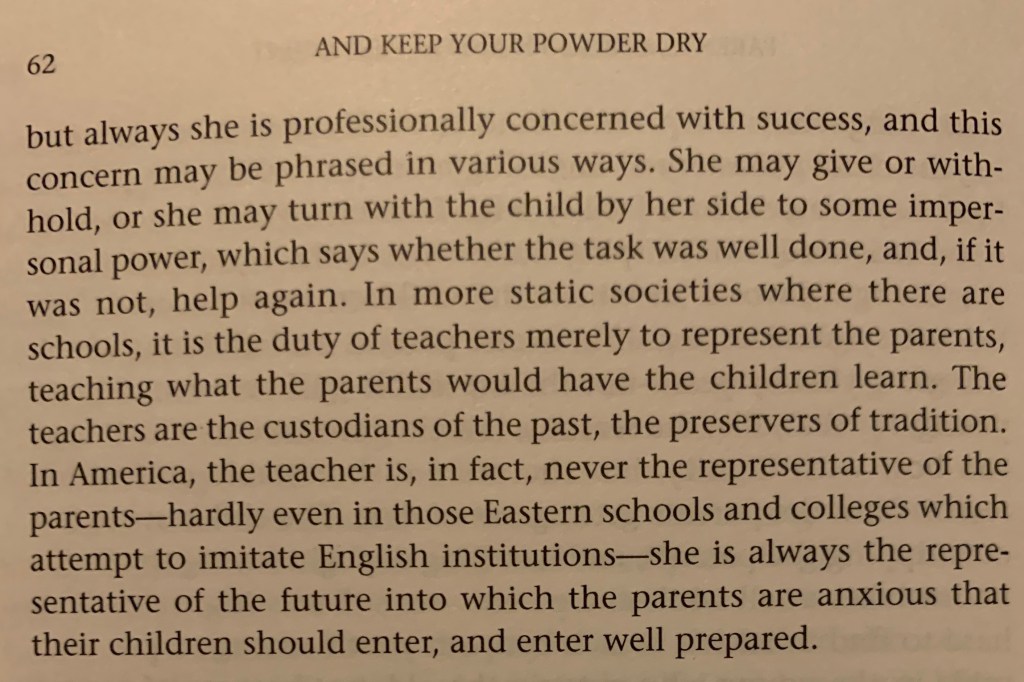
“In America, the teacher is…always the representative of the future into which the parents are anxious that their children should enter, and enter well-prepared.”

(Berghahn Books 2000)

I think, especially when it comes to academic achievement, we have a tendency to think the anxiety is new. It’s strangely reassuring that we drive the kids and the teachers and ourselves bonkers about it, because we are Americans.

The Foundational Fathers

This will round out the blogs discussing Chapter III of And Keep Your Powder Dry by Margaret Mead. In this one, we will invoke the founding fathers.

(Berghahn Books 2000)

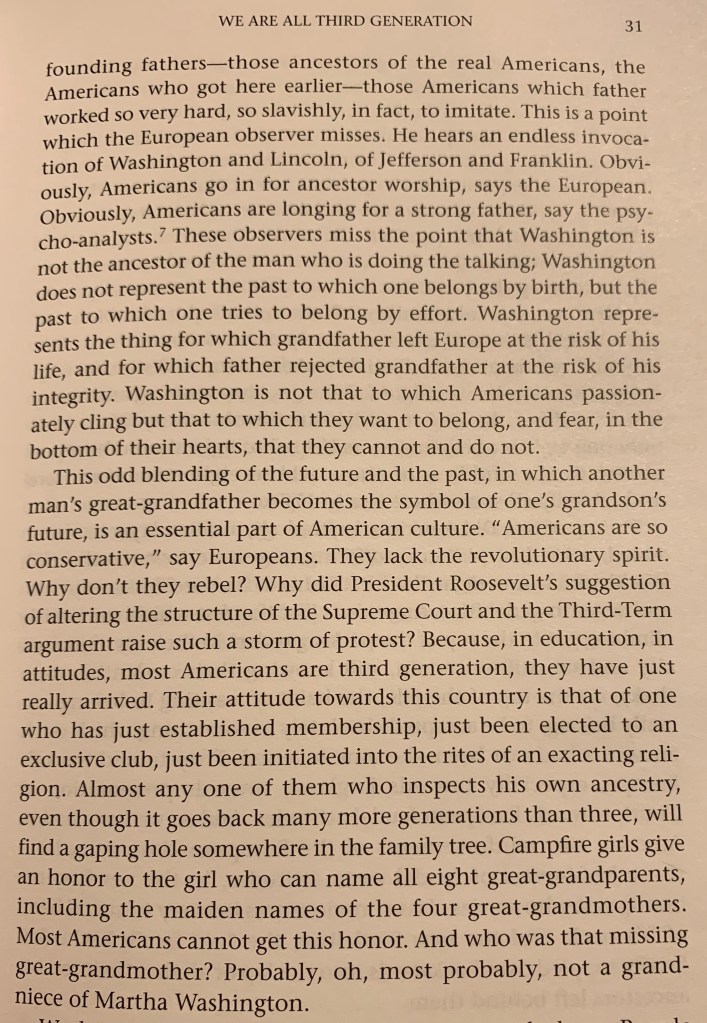
This next part is important, because Mead explains a connection to our founding fathers that goes beyond hero worship or simple respect and gratitude.

“Washington does not represent the past to which one belongs by birth, but the past to which one tries to belong by effort.”

(Berghahn Books 2000)

What a beautiful sentiment is that: “…the past to which one tries to belong by effort…” (2000).

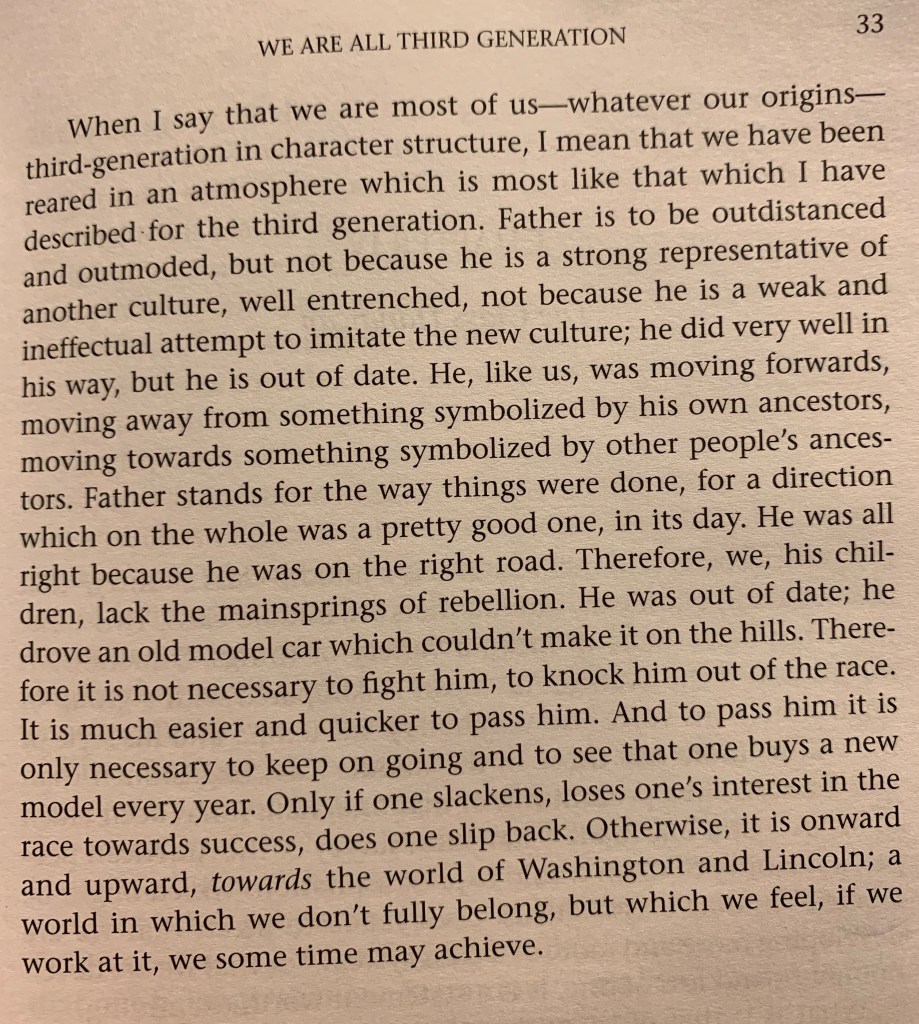
Adoration of Washington isn’t an attempt to hold onto a past; he’s a symbol of what we, as an individual in America, can achieve here. I love this explanation, as well, for why a nation of revolutionaries doesn’t really revolt. If we take on the characteristics of the third-generation American, she explains, our place as Americans finally feels certain. We won’t be deported. Our parents won’t be deported. We know the rules. Everything’s cool. We don’t revolt, because don’t want to lose our place. This place.

“Otherwise, it is onward and upward, towards the world of Washington and Lincoln; a world in which we don’t fully belong, but which we feel, if we work at it, we some time may achieve.”

(Berghahn Books 2000)

Americans do not fight authority and beat him down, because we presume we can more easily work hard and pass him. Our goal was never revolution for its own sake. It was always for the sake of progress. And, progress is just a matter of progressing.

At the end of the day, we don’t have to revolt, because Washington and Hamilton already did that. We don’t have to save the union, because Lincoln already did. Our purpose and cause are beyond their imaginings, so we need not lay theirs to waste.

An Affluent, White Woman Wrote This Book

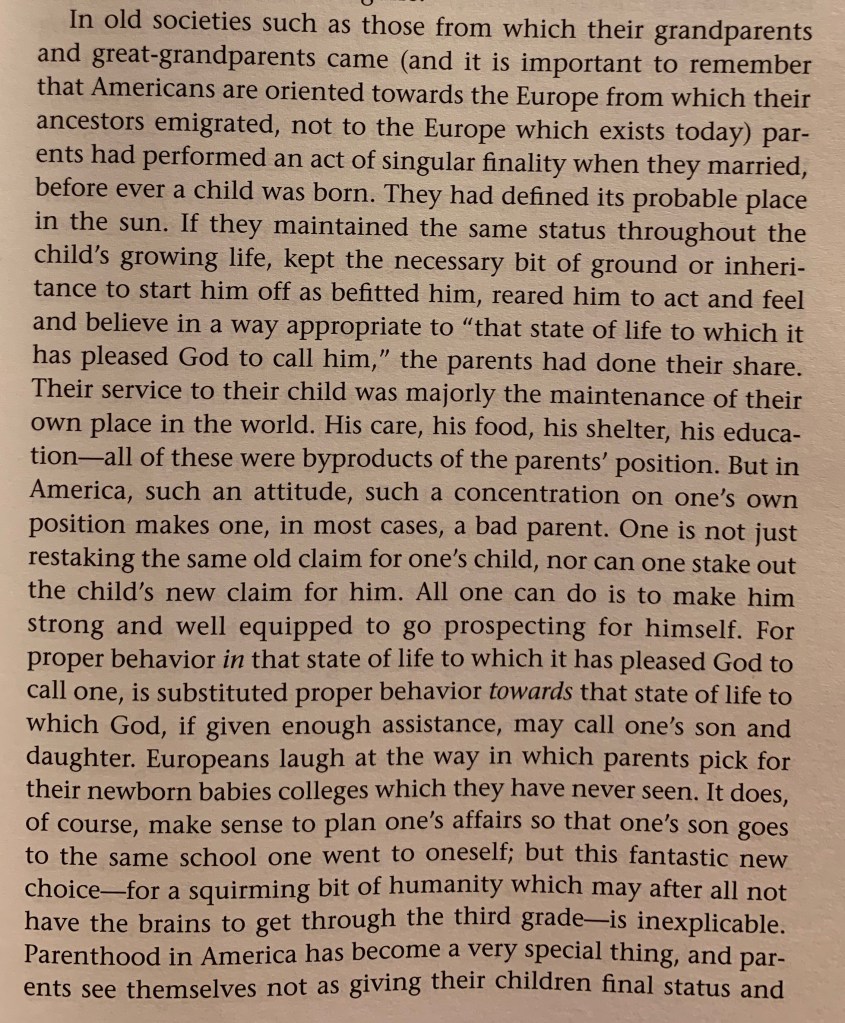
“But in America, such an attitude, such a concentration on one’s own position makes one, in most cases, a bad parent.”

(Berghahn Books 2000)

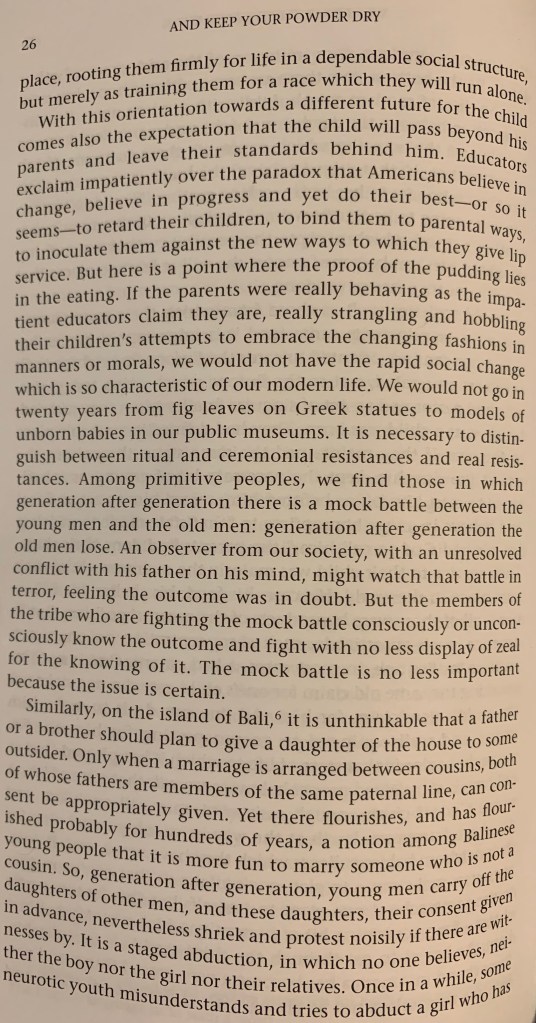
As Margaret Mead continues to share her ideas in Chapter III of And Keep Your Powder Dry, I remind myself that she lived in a different time, and in that time, her words would have been interpreted differently. (I think it’s safe to say that “not have the brains to get through the third grade” (2000) would probably not survive an academic edit today, but is also hilarious.) Mostly, I am captivated by how much of what she says still rings true. “Parenthood in America has become a very special thing” (2000) was probably basically said by a mommy blogger yesterday.

I don’t want to run away from these next thoughts of mine, because I don’t think Mead would either. Just as she acknowledges above that the Europe she is contrasting wasn’t the present-day one, she continually expresses a strong understanding that people and places change. I don’t think it would take her by surprise that America did. Some of the changes we’ve made since 1942 mean that, from here, we can see that this is a very white, Euro-centric view of ourselves. She had her place in the sun, which limits the scope of the book. When she says that Americans are “oriented toward the Europe from which their ancestors emigrated,” (2000) my first thought is, “not all Americans.” There is no interest in the internment of Japanese-Americans happening in her midst, and no direct acknowledgment that some Americans were brought here by force to build this nation. The point she ends up making, though, survives this critique, because it remains true for all or most Americans, regardless of whether their ancestors lived here or came by choice or force from anywhere else in the world (keeping in mind that just as she was taking about a past Europe, I’m talking about a past world).

For Americans, their ancestors likely were born into the status where they would remain throughout their entire lives. America is pretty rare (entirely unique?) in being a culture founded explicitly on the idea that you have the right to move on with the hope of moving up. After expressing how Americans begin to impress those hopes upon their babies as soon as they are born, she then introduces the American teacher.

When Mead discusses the schooling of children, even briefly, it’s always a special thing; you really think she’s got her finger on the pulse of today’s America. Her language here may be jarring, though.

“It is necessary to distinguish between ritual and ceremonial resistances and real resistances.”

(Berghahn Books 2000)

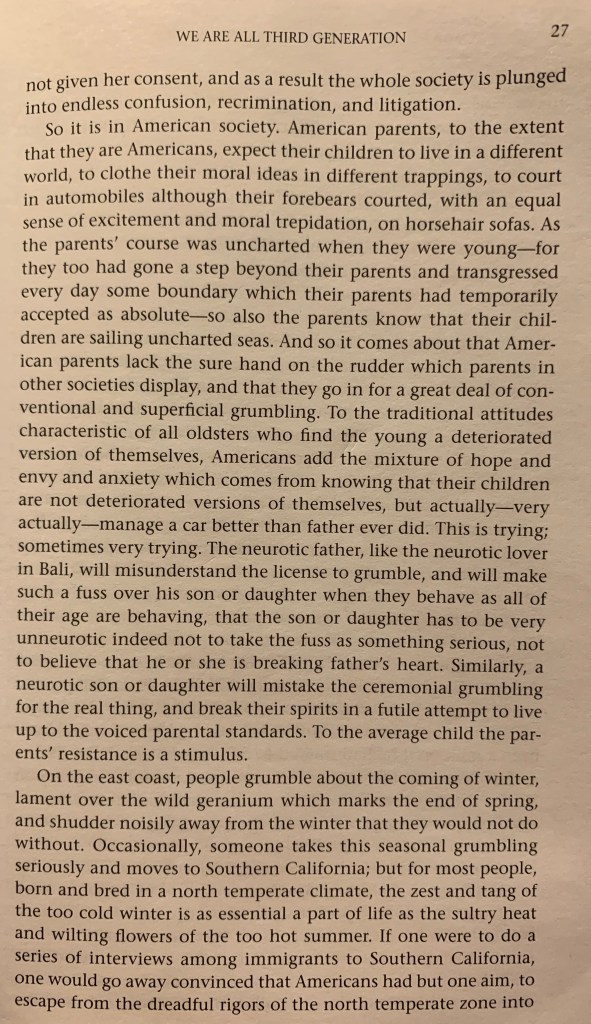
Here, I debated whether or not to include the piece on Bali, because I am lazy and not inclined to research the validity of the perspective of a 1940s’ anthropologist, and I was afraid it might offend. I included it, because I think it strongly demonstrates how she examines, contrasts, and compares cultures to give a picture of what our culture, ever-evolving as it is, is. And, the ever-evolving part is something Mead understood well even if she couldn’t actually see where we were headed. She says it here, “American parents…expect their children…to clothe their moral ideas in different trappings…” (2000).

“To the average child the parents’ resistance is a stimulus.”

(Berghahn Books 2000)

Again, there are things that might not sit well with modern readers, but I feel like there is much more that speaks to Mead’s knowledge and insight.

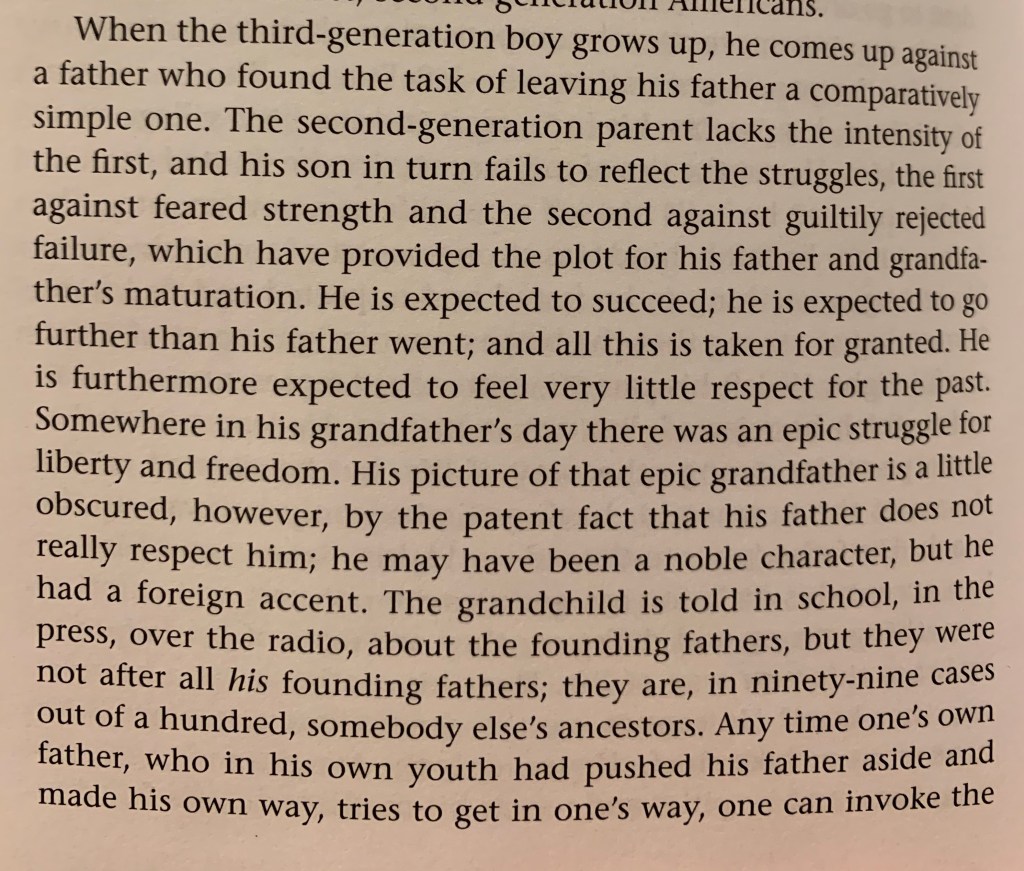
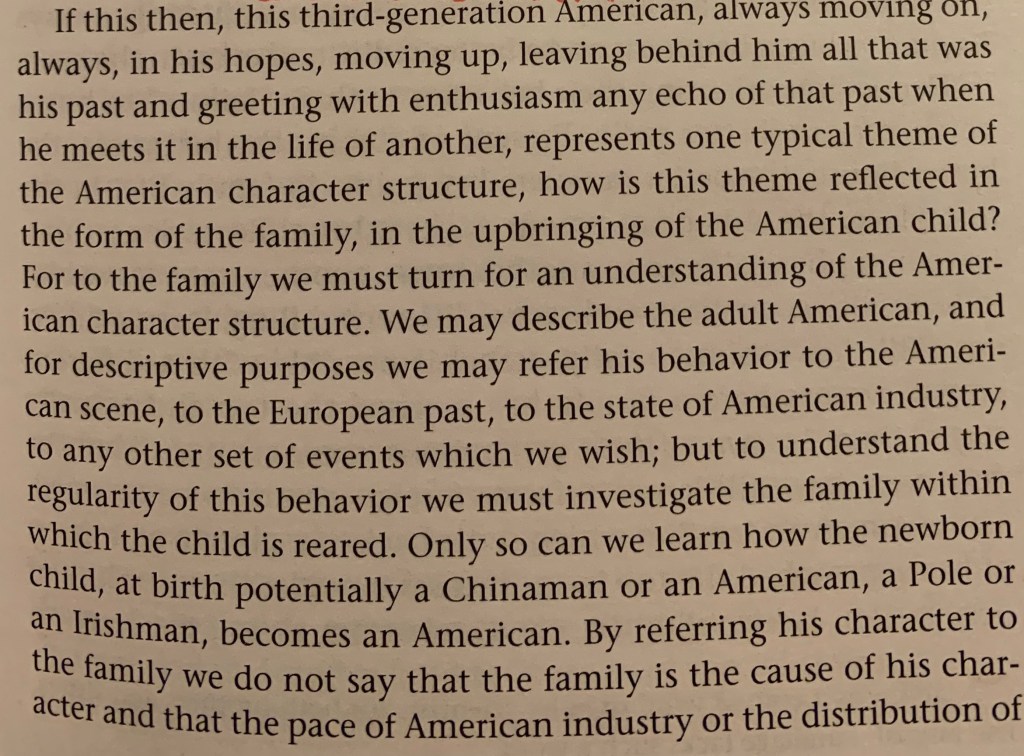
Let’s go back to the theme of American character that Mead sees explained in the third generation American in the last blog “…always moving on, always, in his hopes, moving up, leaving behind him all that was his past and greeting with enthusiasm any echo of that past when he meets in the life of another, represents one typical theme of the American character structure…” (Berghahn Books 2000)

She talks about the “hope and envy and anxiety” (2000) of Americans and how it causes them to want to fly but also does a great job of clipping their wings. There is this push and pull in the American character between the new world and the old world, between progress and its necessary uncertainty, and between rebellion and convention and the stability it brings that she conveys in usually relatable ways.

I know her perspective and education on Americans isn’t complete, but I think it is valuable for all of us to read.

Feel free to challenge me on that, though. You see, an affluent, white woman wrote this blog, too.

Continue reading “An Affluent, White Woman Wrote This Book”

Let’s judge each other by our radio programs.

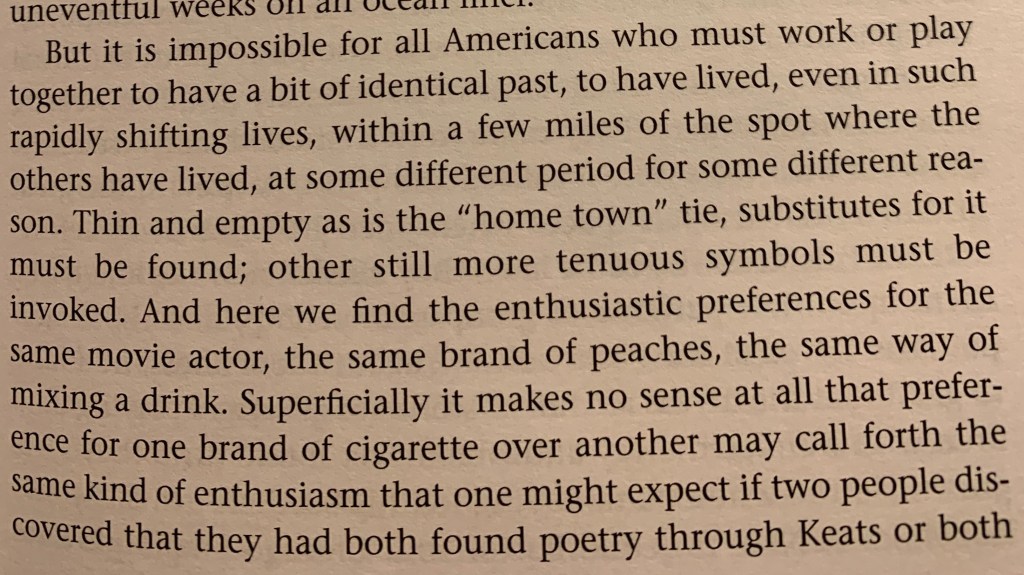
This blog picks up basically where the last one left off in Chapter III, “We Are All Third Generation.” From explaining how Americans love to form bonds with people based on common paths traveled, Margaret Mead starts talking about our propensity to form kinships based on things like favorite beverage.

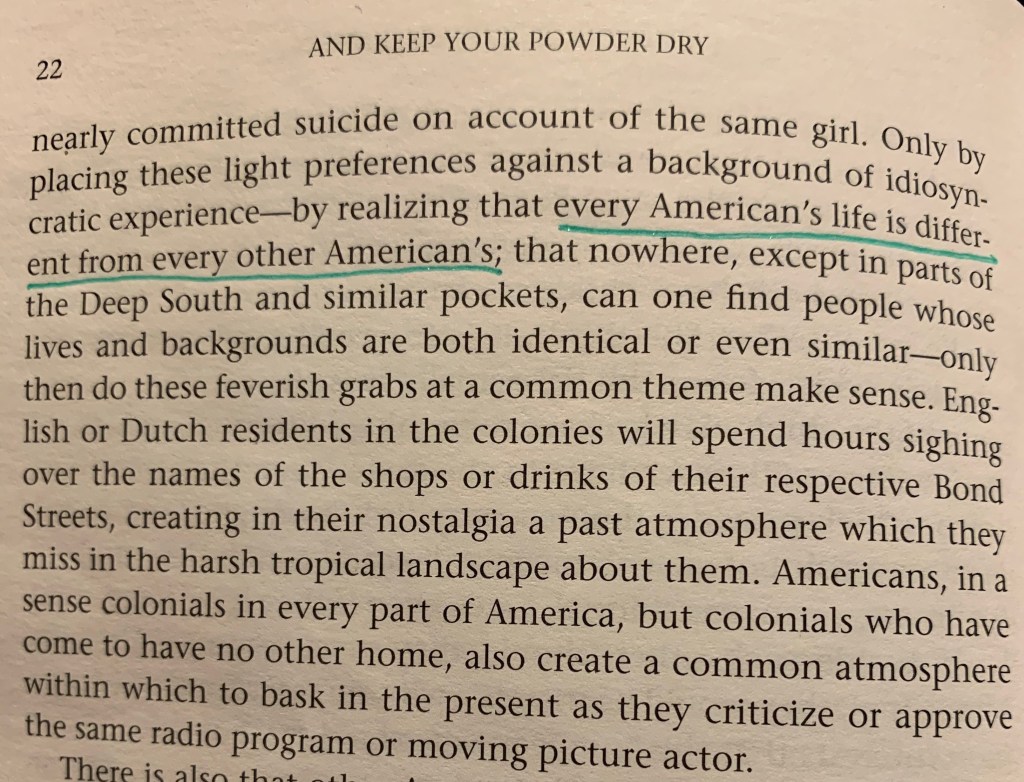
“Superficially it makes no sense at all that preference for one brand of cigarette over another may call forth the same kind of enthusiasm that one might expect if two people discovered that they had both found poetry through Keats…”

(Berghahn Books 2000)

Are you a Pepper? You don’t have to answer that, because chances are good that I already know if you are a Pepper.

“Americans…bask in the present as they criticize or approve the same radio program…”

(Berghahn Books 2000)

Who amongst us doesn’t judge others by their radio shows?

I’ll keep my opinions of your radio shows to myself, but share that one of my proudest moments was when Kai Ryssdal said my name on air to introduce a letter I wrote to Marketplace. You probably think I listen to serious radio. The fact is that I mostly listen at the level of Her Ripe Begonias.

I approve of you thinking I garden, but I chuckle with those who know I don’t.

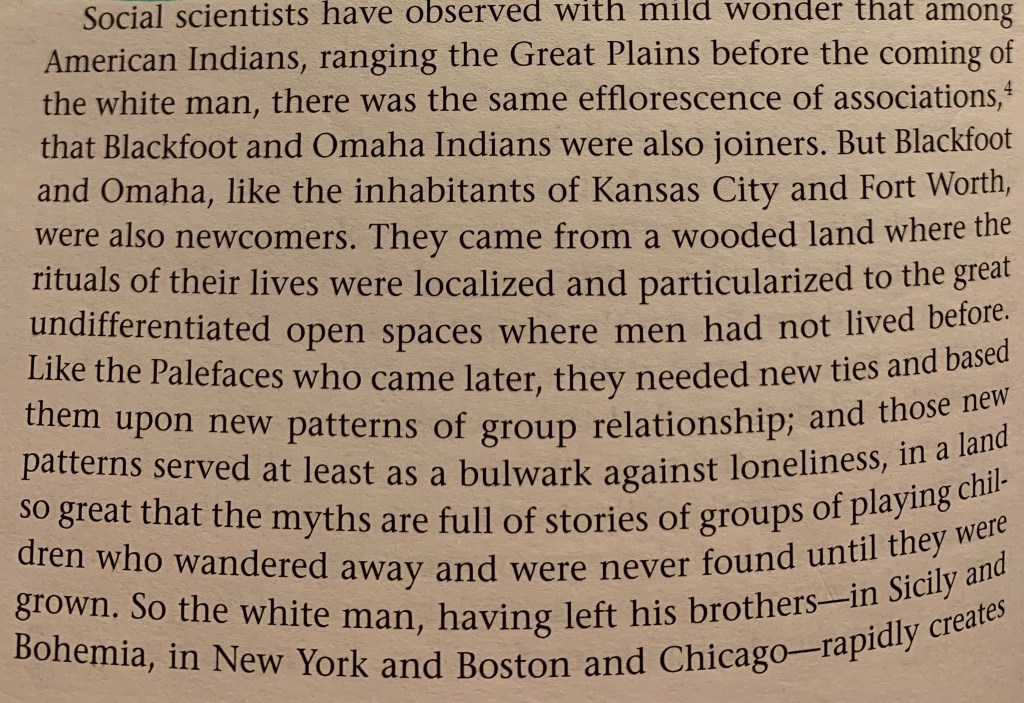
But, seriously, the take-away here isn’t that we are a judgey people, though we are, but that these loose associations are important kinships in a place where people are expected to have grown up differently and come from different places. Interestingly, she also says that this was a characteristic of some native tribes, too. I am not surprised that indigenous peoples would have influenced how Americans form relationships here, but I find this idea fascinating that our land might play some role in how people interact, too.

“Social scientist have observed with mild wonder that among American Indians, ranging the Great Plains before the coming of the white man, there was the same efflorescence of associations…”

(Berghahn Books 2000)

As Mead begins to draw contrasts between Americans and other cultures, it can feel strange and uncomfortable. My recommendation is to feel any uncomfortable feelings, and read.

(Berghahn Books 2000)

Read this again:

“…this third-generation American, always moving on, always, in his hopes, moving up, leaving behind him all that was his past and greeting with enthusiasm any echo of that past when he meets in the life of another, represents one typical theme of the American character structure…”

(Berghahn Books 2000)

Does that feel like Americans to you?

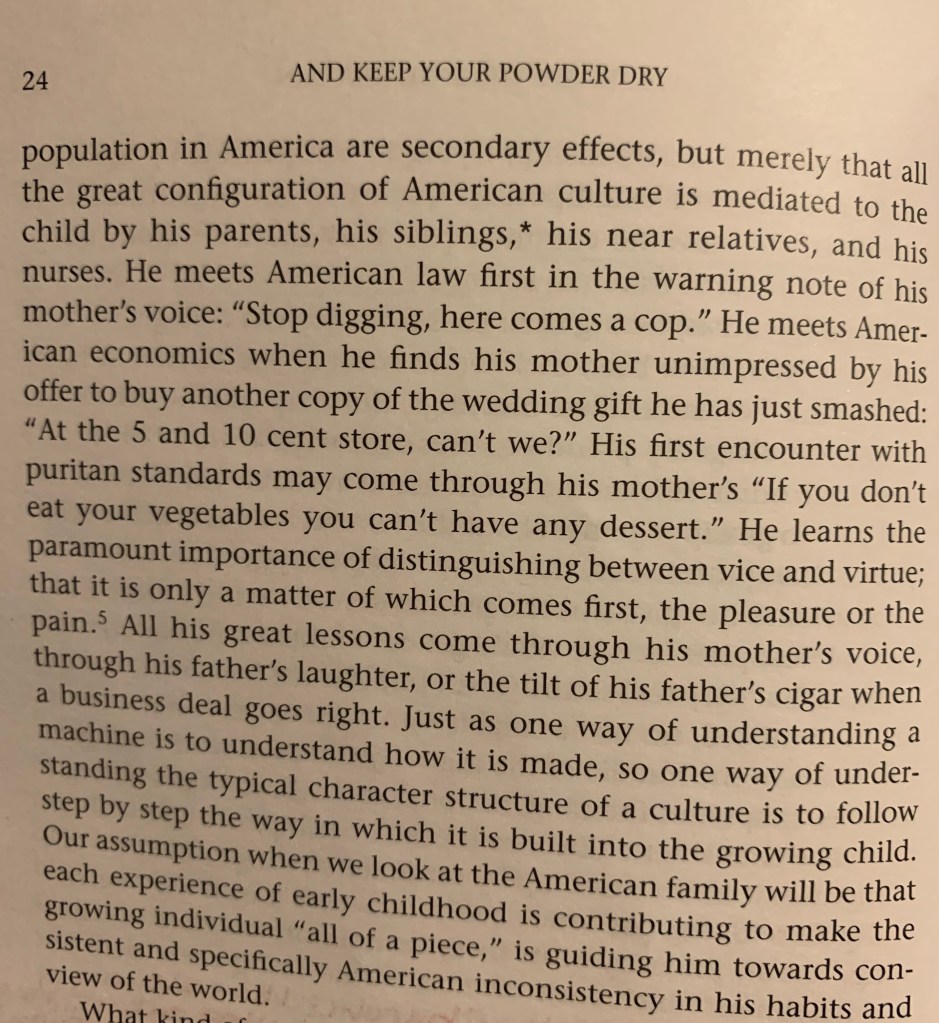
“He learns the paramount importance of distinguishing between vice and virtue; that it is only a matter of which comes first, the pleasure or the pain.”

(Berghahn Books 2000)

Our American-ness is built into us, by our parents, the people closest to us, and our society. She’s going to explain how, just as she so eloquently explained why we care so much about our trivial kinships and criticize or approve, well, everything.

Please, keep reading…

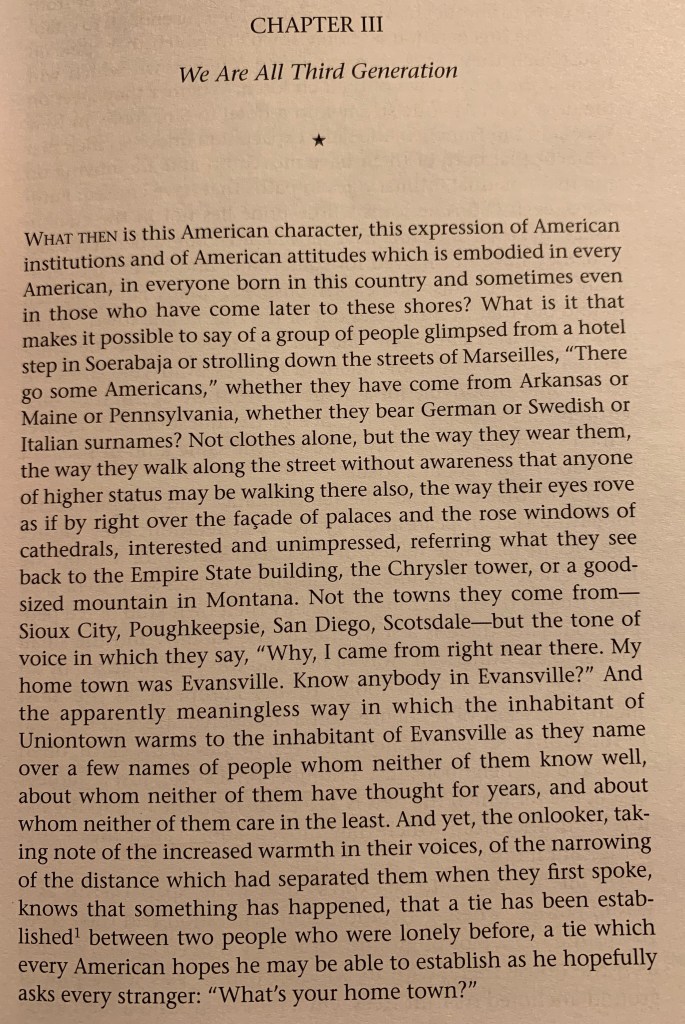
“We Are All Third Generation.”

“…they walk along the street without awareness that anyone of higher status may be walking there also…”

(Berghahn Books 2000)

This is one of my favorite pages in the book. It’s descriptions of Americans like this that make me think she was really onto something.

This notion isn’t unfamiliar today: that Americans from anywhere in the country are immediately identifiable as Americans anywhere else in the world. Because of how we walk. And how we don’t care if a king is walking next to us. (Except that we kind of do, and she talks about that, too.)

It’s how she writes of Americans making connections, though, that makes me think dearly of my friends and family now. The way we form kinships with people is still exactly how she describes. We look for common places we’ve lived, places our paths could have crossed but didn’t, our favorite sodas, and the bands we love the most.

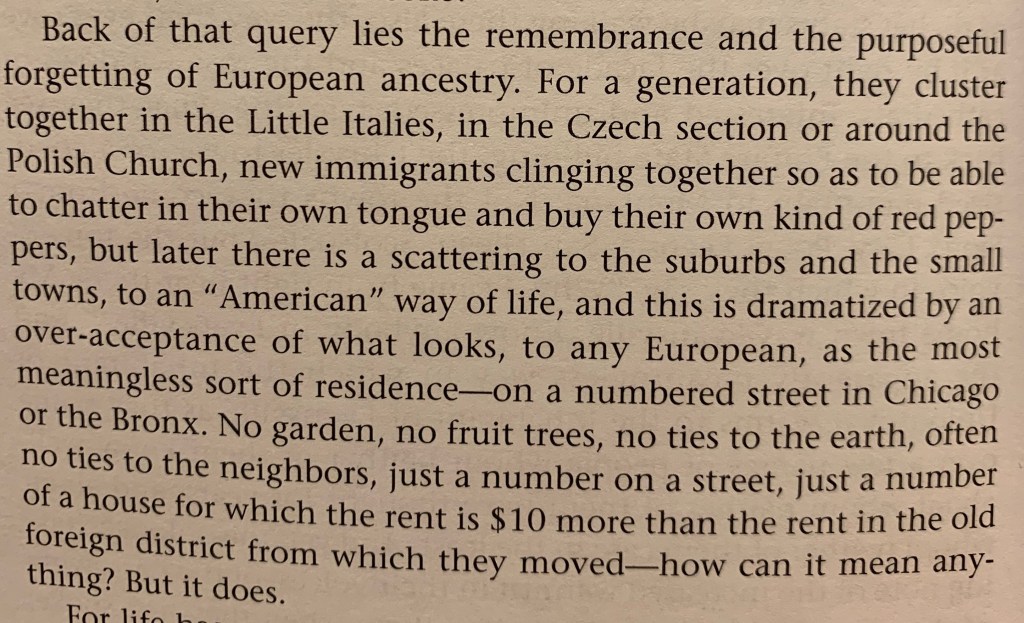
First, Mead lays the foundation by describing how this developed from the immigrant experience in America.

(Berghahn Books 2000)

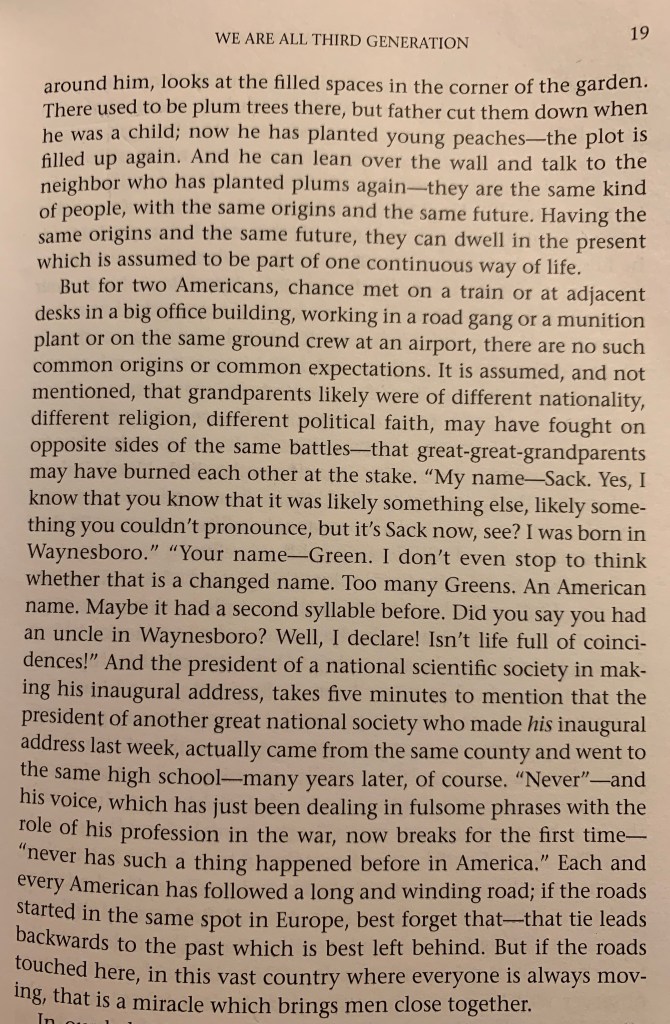
As you read this blog, don’t expect the snapshots of the book to always pick up where the last left off. They don’t. This next one starts with a description of life in the old world and comes back to Americans.

“But if the roads touched here, in this vast country where everyone is always moving, that is a miracle which brings men close together.”

(Berghahn Books 2000)

I have a friend in Pittsburgh who reminds me sometimes that we both lived in Apache Junction, AZ as kids; it’s a bond we share even though we didn’t live there at the same time or in the same neighborhood. We’ve seen the sun rise over the same mountain—good enough. Pittsburgh, which is not nearly as transient as much of the country, makes sport of this sort of seeking for common points on the map. People find kinships from living on the same street in college two decades apart or having grandmothers that grew up in neighboring boroughs.

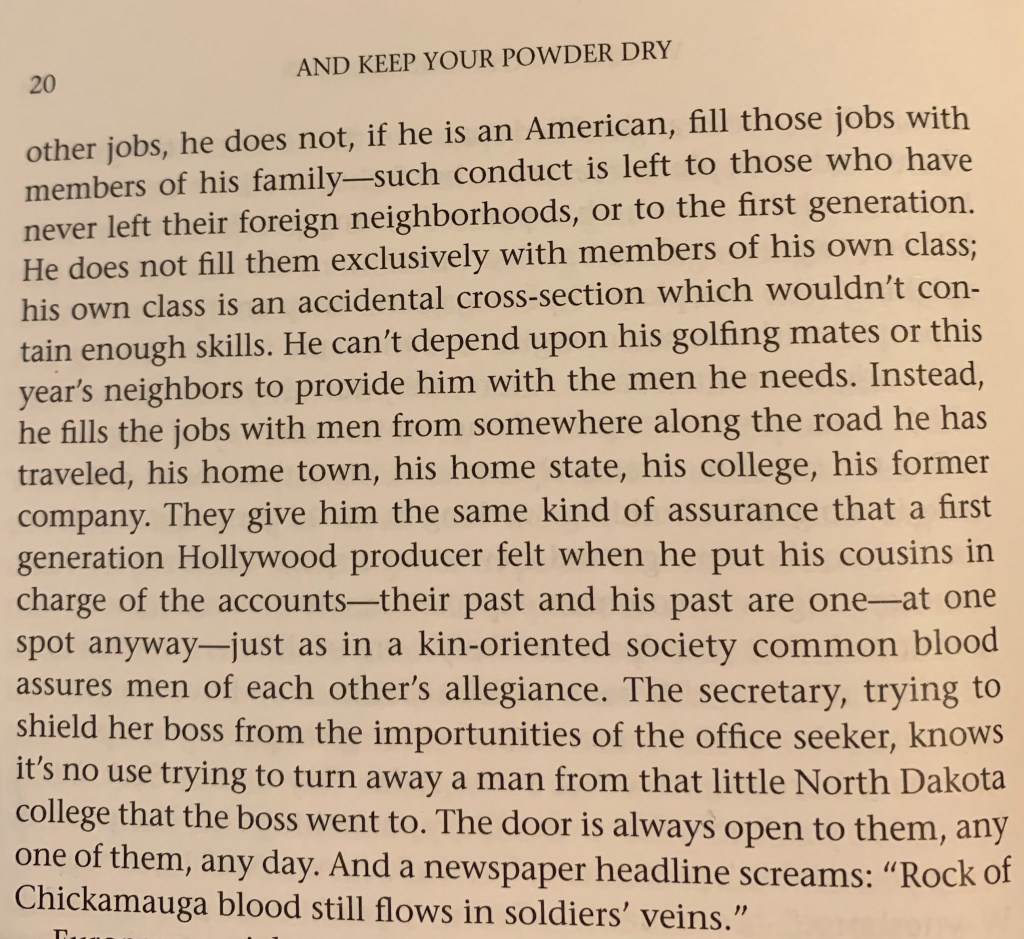
“Rock of Chickamauga blood still flows in soldiers’ veins.”

(Berghahn Books 2000)

You see that a lot in modern American life. You might know someone heavily involved in the sorority they joined thirty years ago, who can tell you stories of being rescued by a sister she hadn’t met before. On a more modern front, you can find people who form these connections in cyber-space. In 2020, you can find women sending moms they never met to rescue their young adult who got a flat tire on a road trip. They trust her, because the values or trials that brought them together on the Internet (be it homeschooling, breastfeeding, or caring for a diabetic kid) make them trust one another.

And Keep Your Powder Dry benefits from the care Margaret Mead takes in explaining her points. You understand her thinking as she forms her ideas, but more importantly, she is describing an America that you know, because you live in it. She describes people you know, because they are Americans. The America you know is not Mead’s America, but still, she knew yours very well.

1942

Chapter I is “The Introduction” of And Keep Your Powder Dry as written in 1942. On page 2, Margaret Mead writes:

“The obligation of the scientist to examine his material dispassionately is combined with the obligation of the citizen to participate responsibly in his society. To the investigation of social materials to the end that we may know more —here—now—in America towards fighting the war in a way that will leave us with the moral and physical resources to attack the problem of reorganizing the world.”

(Berghahn Books 2000)

When reading And Keep Your Powder Dry, the time and purpose must stay on the surface. Mead was writing for people in a different century, with a very particular goal in mind. When she writes about the enemy, there’s no ambiguity who she is talking about and she isn’t talking about any present-day enemies. When she says we need to reorganize the world, she means it literally—the world as it was organized in 1942 was not going to survive the end of Nazi Germany. When she speaks of black Americans, the language is archaic. You wouldn’t know unless you are familiar with her story that she was respected by James Baldwin. Mead would not know what an ableist is. Mead was not a time-traveler.

It might not seem like I’m making the case to read this book, but hang in there with me…

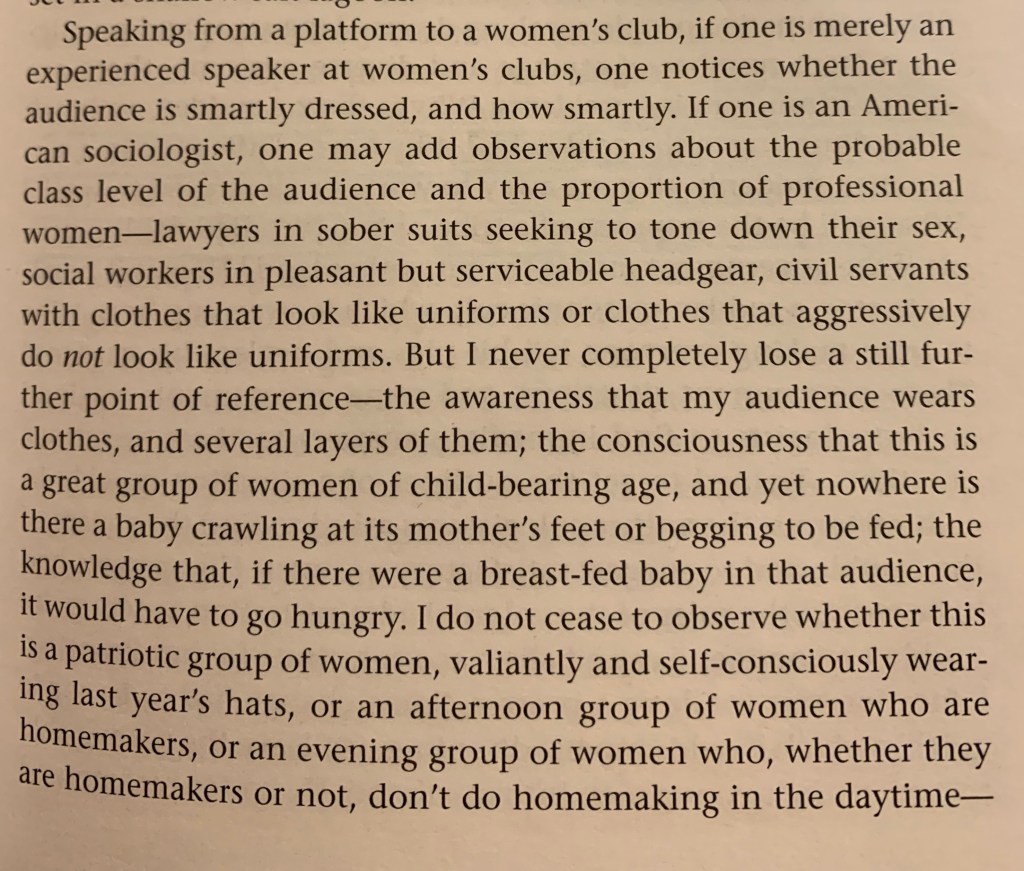
“But I never completely lose a still further point of reference—the awareness that my audience wears clothes, and several layers of them…”

(Berghahn Books 2000)

Despite the distance Mead has from modern Americans (she was born 99 years before my oldest daughter), she has a clear understanding of what makes our culture unique in the world, because she understood what made other cultures unique. Her ability to contrast and compare us to other cultures allows us to see an American character structure that still very much exists in some very recognizable and surprising ways. Also, she is funny. I hope you keep coming back for the descriptions like, “…civil servants with clothes that look like uniforms or clothes that aggressively do not look like uniforms…” (2000).

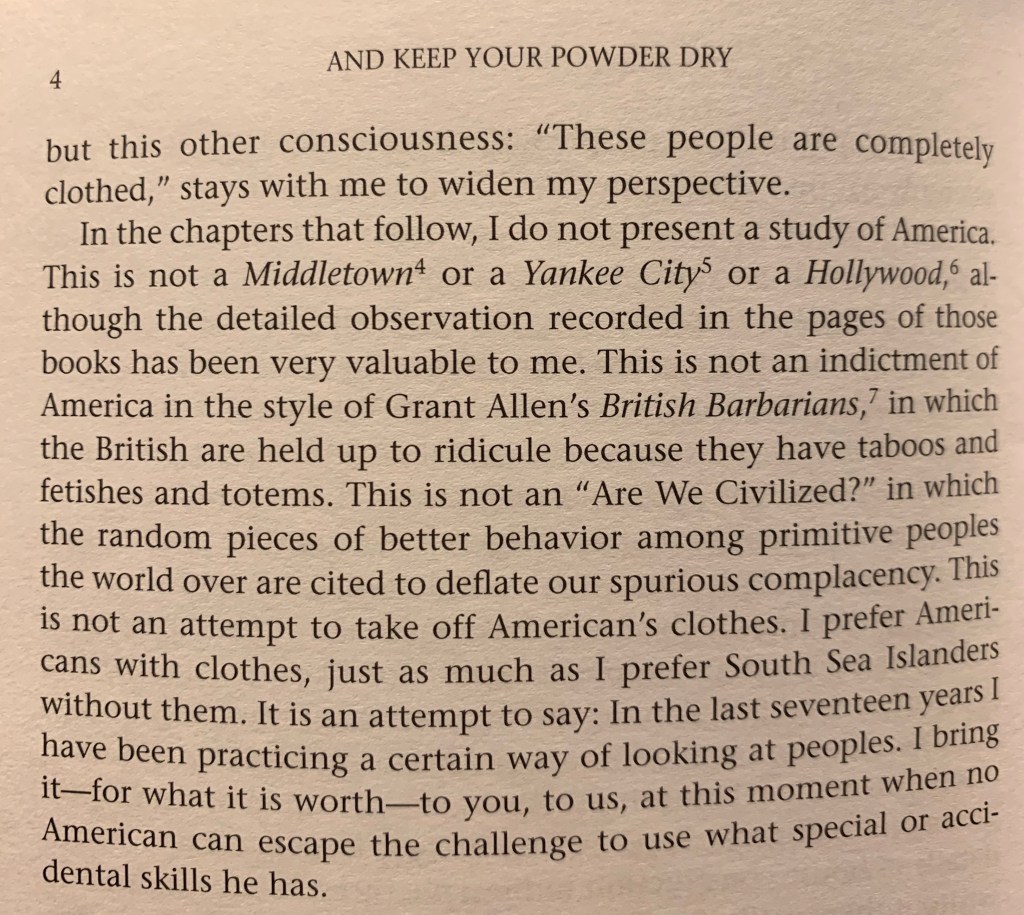
“These people are completely clothed.”

(Berghahn Books 2000)

Despite the seriousness of the subject matter, Mead brings a humor and wit that I hope you will find as engaging as I do. She also brings a strong understanding of the concepts she is teaching, able to present them with nuance and clarity, simultaneously. She understands not only the strengths and weaknesses of the American character, but the challenges and criticisms of the work she is undertaking. With And Keep Your Powder Dry, Mead gives us a framework for understanding the American character, and, despite some clear limitations brought by her position in the world and the time she was writing, she gives us a role model for how to talk about it.

She has a lot to offer, and presents it with understanding, humor, and self-reflection. I hope you’ll agree in the weeks to come. Thanks for reading with me.

March 3, 2020

Today marks Super Tuesday of what promises to be a long, trying election year.

It will be said that November’s election will decide many things, and it probably won’t about innumerable policy issues. It will tell us something, though, of who we think we are. I think a challenge we have, and it’s not new to us, is that we don’t exactly know the answer to “who are we?” We have some impressive documents to guide us, but they don’t change that we have wildly different thoughts on what the answer is or should be.

It’s hard to answer, because our country has changed so dramatically, and has helped dramatically change the world, in the centuries it has existed. We are supposed to innovate, adapt, and chart new courses in unimagined places. In this country, we can look back, know the history books left out the stories of many Americans, and demand a rewrite that takes them into account. Add to that, we are a nation of individuals, so we are not beholden to the perceived shared values of one another. Every election, like this election, our shared values are up for debate.

The difficulty of the question doesn’t mean we can’t answer it, though.

We will and must answer “who are we?” at the polls and in our homes, whether we like it or not, so this blog is my effort to lead a discussion about it, by reading a book about it with you. That book is And Keep Your Powder Dry by Margaret Mead.

Originally published in 1942 and most recently in 2000 by Berghahn Books, the book was Mead’s attempt to use her skill as a social scientist to help Americans understand their collective strengths and weaknesses in an effort to win the war and the peace. Needless to say, this leaves room for debate and disagreement. I don’t recommend this book as some inarguable truth nor do I claim Mead or her ideas are somehow beyond reproach. I present it, because she thought a lot about the question and wrote one of the most studied, articulate answers to it.

Any American reading And Keep Your Powder Dry in 2020 is likely to see some of it as clearly wrong, misguided, or just plain puzzling. They are also likely to laugh loudly at times, struck by how right she could get it about present day Americans from way back in the 1940s. Mostly, and the reason I’ve been moved to write this blog, I think anyone who reads this book in this election year will think about the American character and our place in the world in a way that they haven’t, and in a way that we haven’t as a nation, in a long time. She will move you.

Please, find a copy or just read along with me. I am so excited to share this book with you now!

(You can learn more about Mead and 1942 in the Background Links page of the website.)