“…when I talk about what Americans must do if they are to use the full resources of their character structure, I will be making highly technical statements, and they will often sound exactly like a Sunday-school lesson.” —Margaret Mead
The remaining chapters, including one written with a reprint in 1965, are for those of you who get yourselves a copy of Margaret Mead’s And Keep Your Powder Dry. The final chapters are as insightful and thought-provoking as the others, but I did not want to co-opt her entire work here.
I have tried to steer clear of partisanship and modern political advocacy in this blog, but my intention was deliberately political. I want everyone to think of Margaret Mead’s words and consider her ideas about the American character when they step into the voting booth.
I hope you feel like Mead’s words are worth revisiting throughout this election year, and that you will consider them when you read the news.
I am incredibly grateful to Mary Catherine Bateson, who gave me permission to copy her mother’s words and made this blog possible! I told her that my goal was to illuminate her mother’s work and legacy, and I hope she feels that I accomplished that.
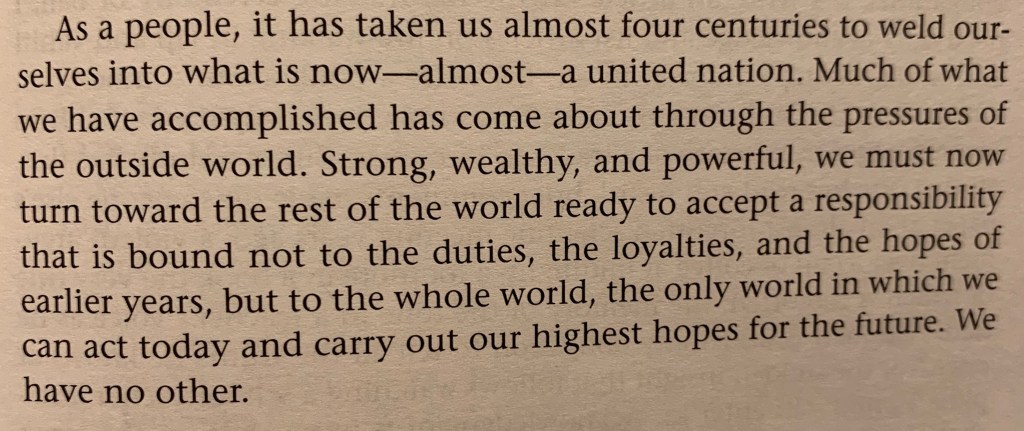
I am going to close with the final paragraph, which was written in 1965 when the book was reprinted again to give Americans insight during another hard time. Take it to heart now, as we make our way through this hard time.
“Strong, wealthy, and powerful, we must now turn toward the rest of the world ready to accept a responsibility that is bound not to the duties, the loyalties, and the hopes of earlier years, but to the whole world, the only world in which we can act today and carry out our highest hopes for the future. We have no other.”
As I round out Chapter XIII, “Building the World New,” I feel it’s important to start off with a reminder that Margaret Mead was not a time-traveler. Mead wrote And Keep Your Powder Dry in 1942, for an audience at war. None of her writing should be interpreted as a commentary or position on any issues or events today. I remind you, because as she moves from teaching about the American character to what that means for our place in the world after the war, she is becoming more prescriptive and predictive. She is in part advocating, so it reads like advocacy.
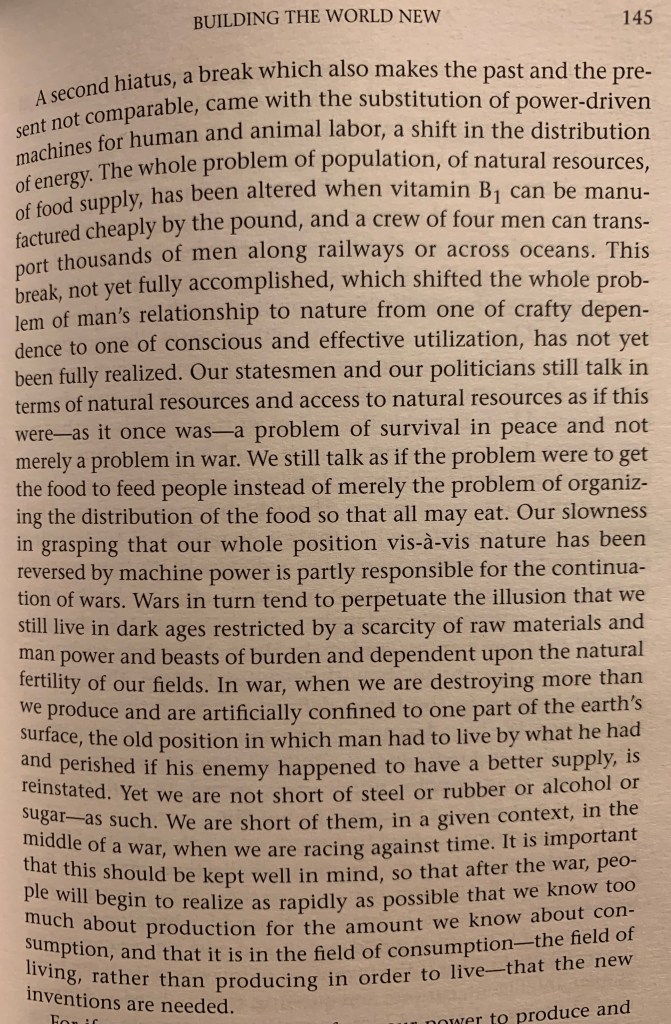
“Wars in turn tend to perpetuate the illusion that we still live in dark ages restricted by a scarcity of raw materials and man power and beasts of burden and dependent upon the natural fertility of our fields.”
(Berghahn Books 2000)
“…we know too much about production for the amount we know about consumption” (2000) was written in 1942, but could appear on a billboard today. That lack of understanding, Mead clearly ascertained, perpetuates war in as much as war is a competition for resources.
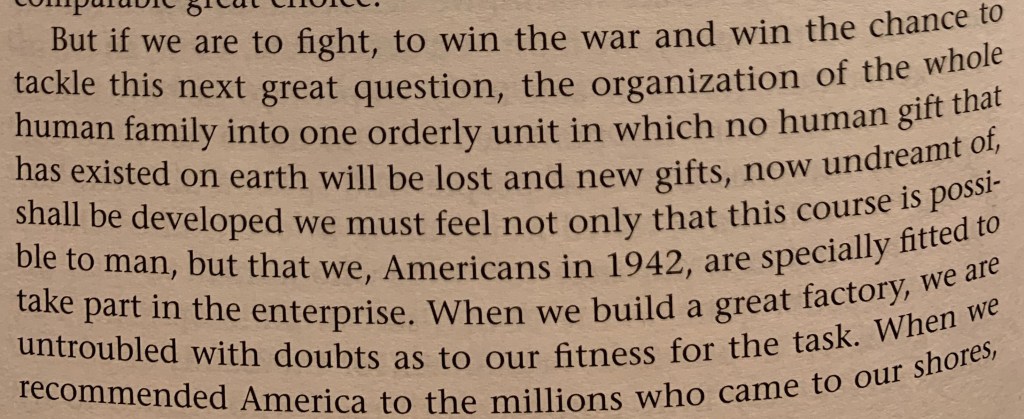
“…we must feel not only that this course is possible to man, but that we, Americans in 1942, are specially fitted to take part in the enterprise.”
(Berghahn Books 2000)
More and more, Mead uses the word order. I initially had a knee-jerk reaction to the word, but it is clear that she means order as the ability to live together without violent hostility.
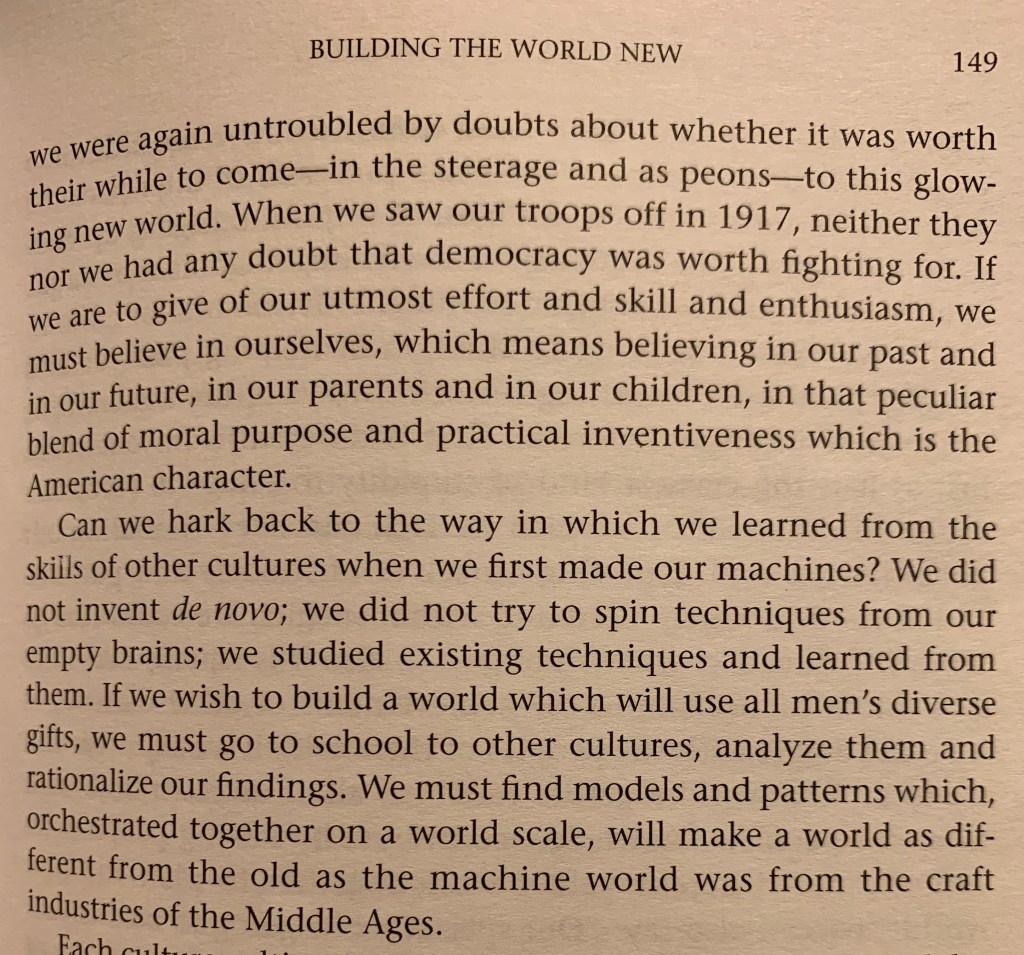
“If we are to give our utmost effort and skill and enthusiasm, we must believe in ourselves, which means believing in our past and our future, in our parents and in our children, in that peculiar blend of moral purpose and practical inventiveness which is the American character.”
(Berghahn Books 2000)
If we want a world which benefits from the gifts of all peoples, we must know what their gifts are. That seems pretty logical.
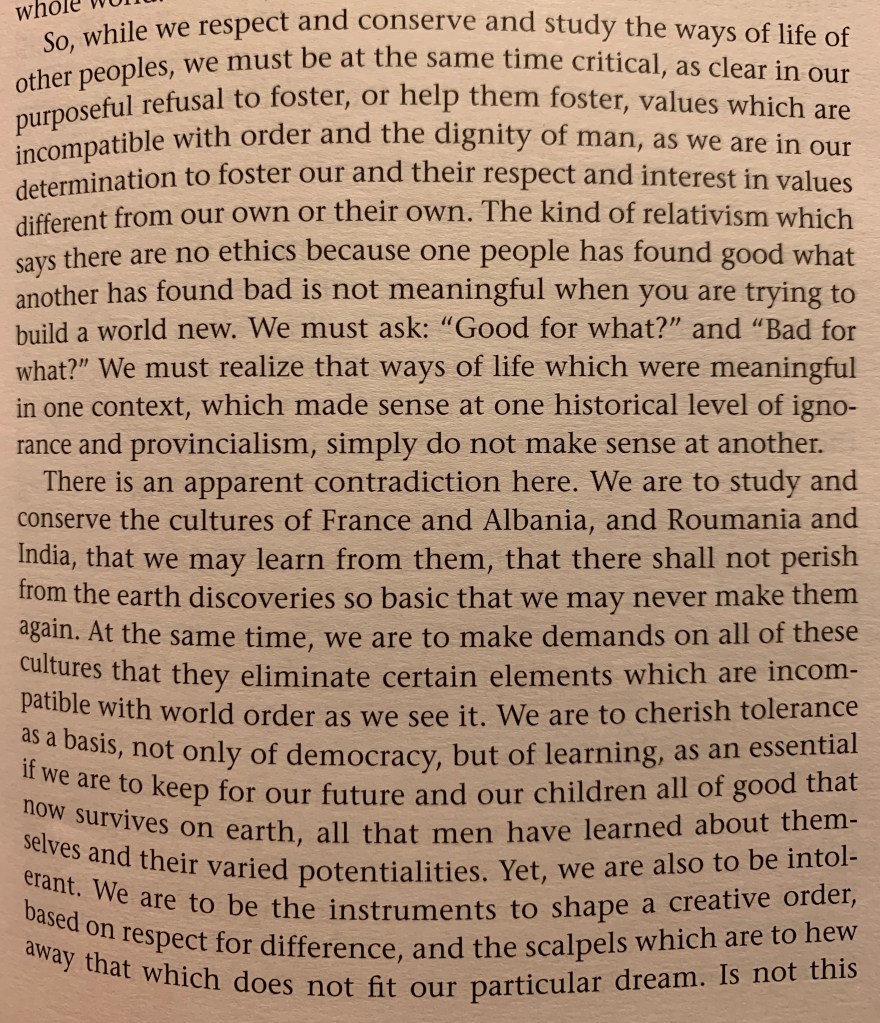
“The kind of relativism which says there are no ethics because one people has found good what another had found bad is not meaningful…”
(Berghahn Books 2000)
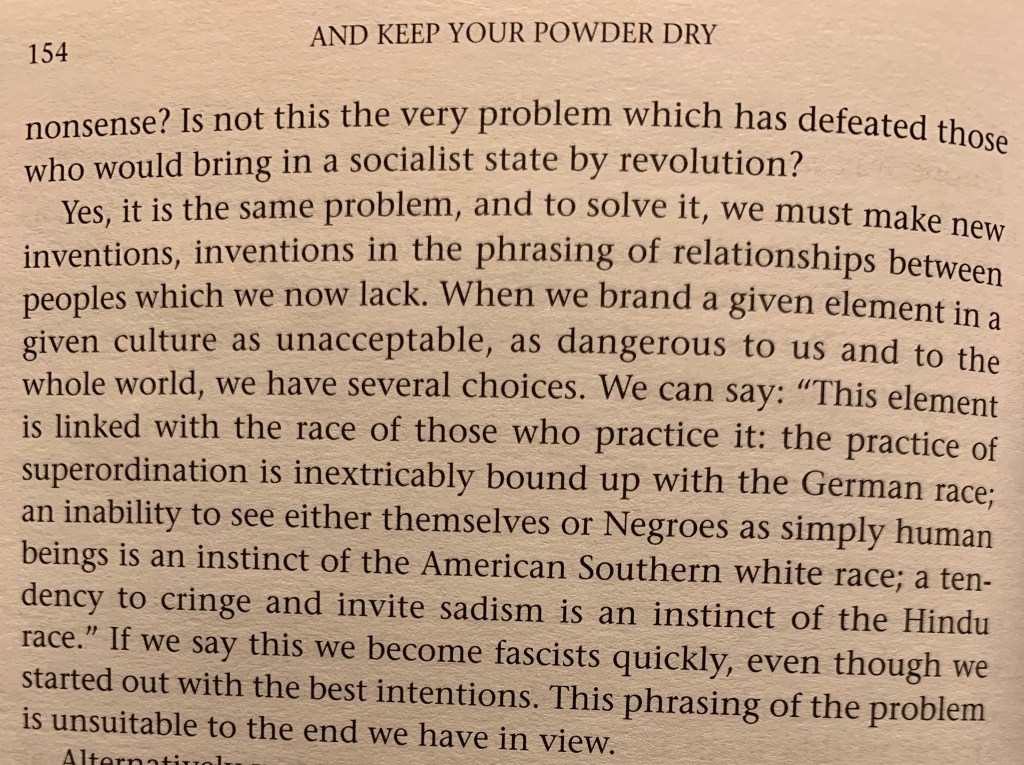
I love how she handles intolerance of intolerance and the (apparently) old criticism that those who will not tolerate intolerance are just perpetuating the thing they hate. She articulates better than anyone I’ve read why we cannot tolerate intolerance. This profound skill for handling nuance without jumping to accusations of hypocrisy makes her work incredibly compelling and rich.
“Yes, it is the same problem, and to solve it, we must make new inventions, inventions in the phrasing of relationships between peoples which we now lack.”
(Berghahn Books 2000)
In typical Mead fashion, she first reminds us of our American strengths and inventiveness here, and then explains how our weaknesses might send us down the wrong path. She, then, turns her attention to how we can go down the right path. She does it, though, with some palpable disdain for the Germans, which is easy to forgive given they had Hitler in charge at the time.
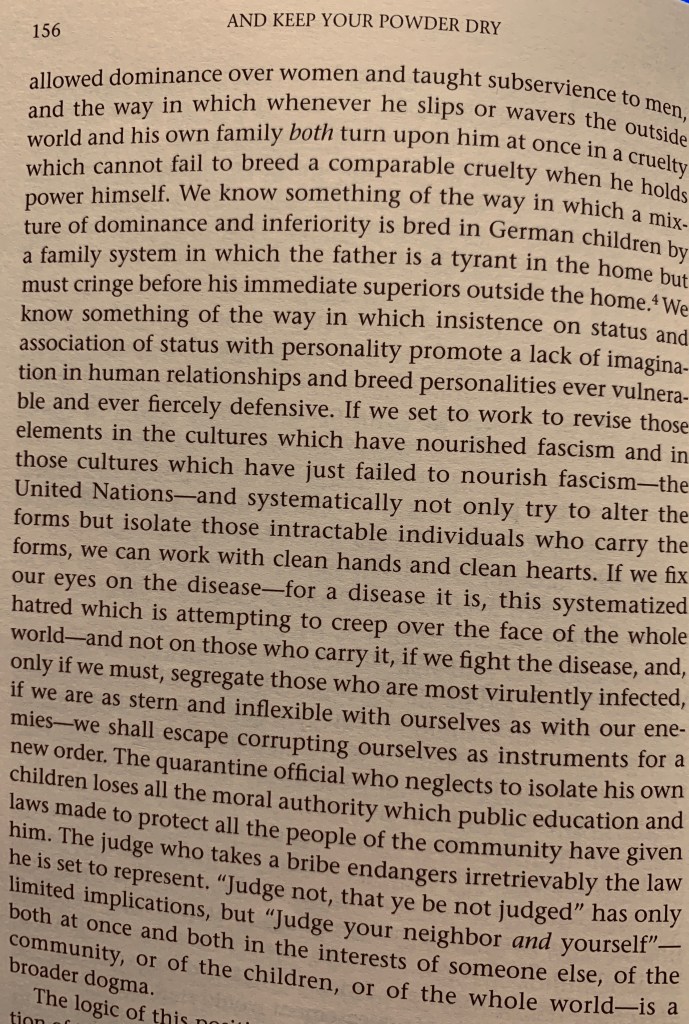
“We know something of the way in which insistence on status and association of status with personality promote a lack of imagination in human relationships and breed personalities ever vulnerable and ever fiercely defensive.”
(Berghahn Books 2000)
Figuring out how to avoid corruption as we uphold our values was of paramount importance to Mead, but she was not making a value judgment. She was telling us that the American character demands it. It’s a fine distinction, but it’s vitally important. American character means that we must uphold our values and do what’s right (or at least actively try to) in order to succeed.
As we near the end of And Keep Your Powder Dry, Margaret Mead increasingly turns her attention to the future, hoping to encourage a right and moral path forward. Having seen the Great Depression, and believing it was a moral failing, she did not want her nation to walk into the same trap. She wanted us to be very clear about what our values are, and to strive to represent them.
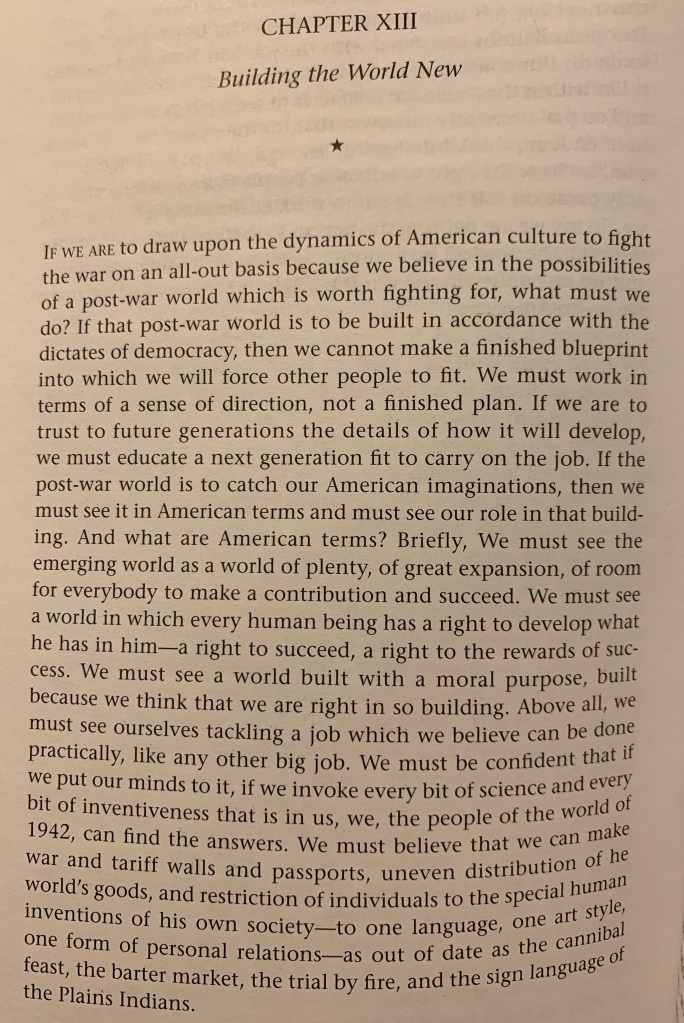
“Building the World New” is the title of Chapter XIII. We exist beyond her imaginings in 1942. Characteristically, though, for not knowing our world, she sure knows us very well.
“If that post-war world is to be built in accordance with the dictates of democracy, then we cannot make a finished blueprint into which we force other people to fit.”
(Berghahn Books 2000)
Mead reiterates a point she has made over and over: democracy requires an uncertain future. We cannot write the blueprint for future generations, because that would take away their right to self-determination; we can only give a sense of direction. She says, though, that we must see the emerging world as a world of plenty.
What does that mean in 2020, when the population is considerably larger than in Mead’s time and the reality of finite resources is more immediate? I would argue that our direction, that hard work will lead to success, is the right path, but our commercial blueprint, that success means plenty of stuff and increasing amounts of it, could use modernization.
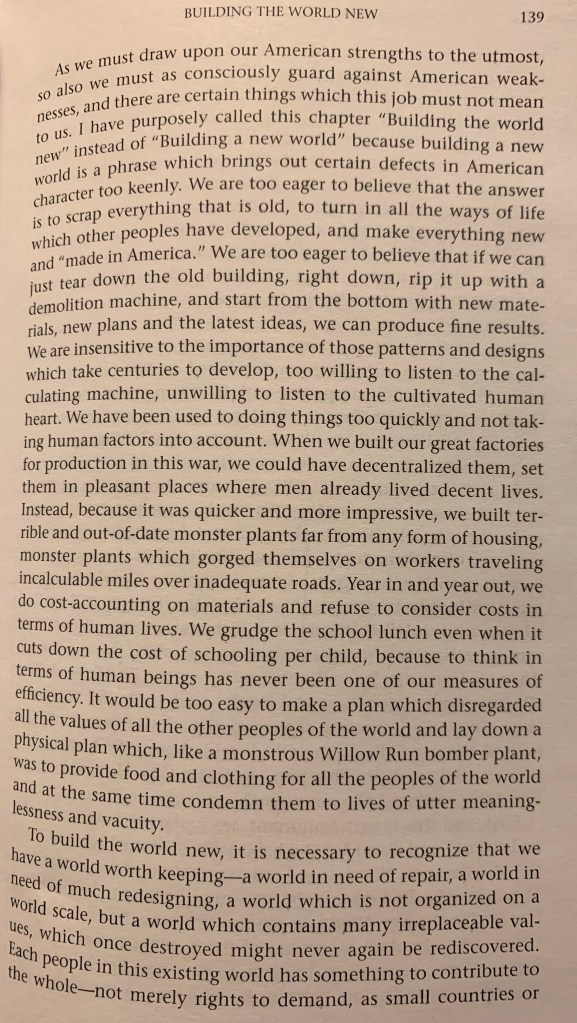
“We are too eager to believe that the answer is to scrap everything that is old, to turn in all the ways of life which other peoples have developed, and make everything new and ‘made in America.’”
(Berghahn Books 2000)
How familiar is this idea that we begrudge school lunch even though everyone knows it saves money in the long run? It’s only been prevalent for at least eighty years, apparently.
She notes that it could be very easy for us to lay down a plan that provides for food and shelter for all people but nothing very meaningful to life, much like our bomber plants provided jobs but disregarded transportation to them.
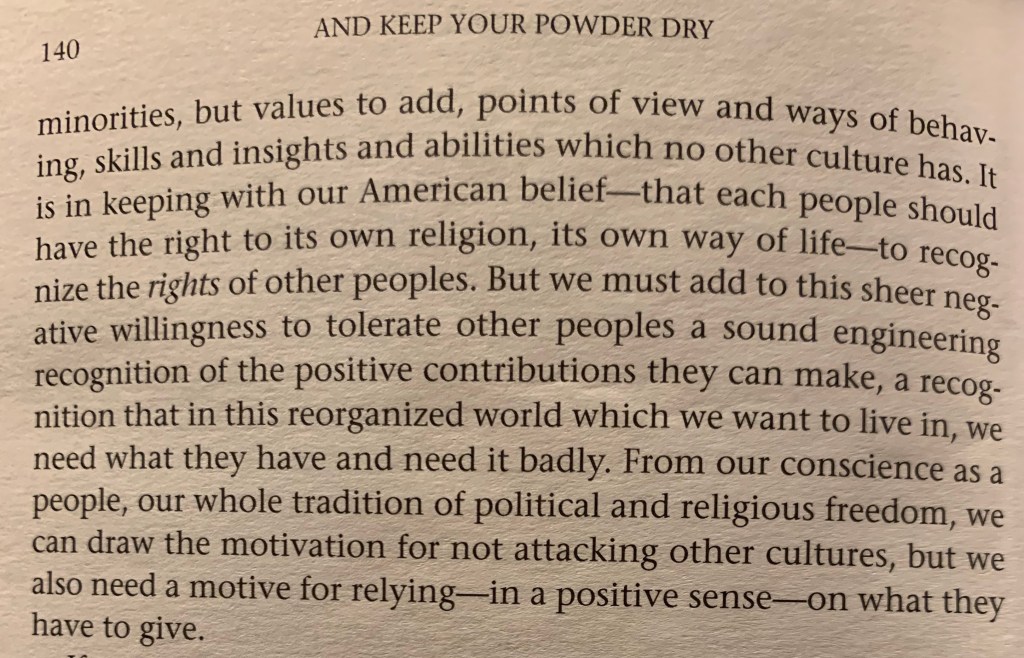
“But we must add to this sheer negative willingness to tolerate other peoples a sound engineering recognition of the positive contributions they can make, a recognition that in this reorganized world which we want to live in, we need what they have and we need it badly.”
(Berghahn Books 2000)
She is strong in her assertion that it is not enough to recognize the rights of minorities. To lead with our values, we must recognize that we, as Americans, fundamentally need other cultures. It’s not good enough to believe that they have a right to exist; we need to see that it’s in our best interest that they do exist. They have knowledge we do not have, being we are so quick to leave behind old ways. We aren’t going to be able to develop that knowledge on our own, because our culture isn’t built for it. We do need that knowledge, though, to innovate, which means learning from others.
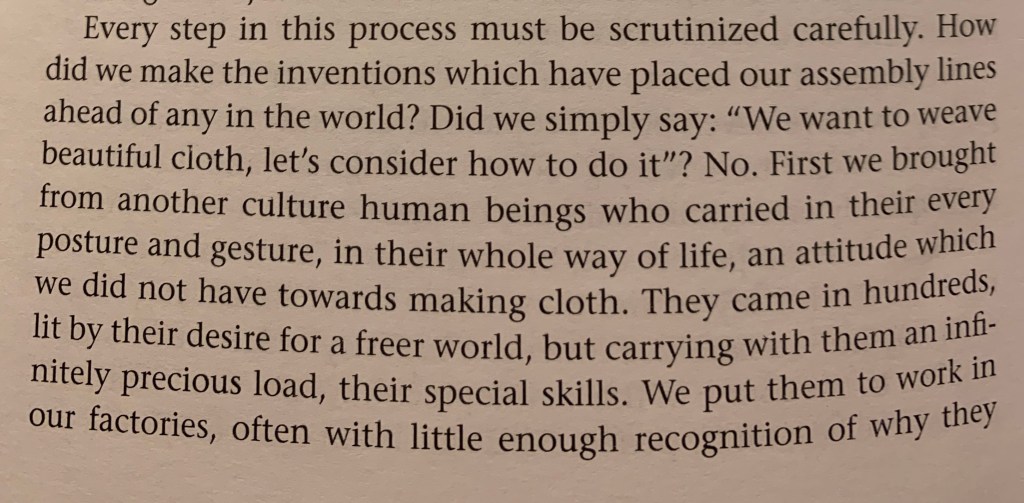
“They came in hundreds, lit by their desire for a freer world, but carrying with them an infinitely precious load, their special skills.”
(Berghahn Books 2000)
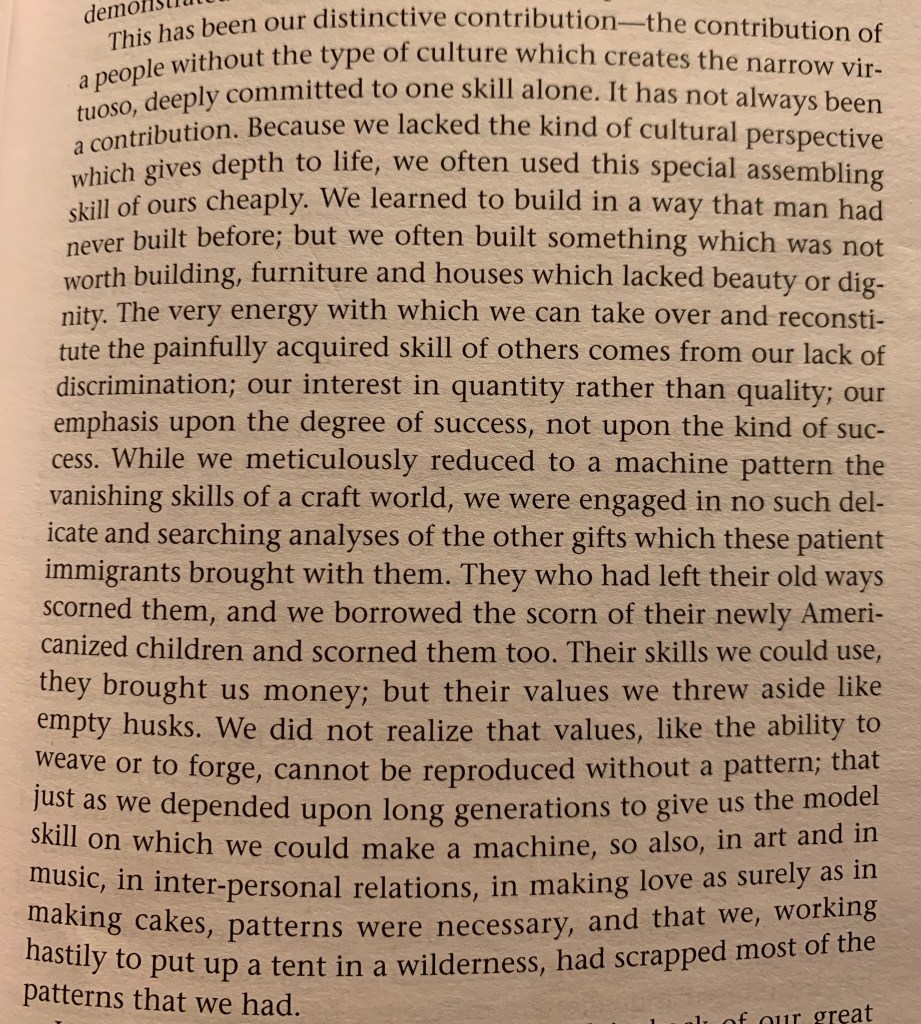
She expounds upon the importance of immigrants to helping us build the factories that defined the America of her time. We did not build machines that successfully made clothes through sheer imagination.
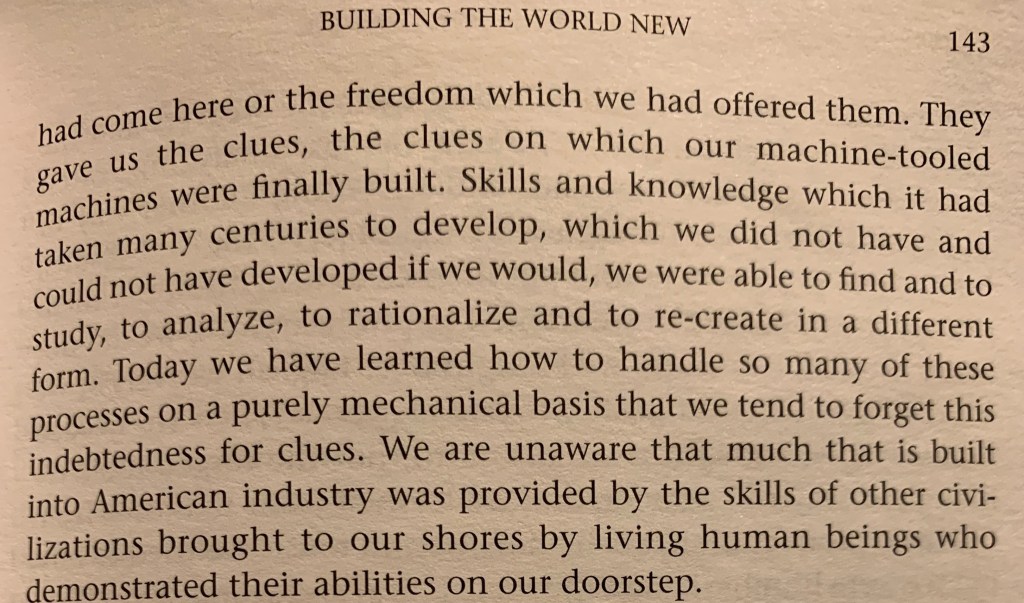
“We are unaware that much that is built into American industry was provided by the skills of other civilizations brought to our shores by living human beings who demonstrated their abilities on our doorstep.”
(Berghahn Books 2000)
As she makes the case for why we need to value the rights of immigrants and the skills that they bring, she again shows her remarkable understanding of how our strengths and weaknesses often come from the same place. Her knack for bringing clarity to nuance, so you can understand the subtleties of her ideas, is unique and rare. I can’t think of anyone today who does it as well.
(Berghahn Books 2000)
“They don’t make ‘em like they used to” is a common complaint here. Is there not an American alive who doesn’t think we used to build things of better quality? This is an old, favorite American past time, remembering back to a day that apparently never actually existed. Remember, Mead’s contemporaries had just started building neighborhoods for cars, forget homes for televisions and computers. We’ve been complaining about this for a long time.
Mead seems to be telling us that, when we gripe about how poorly we make or do things these days, it’s a good time to turn to other people who know how to do well that which we do poorly.
Presently, we have an extraordinary opportunity to discover things about ourselves, and learn. Through this pandemic, we will have an unusual opportunity to see how different cultures react to the same threat, what is says of their values, and how they fare when it’s all over. If we pay attention, we can learn a great deal about our present-day strengths and weaknesses, those of other nations, and how we can all work together to build a stronger world for the next generation.
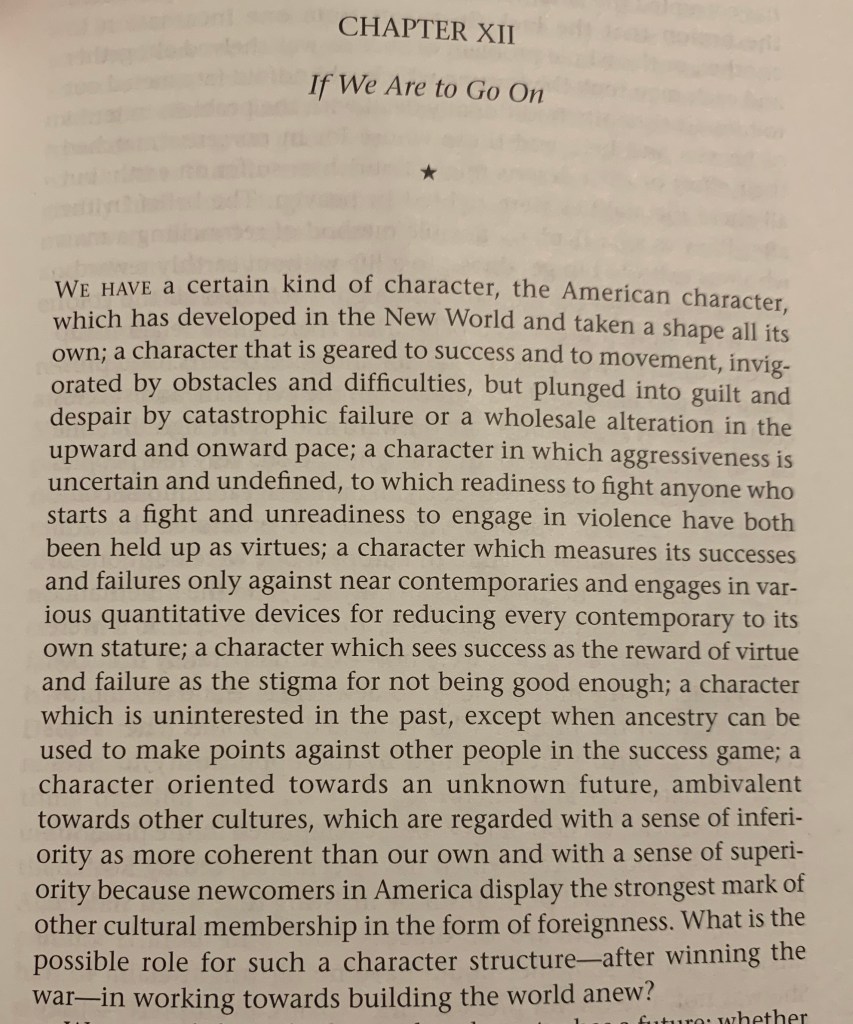
In the first paragraph of Chapter XII, “If We Are to Go On,” Margaret Mead summarizes all she has taught about the American character in And Keep Your Powder Dry, a book originally published in 1942.
“What is the possible role for such a character structure—after winning the war—in working towards building the world anew?”
(Berghahn Books 2000)
She wants us now to consider our place in the world. She does not know the future as we do; she is focused on the events of her day. Hitler is the clear enemy, a tyrant who threw the whole world into despair. For America in 1942, fascism was the undeniable enemy. Mead wanted Americans to understand that we were, because of our national character, completely at odds in our values to fascism and also highly susceptible to it.
This chapter is her effort to help us inoculate ourselves, and by extension the world, to the great evil that defined her time.
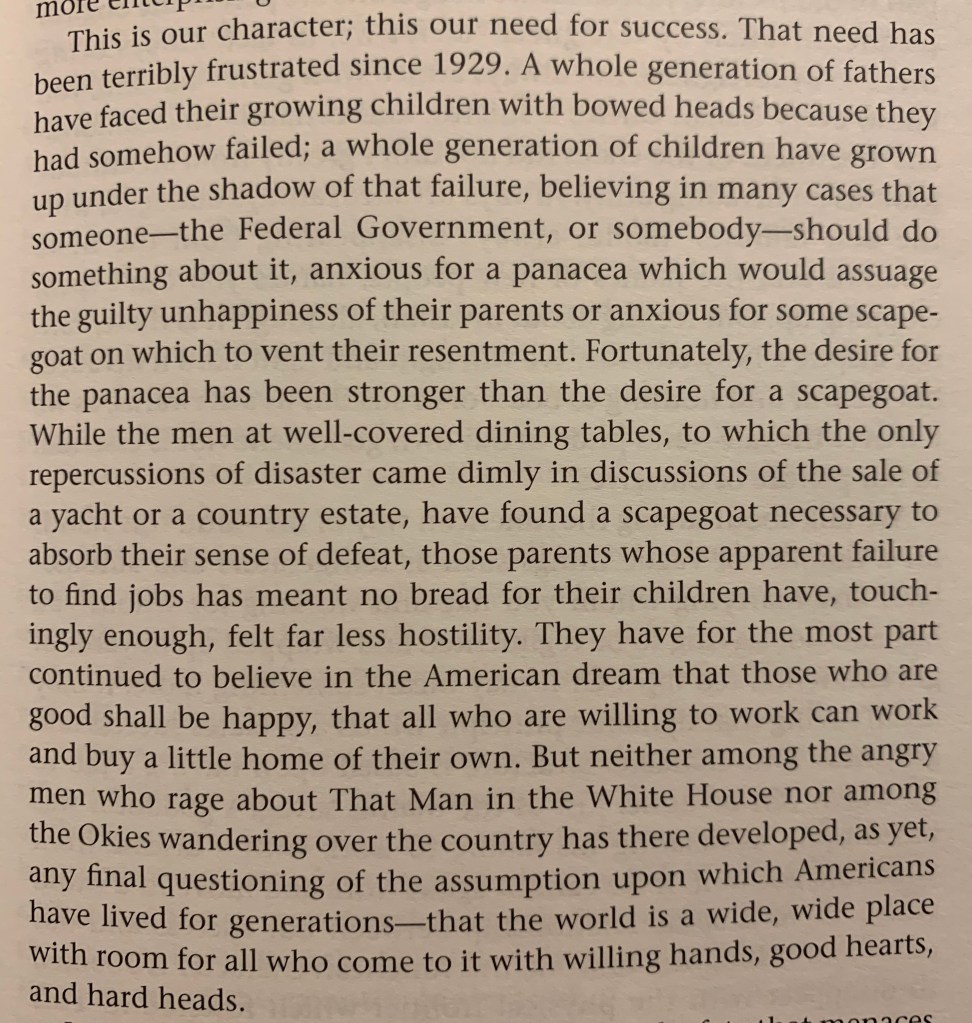
“…the world is a wide, wide place with room for all who come to it with willing hands, good hearts, and hard heads.”
(Berghahn Books 2000)
Panaceas and scapegoats. Sound familiar?
She says that the rich men of her time found a scapegoat when times got hard, but Americans who lost everything in the Great Depression or the Dust Bowl didn’t fall victim to the same hostility. Average Americans, she maintained, still believed that if you were good and worked hard, you could build a happy life for yourself.
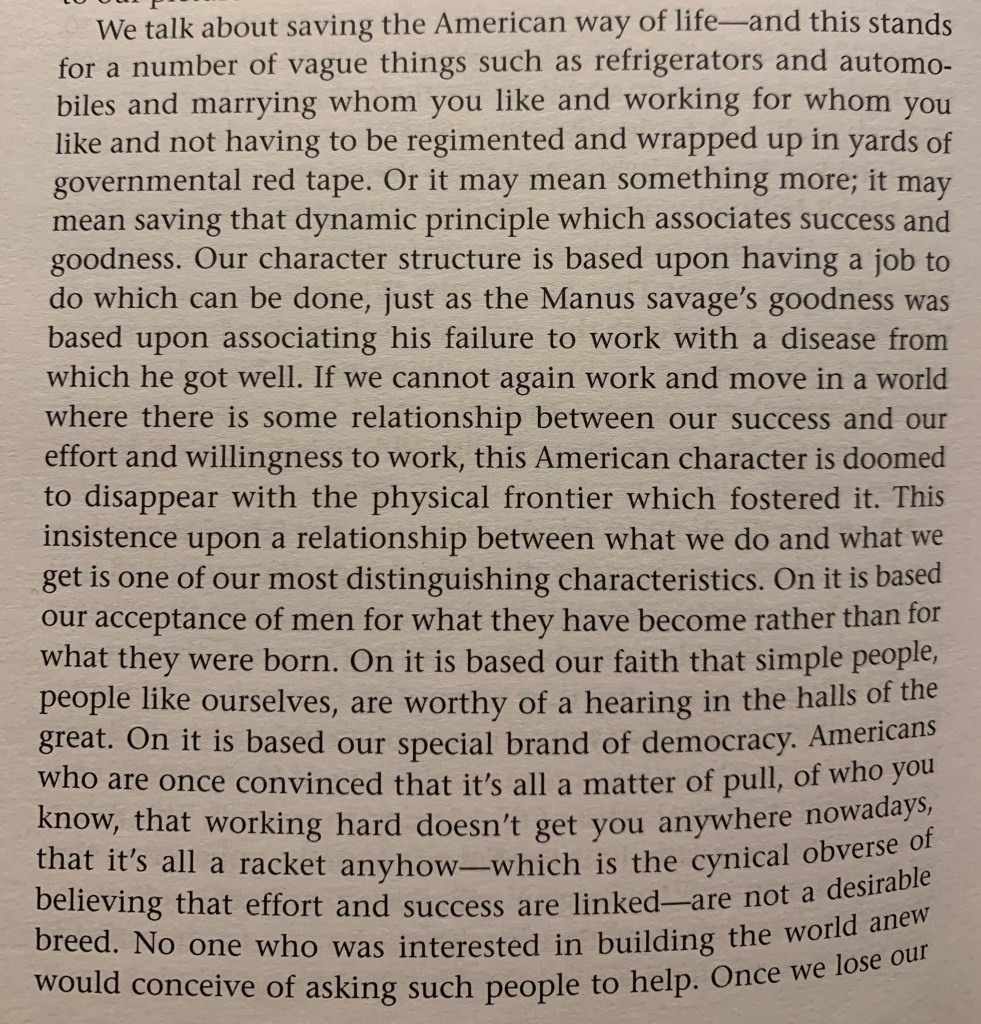
“Or it may mean something more; it may mean saving that dynamic principle which associates success and goodness.”
(Berghahn Books 2000)
She says that our belief that hard work leads to success is vital for us. We must believe it. She says it is fundamental to our belief that you can rise above the station to which you were born through your own effort.
She warns against cynicism in a nation who has based everything on this premise, because the belief requires a faith in it. If you don’t believe your hard work will get you anywhere, what is the point of hard work? This is especially dangerous when we believe that success is usually ill-gotten, she warns.
For Mead, cynicism is a very real threat to American democracy. She explains…
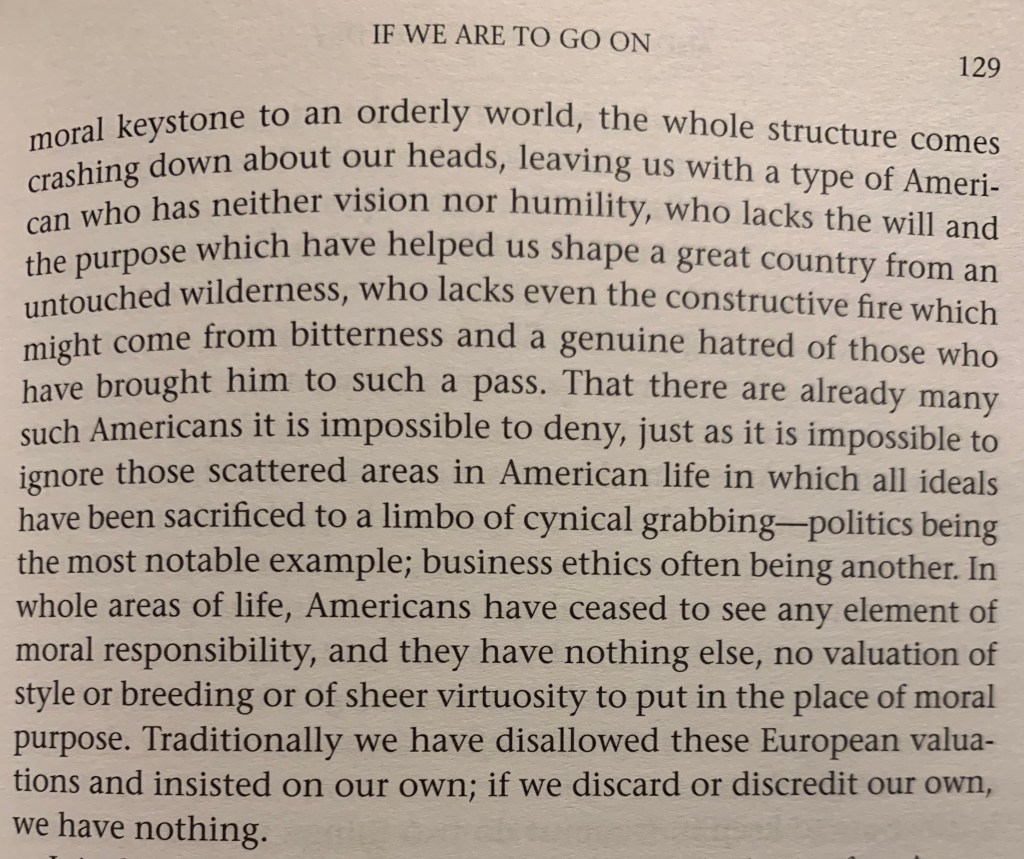
“…it is impossible to ignore those scattered areas in American life in which all ideals have been sacrificed to a limbo of cynical grabbing—politics bring the most notable example; business ethics often being another.”
(Berghahn Books 2000)
First, she delineates between average Americans and politicians and business men, before she brings them all back together. She already sees our ideals corrupted in the halls of power and readily acknowledges that. That’s not the cynicism she’s warning against, exactly. She is concerned that if we allow that abdication of moral responsibility to continue to overtake various areas of American life, and Americans!, we can seriously lose our way.
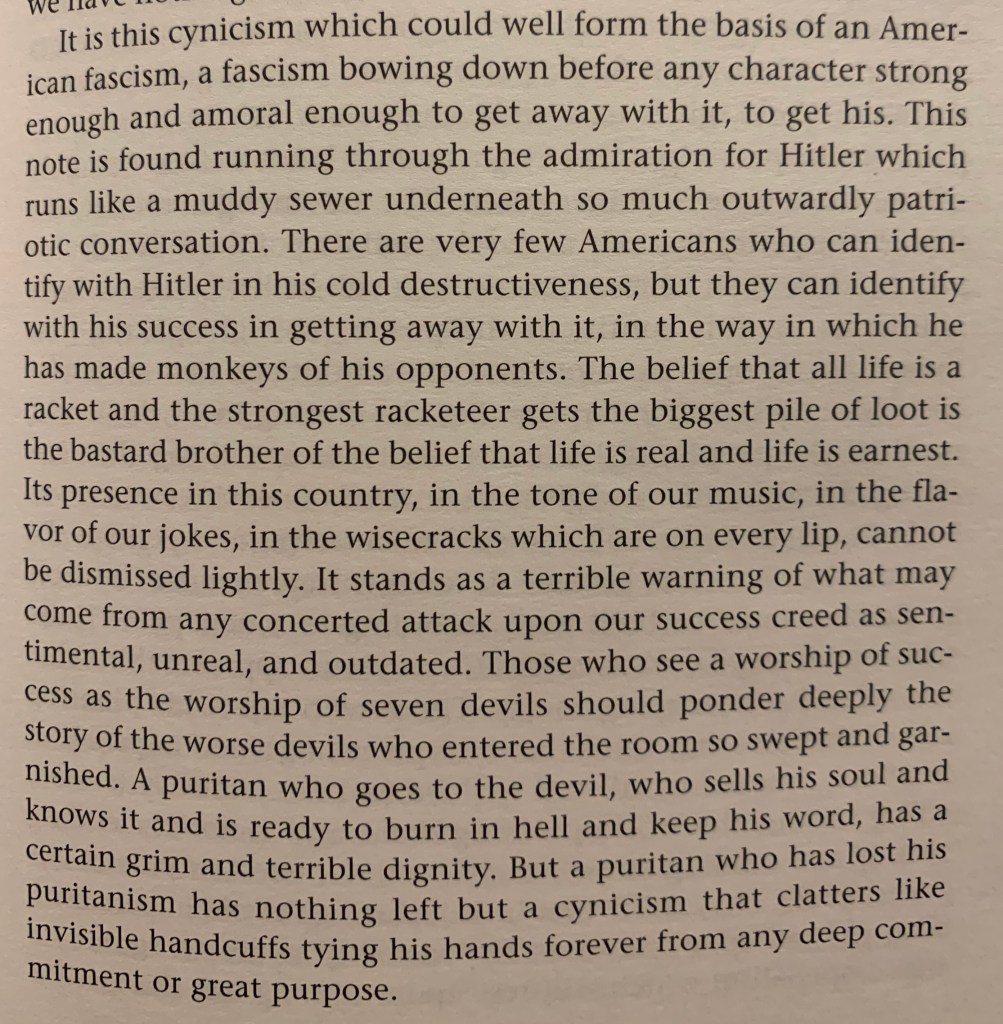
She then warns that if we create that moral vacuum (where we say being good has no bearing on our success or our progress), we run a very real risk that a fascist, the great enemy of her day, could fill it. Here is how she explains…
“It is this cynicism which could well form the basis of an American fascism, a fascism bowing down before any character strong enough and amoral enough to get away with it, to get his.”
(Berghahn Books 2000)
She calls out the admiration she was seeing expressed for Hitler among some Americans in 1942, and she strongly condemns them. She warns that praise upon Hitler is a profound moral danger to America, and she is worried about the moral decay she is seeing. She is concerned that cynicism about our values, and our success creed (do right + hard work = success) in particular, could very well turn us into our enemy.
It’s 2020 now.
Do we see “our success creed as sentimental, unreal, and outdated?”
Will we “…[bow] down before any character strong enough and amoral enough…to get his?” (2000)
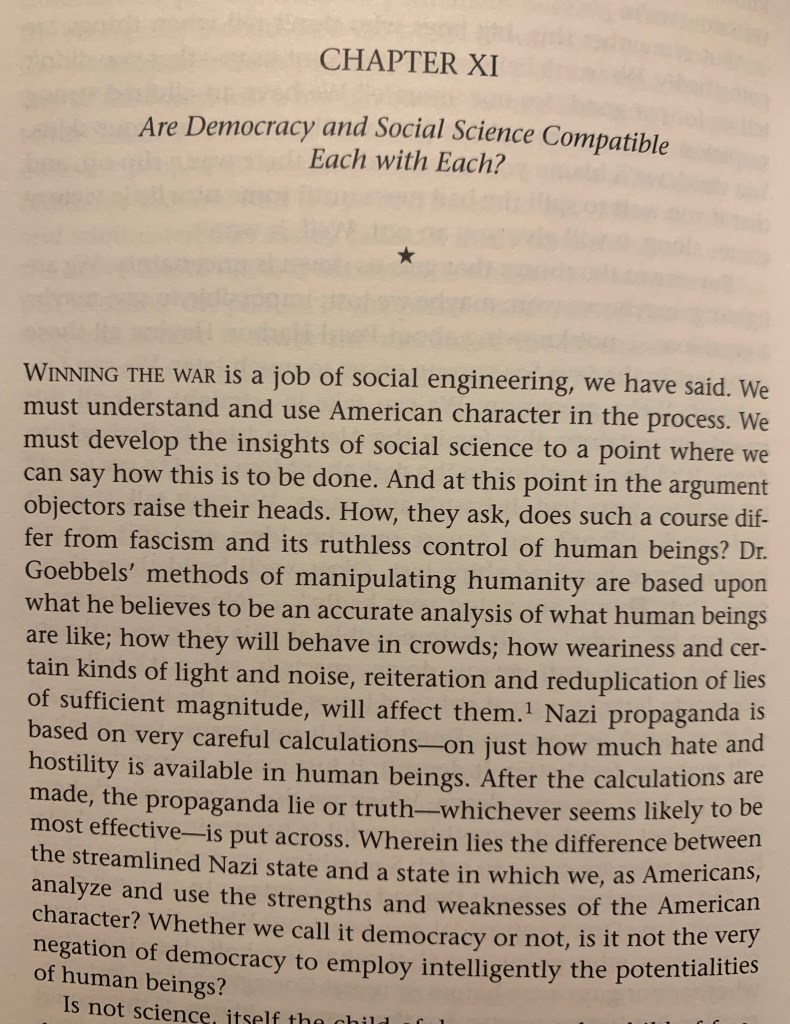
Chapter XI is titled “Are Democracy and Social Science Compatible Each with Each?” Here, Margaret Mead talks specifically about social engineering, what it means in terms of what she is doing with And Keep Your Powder Dry, and the criticism she has received or knows she will. She answers the criticism mostly by showing that she’s thought a great deal about the question: mustn’t this road of assessing people scientifically and using their strengths as tools lead to fascism, the very thing we were fighting against?
“Nazi propaganda is based on very careful calculations—on just how much hate and hostility is available in human beings.”
(Berghahn Books 2000)
Her answer is ultimately that, no, social engineering by way of the scientific examination and use of culture does not have to lead to fascism. First, though, she describes the ways that it can, even in America.
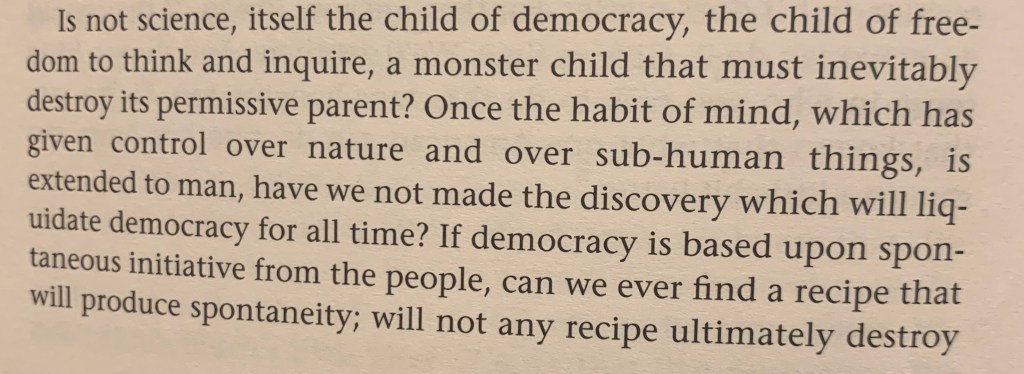
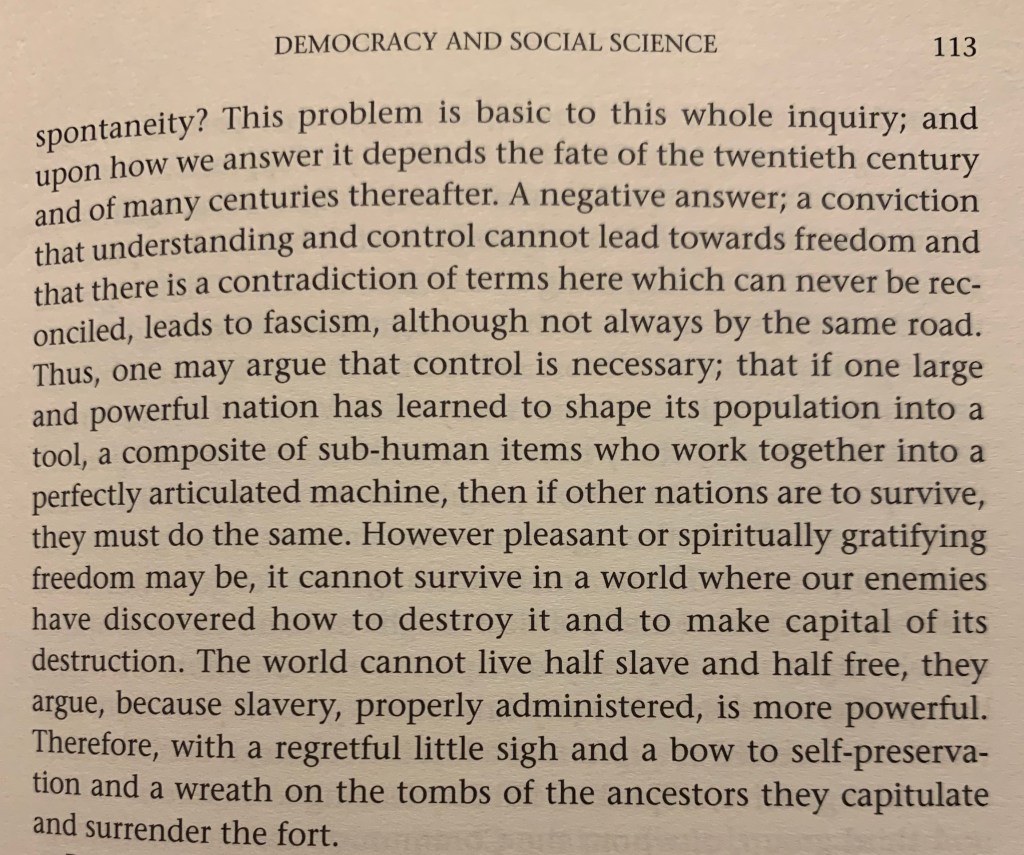
“Once the habit of mind, which has given control over nature and over sub-human things, is extended to man, have we not made the discovery which will liquidate democracy for all time?”
(Berghahn Books 2000)“…a conviction that understanding and control cannot lead towards freedom and that there is a contradiction of terms here which can never be reconciled, leads to fascism, although not always by the same road.”
(Berghahn Books 2000)
I feel like I could chew on that all day and still not quite understand what she is saying here. This is what I’m reading… if you are convinced that the understanding and control science allows inevitably leads to a loss of freedom when applied to people, you will find your way to fascism one way or another.
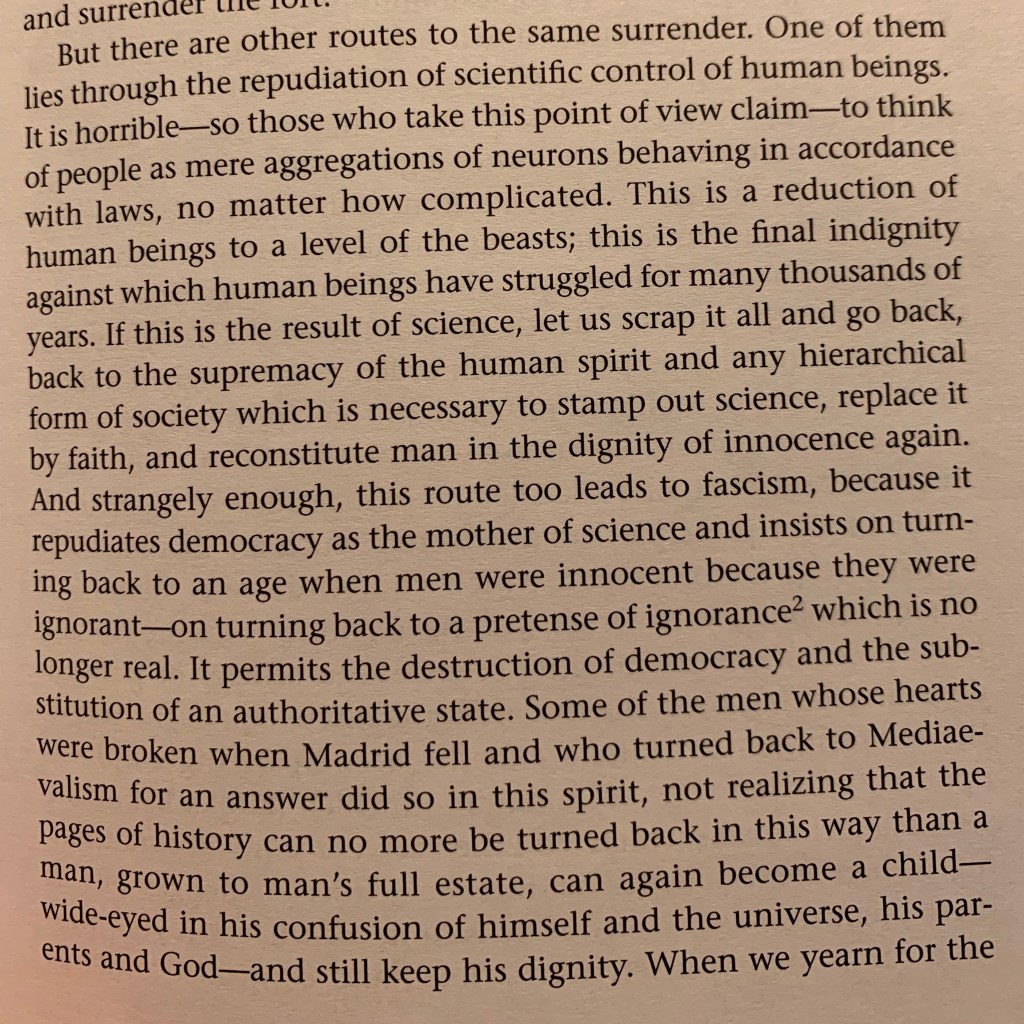
In characteristic form, Mead explains her point with care. If you believe fascism is the obvious end of scientific control, so you reject science in an effort to save yourself, you end up there anyway.
“…the pages of history can no more be turned back in this way than a man, grown to man’s full estate, can again become a child…and still keep his dignity.”
(Berghahn Books 2000)
She reminds her readers that time is always marching forward. An attempt to go back and pretend you don’t know what you know is a fool’s game.
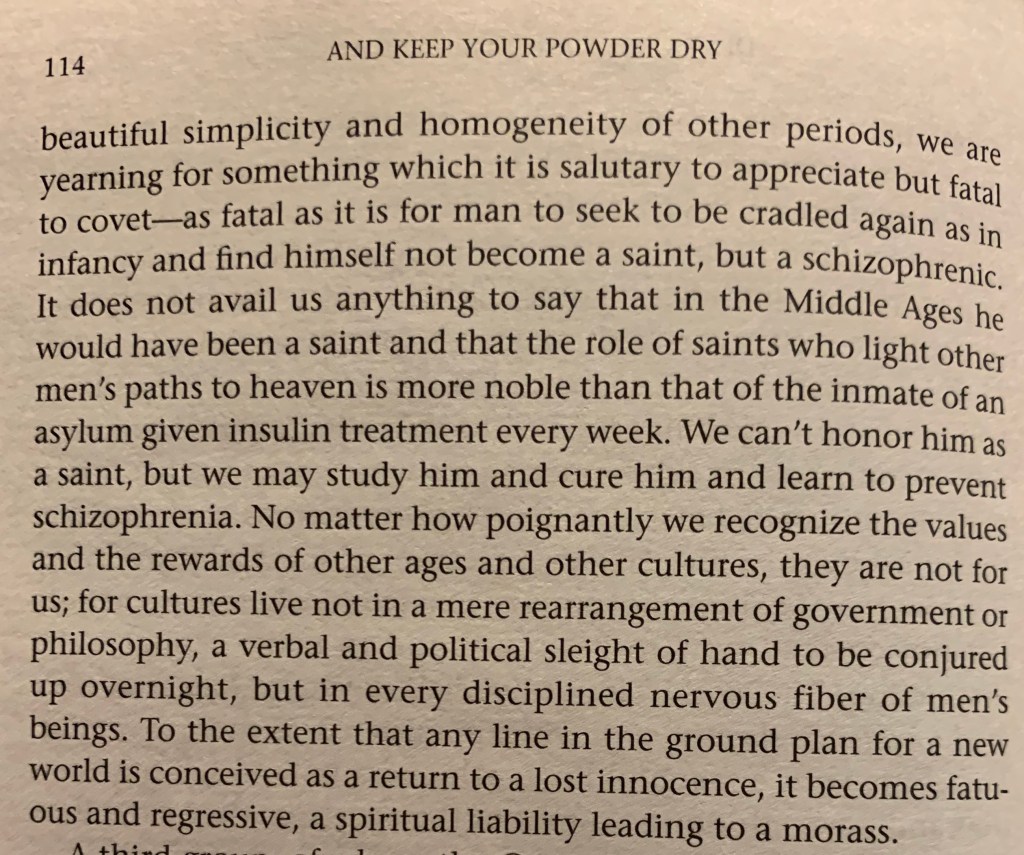
“No matter how poignantly we recognize the values and the rewards of other ages and other cultures, they are not for us; for cultures live not in a mere arrangement of government or philosophy…but in every disciplined nervous fiber of men’s beings.”
(Berghahn Books 2000)
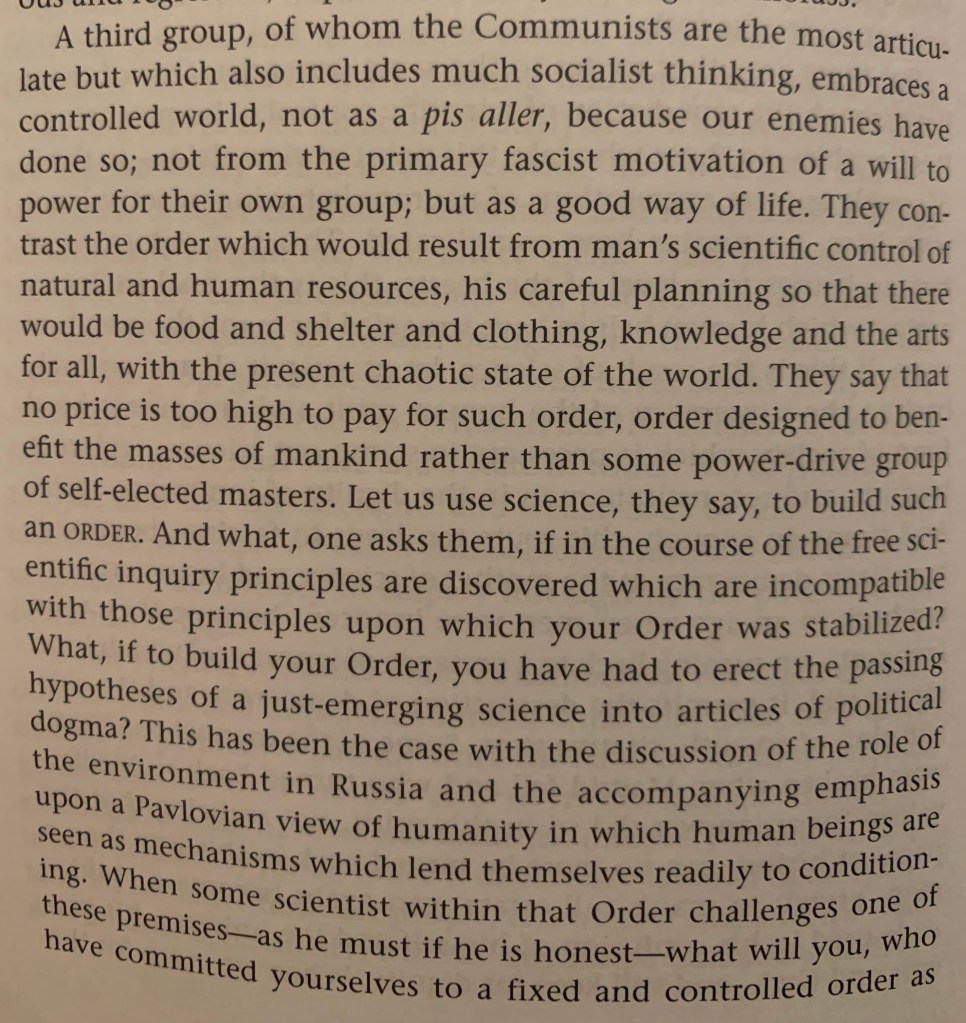
Finally, she addresses those on the Left. She says that when attempting to use science to ensure all people are sheltered and fed, the purpose may be noble, but the order will have to be forced to be maintained over the long term.
“What, if to build your Order, you have had to erect the passing hypotheses of a just-emerging generation of science into articles of political dogma?”
(Berghahn Books 2000)
Order at the cost of freedom is antithetical to who we are. That’s how I read it. Do you?
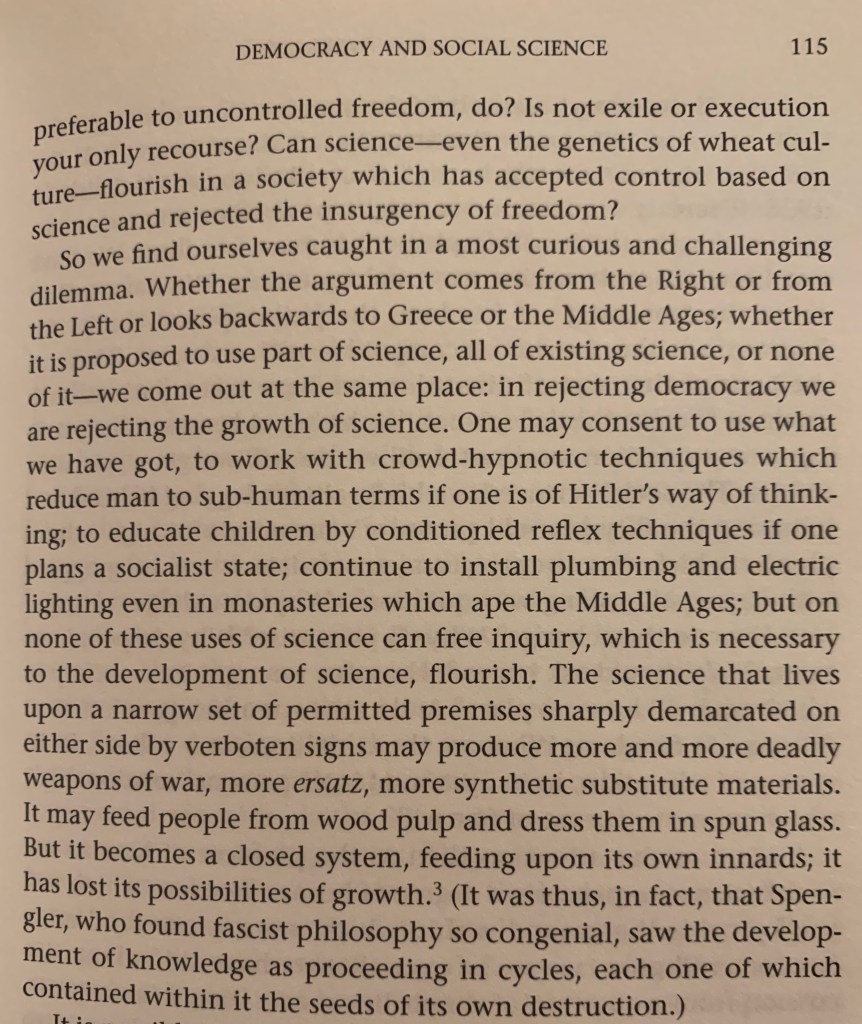
“It may feed people from wood pulp and dress them in spun glass.”
(Berghahn Books 2000)
There is a lot to unpack here, but I think the crux of what she is saying, and the part we can all agree on, is this: both science and democracy require free thought. Once you set the boundaries and determine that you can’t step outside of them, you are at a dead end for both democracy and science.
(Berghahn Books 2000)
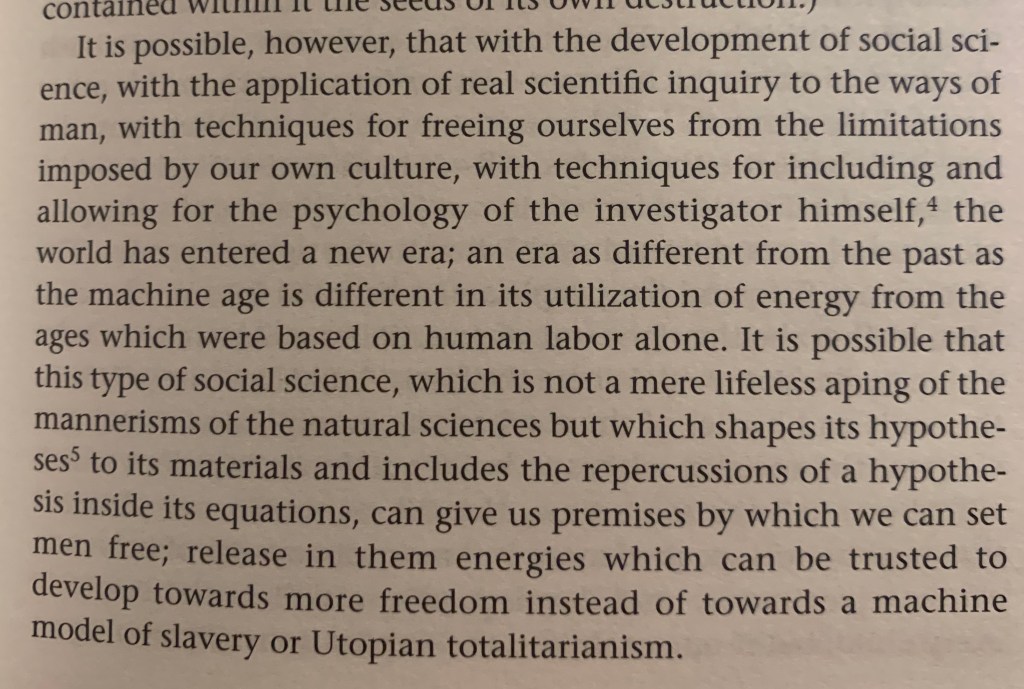
She wraps this up by making the case that you stay on the right path when you understand that your hypotheses are never set in stone, nor should they be. America demands progress, and that means the ability to use scientific understanding to move on and up to a better understanding. In terms of social science, that means we can never believe our understanding of cultures and political systems can’t be challenged. We must understand that we do not know definitively how things are supposed to be, so we do not try to force people to be that.
So, back to the question: Mustn’t this road of assessing people scientifically and using their strengths as tools lead to fascism?
The answer: no, it does not have to. If you believe it must, it will, though, so don’t do down that road. Don’t go down the road of rejecting science either, because we can’t un-know what we know. If you want to use science responsibly, always remember that someone is allowed to prove your hypotheses wrong.
Mead understands that. Just as I do not share her writing as the definitive explanation of the character of America, she did not share it as such. She was saying something more like, “this is what social scientists know now through our observations and careful research. This is what is says about our way forward.”
And Keep Your Powder Dry by Margaret Mead was written with a clear purpose, to win the war with a clear enemy, the Nazis. At the end of Chapter X, she attempts to take all she has taught about American culture and family and our puritan roots to make the case that truth-telling is the thing that could and should separate us from the Nazis.
She knows pushback is coming.
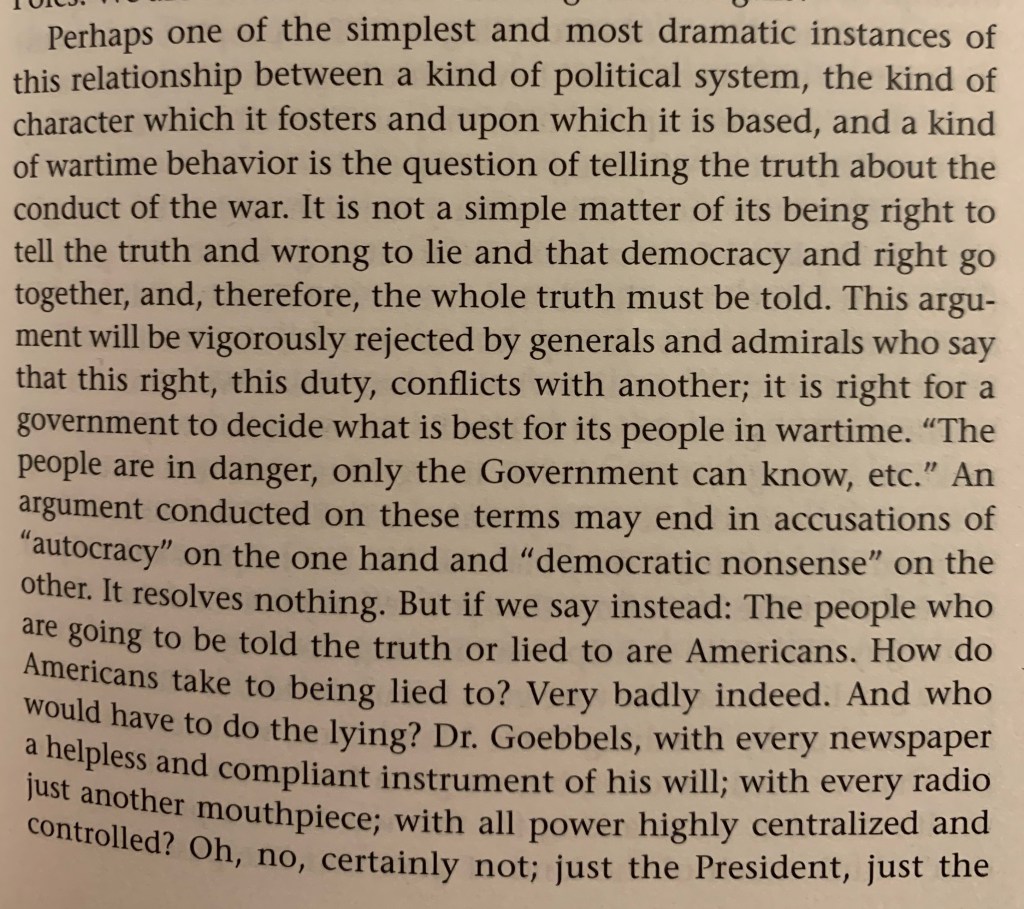
“It is not a simple matter of its being right to tell the truth and wrong to lie and that democracy and right go together, and, therefore, the whole truth must be told.”
(Berghahn Books 2000)
She asserts that democracy and truth-telling go together, because democracy, particularly the American brand, needs to believe there is a right way forward. In a previous blog, we read as she carefully built the case that we, individually and collectively, should be striving to always do right, punishing ourselves when we fail, and then working to do better. As I understand it, she is arguing that that work is fundamental to who we are as a people. Now, she extends that to the practices of the government, and what it means for how our leaders should conduct themselves in wartime. She comes to the conclusion that telling the truth, as quickly as possible, is most in line with the American character, as built from the family up.
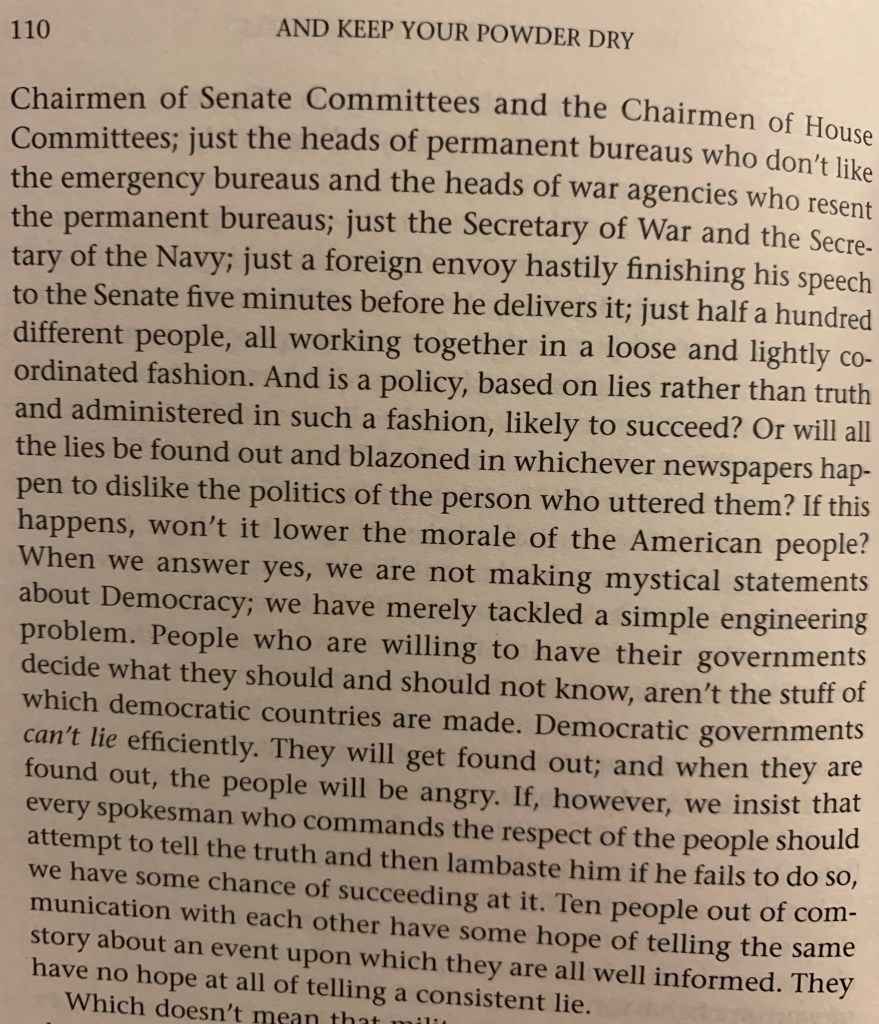
“If, however, we insist that every spokesman who commands the respect of the people should attempt to tell the truth and then lambaste him if he fails to do so, we have some chance of succeeding at it.”
(Berghahn Books 2000)
Mead believes strongly that Americans do not take kindly to lies.
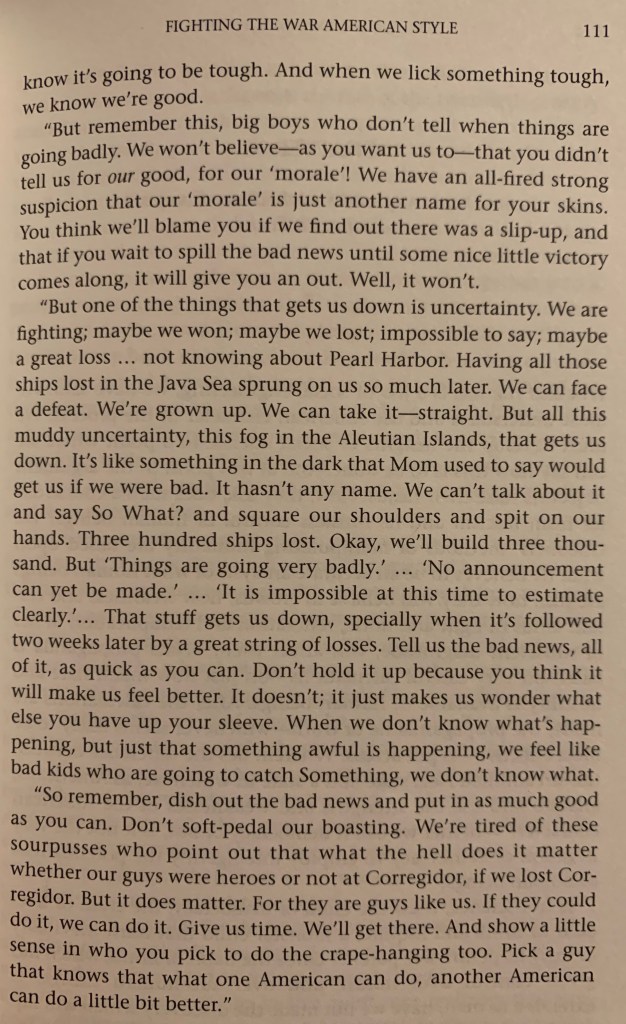
“Pick a guy that knows that what one American can do, another American can do a little bit better.”
(Berghahn Books 2000)
Here, she calls out the leaders of her time, and tells them that not being straight with Americans, even in wartime, was the mistake they kept making. She says that waiting to tell bad news just “…makes us wonder what else you have up your sleeve” (2000). It’s a plea to our leaders in Washington to trust the average American enough to be honest with all of us about what our nation faced.
Mead ends the chapter by reminding us that if our parents or we do not measure up, there is some other American who can.
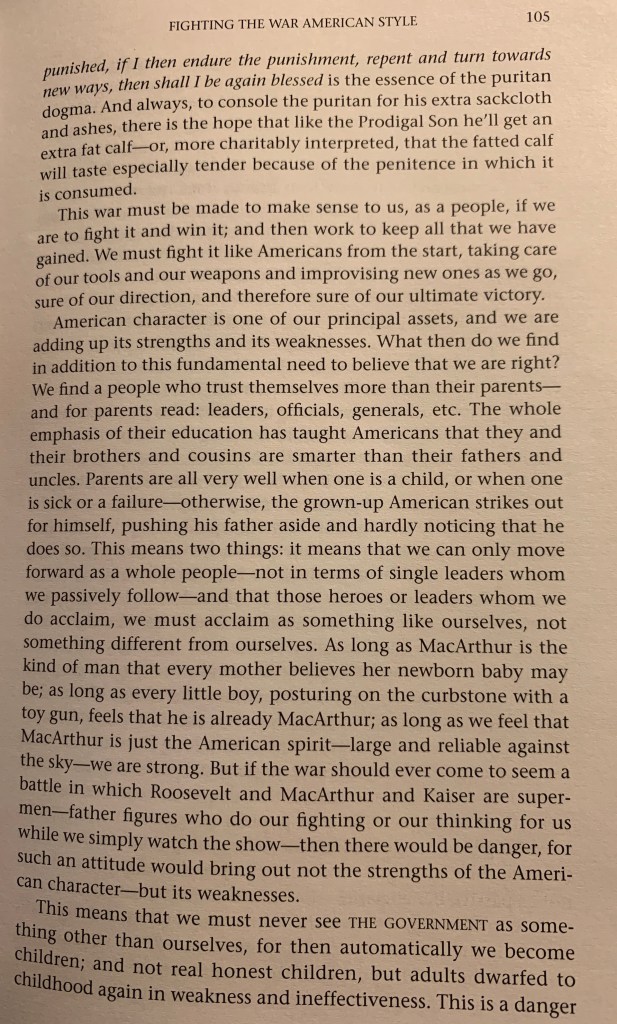
As we continue Chapter X, “Fighting the War American Style,” we will pick up right where we left off in the last blog. There, we read Margaret Mead’s explanation of the importance of moral purpose and moral conceptualizing for Americans. Here, she puts it in a way they might feel more familiar: we “need to believe that we are right” (2000).
“This means that we must never see THE GOVERNMENT as something other than ourselves…”
(Berghahn Books 2000)
She goes on to say that another characteristic is that we trust ourselves more than our parents, and this can be translated into trusting ourselves more than our leaders. We need to feel like our Generals aren’t above ourselves, but that they are ourselves.
She then warns against seeing our leaders as father figures. She insists that we cannot let our leaders “…do our thinking for us while we simply watch the show” (2000). She asserts that plays to our weaknesses.
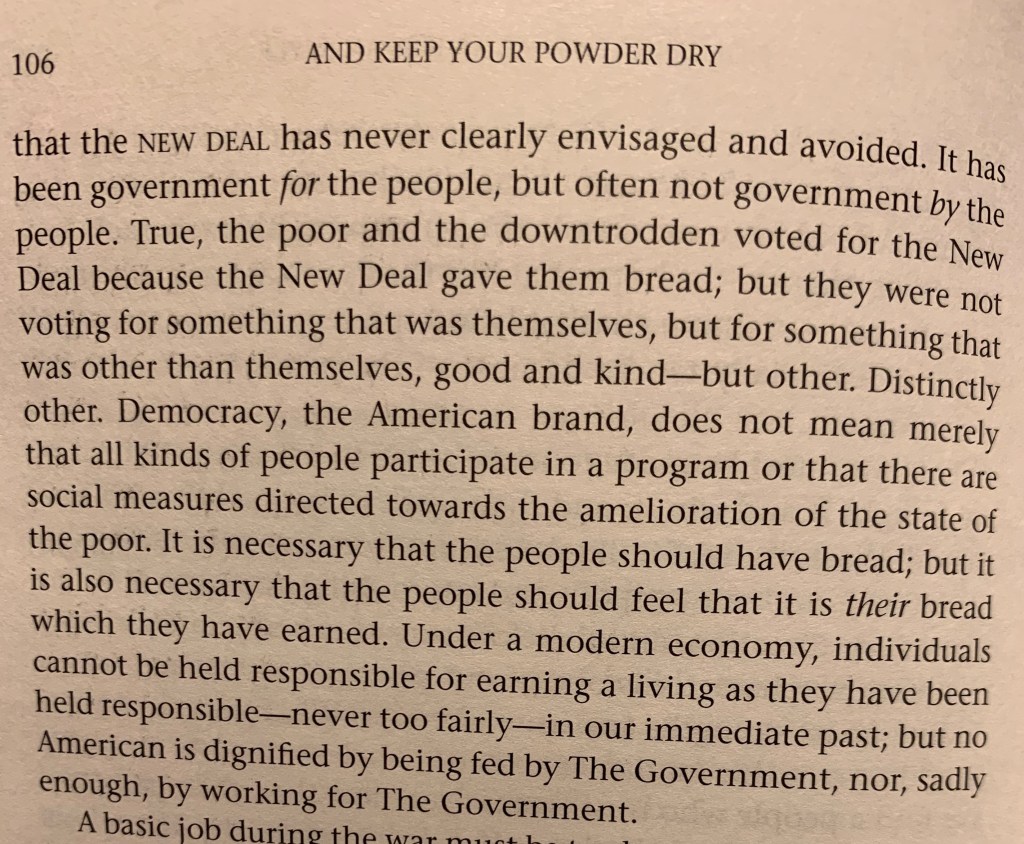
“It is necessary that the people should have bread; but it is also necessary that the people feel that it is their bread which they have earned.”
(Berghahn Books 2000)
And, this takes her back to slamming the New Deal, and she again captures the the push-pull of American values.
Democracy, the American brand, does not mean merely that all kinds of people participate in a program or that there are social measures directed towards the amelioration of the state of the poor…
(Berghahn Books 2000)
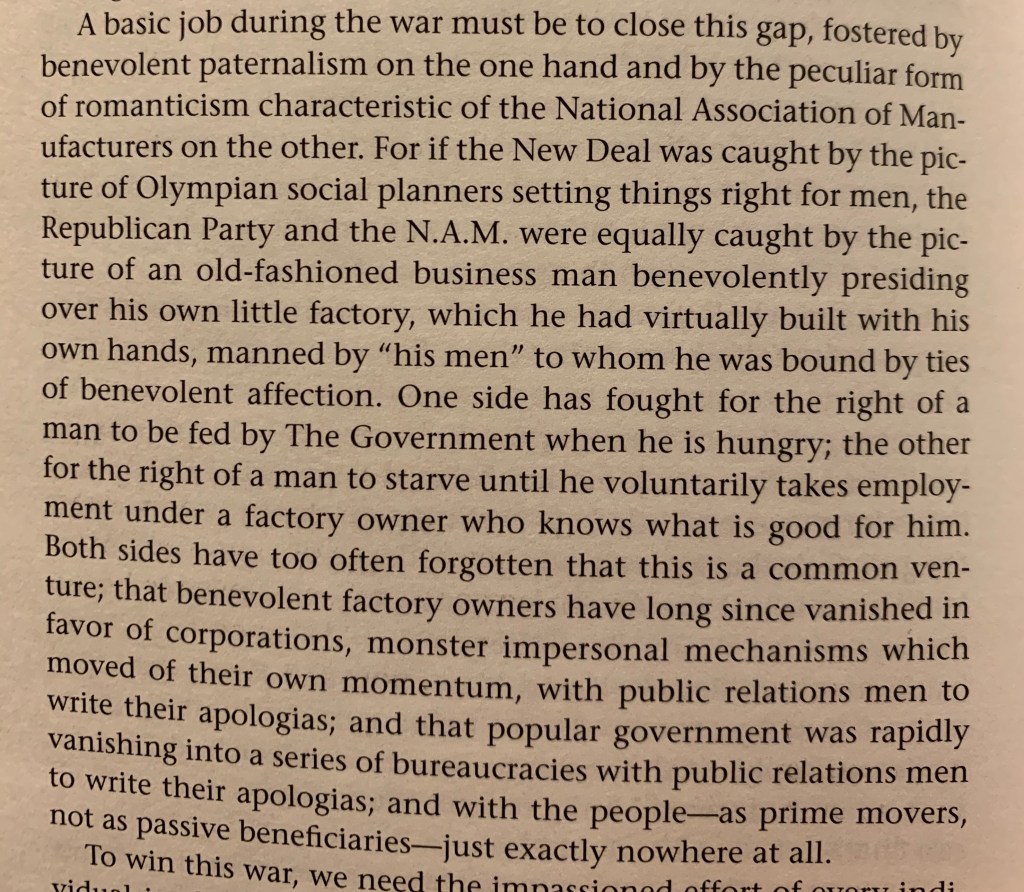
So, it does mean that there should be measures to alleviate poverty. That is just not all it means, in a way that made the New Deal dangerous in her estimation. The American brand means you earn your bread, and not from the government (because the government is the parent, remember, and adult Americans move on from their parents). She presents these ideas so clearly as part of the same character structure that I thought she might be surprised how polarized those values are in American politics today, when they are not often seen as two integral parts of a whole, but as mutually exclusive ideas with each side needing to believe they are right.
Then, she says this…
(Berghahn Books 2000)
Both sides have too often forgotten that this is a common venture; that benevolent factory owners have long since vanished in favor of corporations…with public relations men to write their apologias; and that popular government was rapidly vanishing into a series of bureaucracies with public relations men to write their apologias; and with the people—as prime movers, not as passive beneficiaries—just exactly nowhere at all.
(Berghahn Books 2000)
And, we see that she understands today’s America very well.
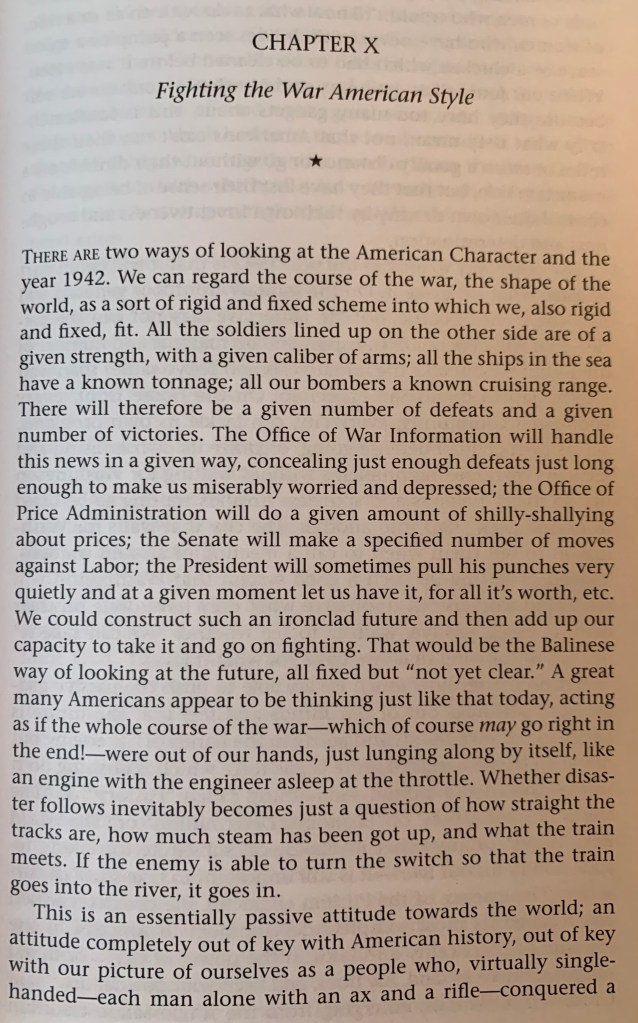
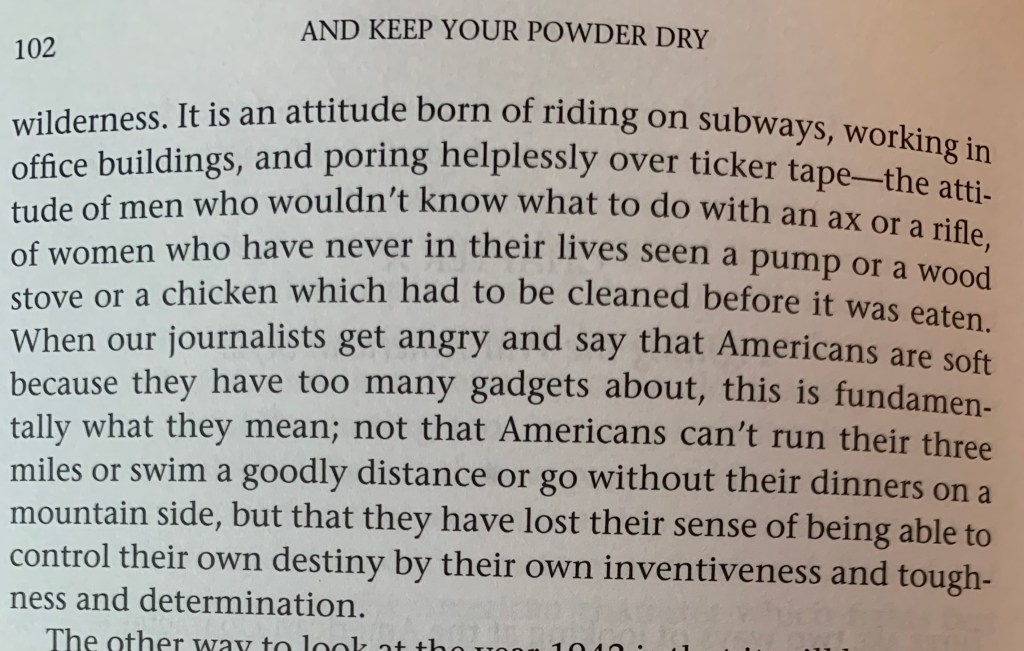
“A great many Americans appear to be thinking just like that today, acting as if the whole course of the war…were out of our hands, just lunging along by itself, like an engine with an engineer asleep at the throttle.”
(Berghahn Books 2000)
I have had this feeling that Americans are sleep walking, and I know many of my friends have, too. I used to think of Kurt Vonnegut’s Timequake when that feeling overtook me, and imagine accidents happening around me as everyone awakened at the same moment. Now, I think of Mead’s And Keep Your Powder Dry, and wonder what Americans will come up with next and which Americans it might be.
“When our journalists get angry and say that Americans are soft because they have too many gadgets about, this is fundamentally what they mean…that they have lost their sense of being able to control their own destiny by their own inventiveness and determination.”
(Berghahn Books 2000)
Margaret Mead wrote this before every home had a washing machine and television. The gadgets that worry the pundits now would blow her mind. Still, she mentions gadgets!
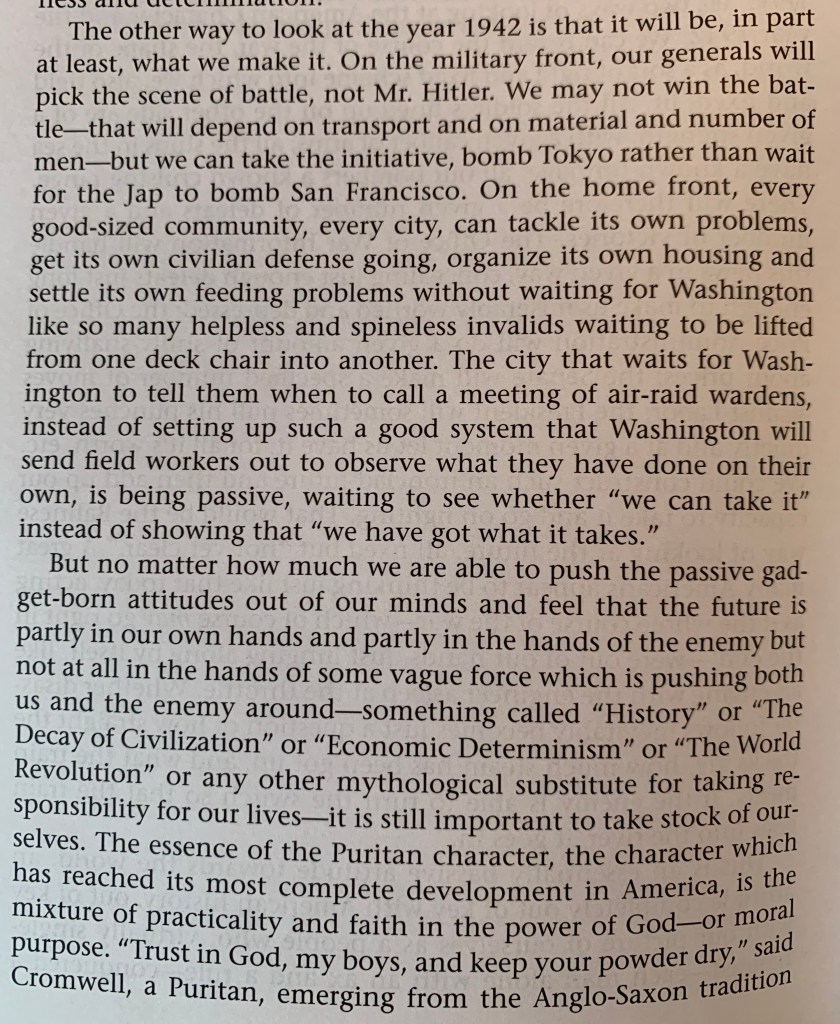
In Chapter X, “Fighting the War American Style,” Mead takes the ideas she’s been developing throughout And Keep Your Powder Dry, and attempts to explain that an understanding of the American Character allows us to accurately assess our strengths and weaknesses, which were (and are) not the strengths and weaknesses of our enemies or our allies. She is talking about America, an undeniable nation of immigrants, to Americans, with a deliberate purpose in mind.
“On the home front, every good-sized community, every city, can tackle its own problems, get its own civilian defense going, organize its own housing and settle its own feeding problems without waiting for Washington…”
(Berghahn Books 2000)
There is lot that can make modern Americans uncomfortable here, but I ask you to sit with that uncomfortable feeling and keep reading. Here, she builds the idea that it is more characteristic of Americans to build something and make Washington learn from you than to wait for Washington to bring you the goods. It might not seem that way when we are always asking presidential candidates to bring jobs to town, but it does feel true when we see how businesses and nonprofits have responded in our current crisis: making decisions to protect their workforce, distributing food and toilet paper in unusual ways, and manufacturing sanitizer instead of beer.
Americans move on, and hopefully up. They don’t wait to be told and have the good life brought to them. It can feel surreal or naive to consider this perspective now, when we are at a literal standstill, but Mead understands hard times and speaks to about control and lack of it, too.
Again, I remind you that Mead forewarned us that a discussion of America would sound like a Sunday School lesson (quote is on blog home page if you missed it). This is a prime example. For me, the takeaway here is that when we surrender to that side of ourselves that feels like we are powerless, we are failing a very important part of ourselves that needs to believe our hard work and determination can move mountains. We need to believe that we have control. That is when we are strong. So, what does that mean in time when we don’t have control?
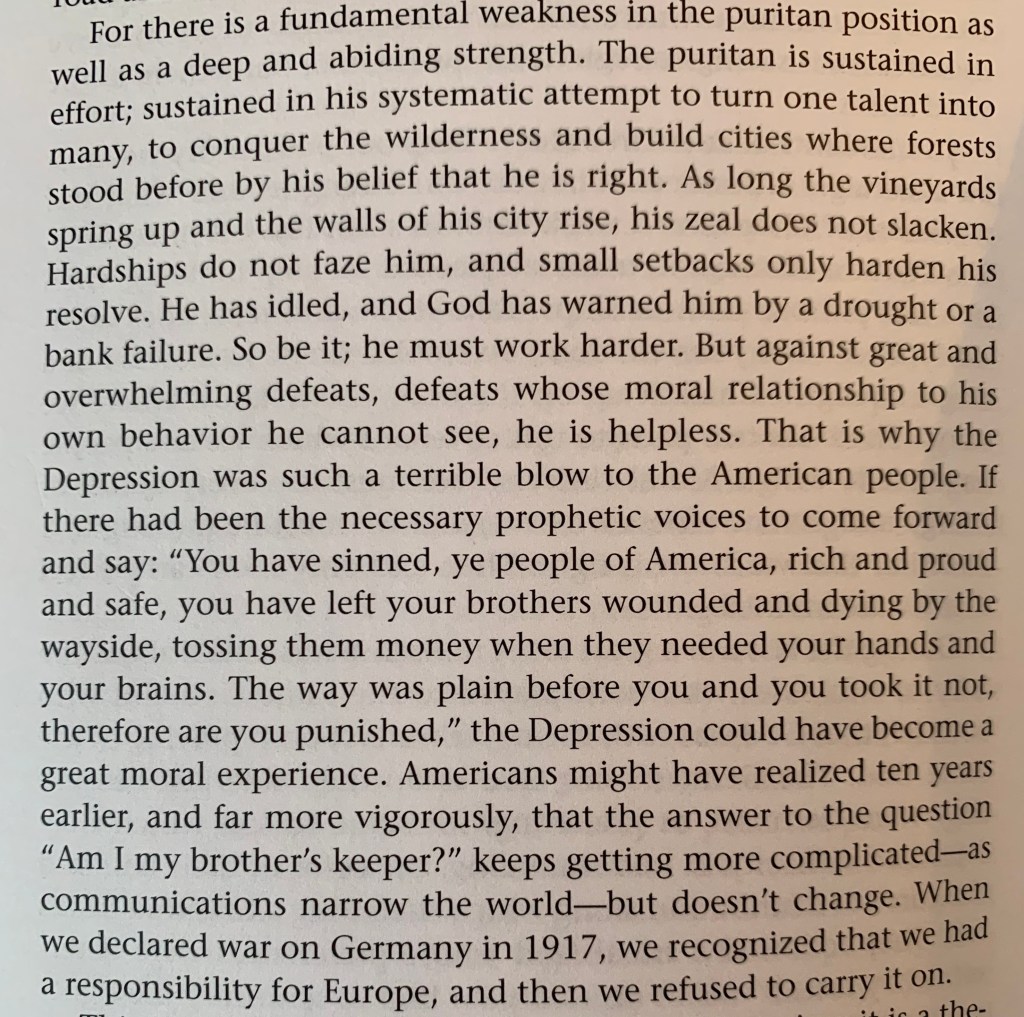
“But against great and overwhelming defeats, defeats whose moral relationship to his own behavior he cannot see, he is helpless.”
(Berghahn Books 2000)
I interpret this is as Mead saying Americans believe that our success and progress is a result of our effort, and our failures are a signal that we must do better. Some things, like the Great Depression, really undo that, because our personal trials have got exactly nothing to do with our personal efforts. She is saying, as I read it, that when that happens, we need to see it as a national failure and the nation needs to do better—that even if it’s not true that what is hurting us is our punishment for doing some wrong, we still need the moral experience of taking responsibility for it to move on.
I think this will make many readers uncomfortable, but I think part of the reason is because the voices that still espouse this idea in such religious terms today are guys like Pat Robertson, who want to blame hurricanes for gay people. We’ve heard these voices blaming Jews for coronavirus. Those aren’t the only voices, though, that still couch our failures and trials is such strongly moral, often religious, terms. We can still see how this aspect of the American character plays out in American politics today. We can see a direct religious appeal from those who believe that abortion is an obvious moral failing that is wreaking havoc on our national character and causing bad things to happen. We see another type of religious appeal from many African-American leaders who pose the very question directly, “Am I my brother’s keeper?” We see a moral appeal among environmentalists, who see pollution and consumption as obvious failings that are having direct consequences on our planet today, consequences that we’ve historically called “acts of God.”
In short, the moral browbeating we give each other that makes us so insufferable to one another is an important, fundamental part of who we are.
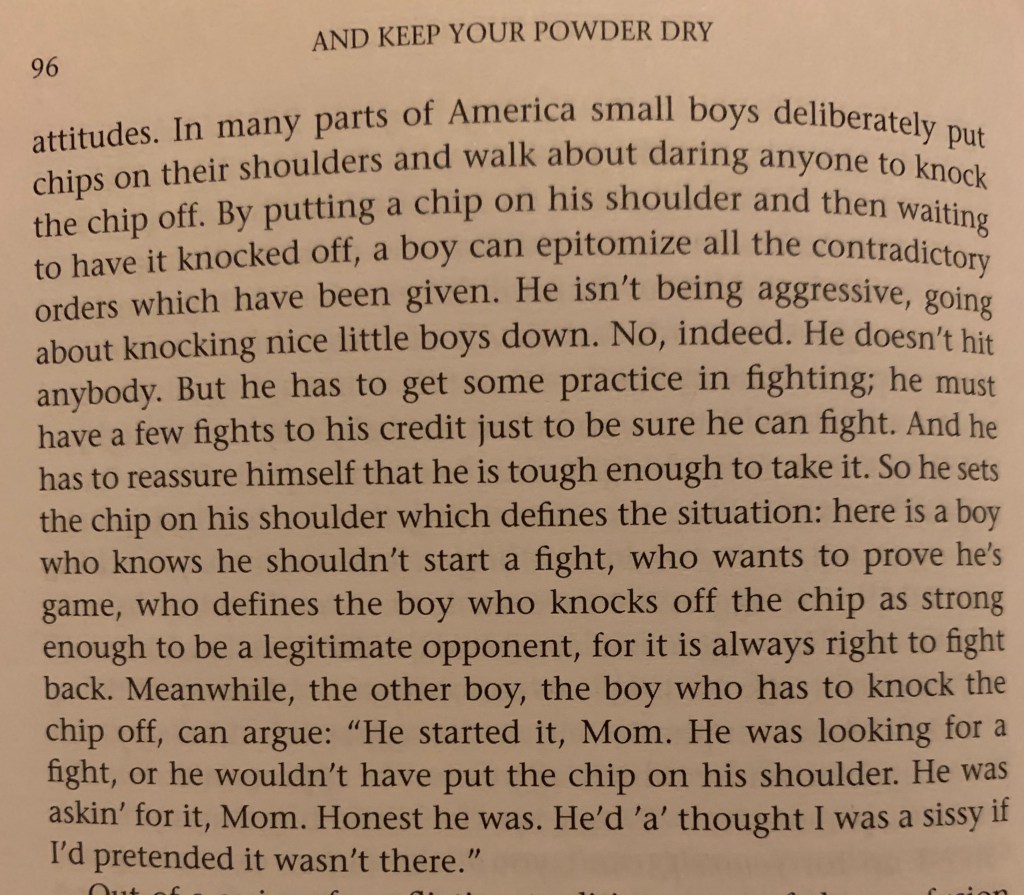
This blog will pick up where the last left off in Chapter IX, “The Chip on the Shoulder.” Let’s start with the game as played by American schoolboys.
(Berghahn Books 2000)
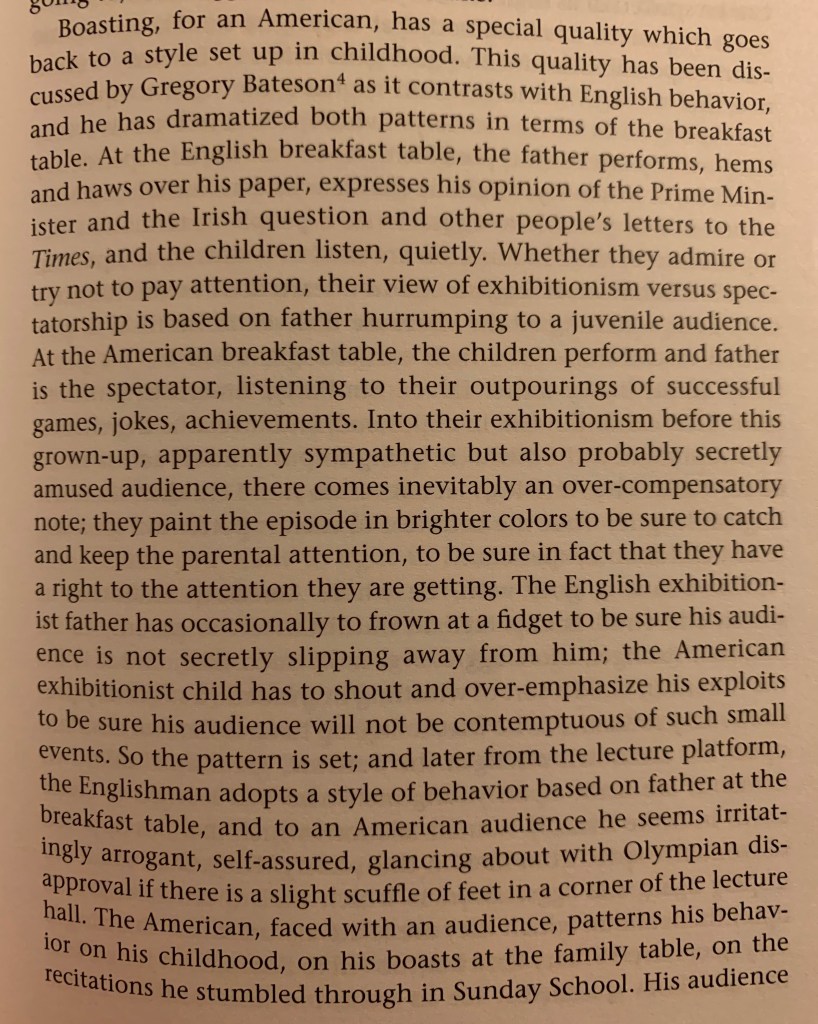
This next passage is one I find completely delightful. I share it in casual conversation. After spending sometime on the playground, she moves to the breakfast table.
“At the American breakfast table, the children perform and father is the spectator, listening to their outpourings of successful games, jokes, achievements.”
(Berghahn Books 2000)
I strongly recommend reading this in a British accent:
“At the English breakfast table, the father performs, hems and haws over his paper, expresses his opinion of the Prime Minister and the Irish question and other people’s letters to the Times, and the children listen, quietly. “
(Berghahn Books 2000)
I can’t speak for modern Brits or all Americans, but I think that is a solid description of how Americans relate to small ones now. If you are anything like me, you read “…apparently sympathetically, but also probably secretly amused…” (2000) and thought, “Isn’t that how you are supposed to interact with kids?”
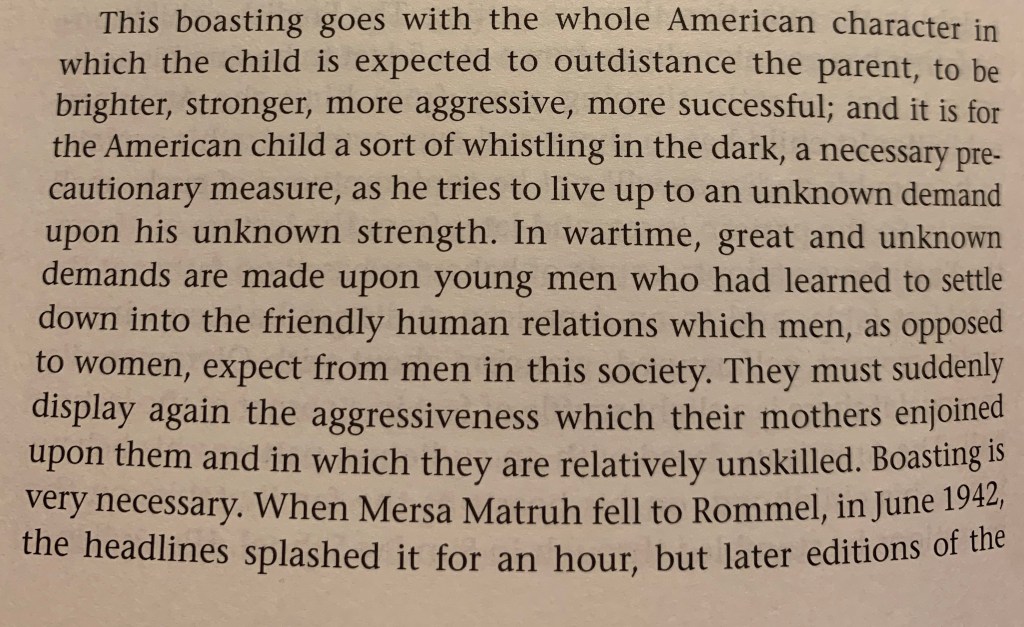
“…and it is for the American child a sort of whistling in the dark, a necessary precautionary measure, as he tries to live up to an unknown demand upon his unknown strength.”
(Berghahn Books 2000)
I absolutely adore the characterization of the American child’s attempt to impress their parents as a “whistling in the dark” (2000). I think most American kids, especially very young ones and young adult ones, would completely relate to trying to “…live up to an unknown demand upon [their] unknown strength” (2000). This is a thread that weaves through And Keep Your Powder Dry—Americans are always bracing for the unknown and unimagined. We are always moving on, always hopeful of moving up.
But, we are never quite sure of where we are headed.
(Berghahn Books 2000)
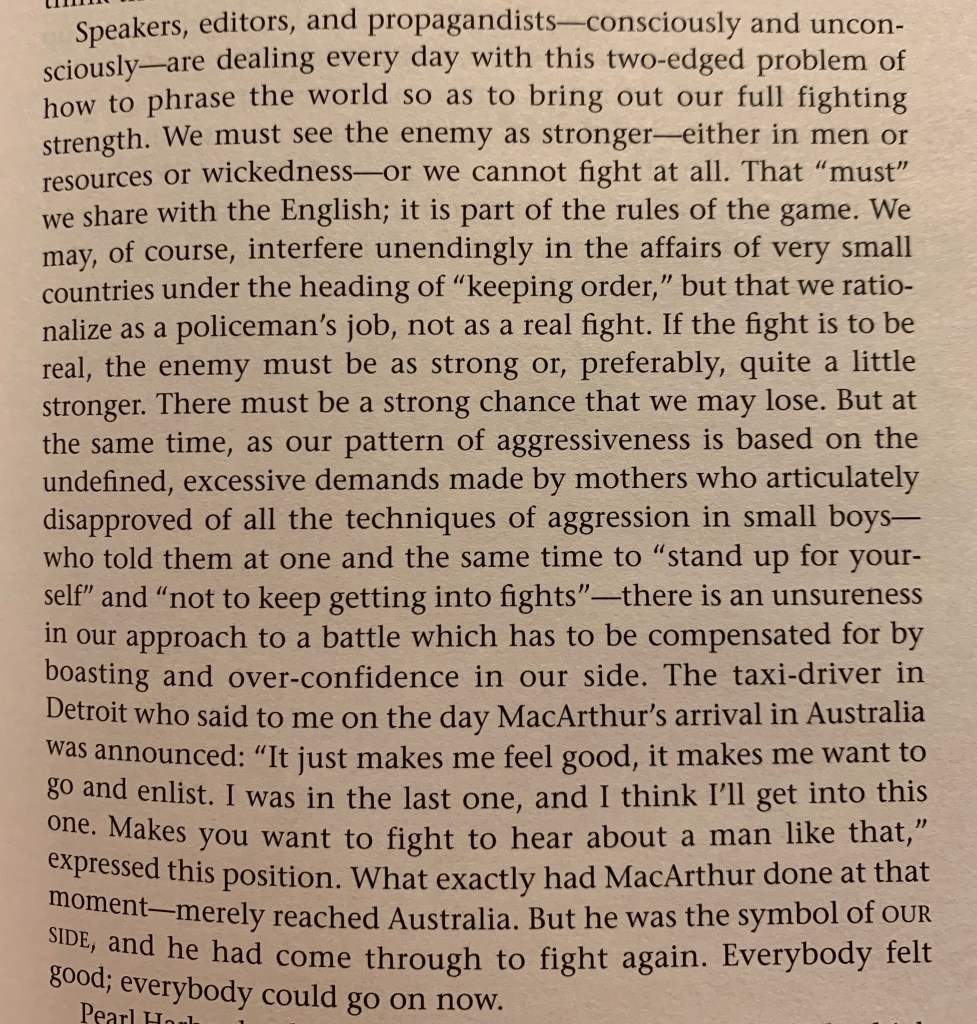
Now, remember, Mead is clearly, unapologetically trying to rally Americans to win the second world war and the peace. Even so, her description of Americans over-confidence in our side doesn’t feel overblown today. Even in our very cynical times, it’s safe to say that the boasting is a very present and trademark characteristic of our national pride. We need to believe that we’ve got a chance, even if it means we fake it until we make it.
And, I’m going to just pull this out, because I think it was a remarkable thing for a woman to say of a General in 1942. It’s the sort of thing that makes me feel good, and like we can go on…
“What exactly had MacArthur done at that moment—merely reached Australia.”
“The Chip in the Shoulder” is Chapter IX of And Keep Your Powder Dry by Margaret Mead. This chapter is where Mead begins to turn her attention to World War II. That is not why it proves to be one of the saddest to me. It is because I am not sure she’d even recognize us anymore when she talks about aggression. At the same time, there are moments when we are still very recognizable.
Because she is shifting her attention to the shining cause of her time, keep these facts close to the surface:
World War II was our national priority.
Great Britain was our closest ally.
Germany was our greatest enemy.
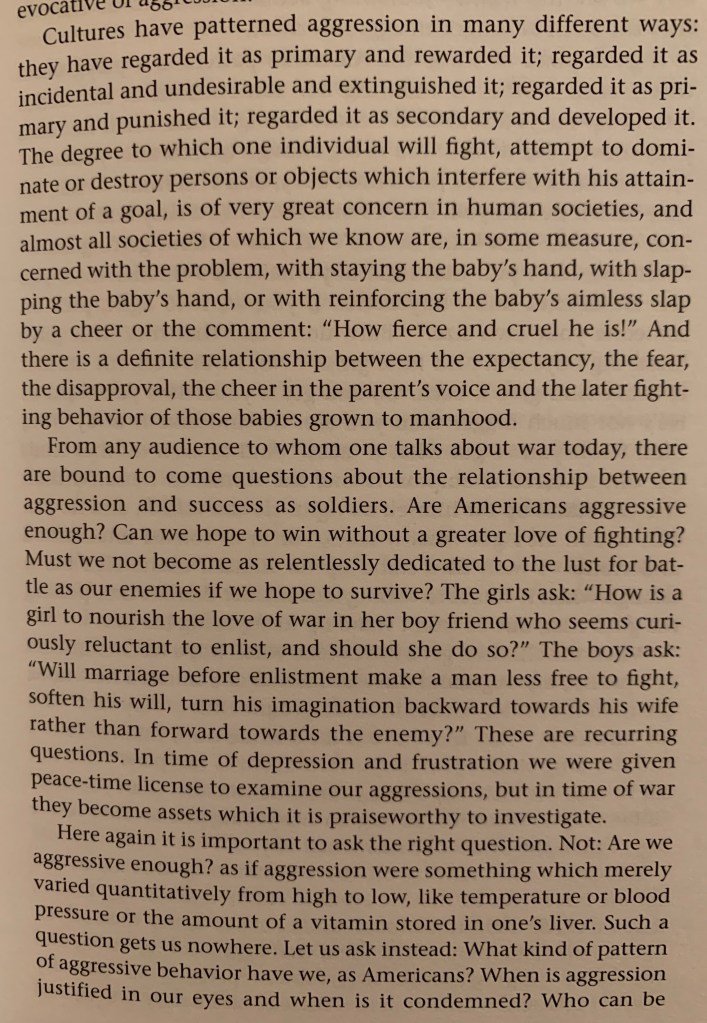
“When is aggression justified in our eyes and when is it condemned?”
(Berghahn Books 2000)
Today, the question is never whether Americans are aggressive enough. Our concern is that Americans are committing violence that is not justified and that they know will be condemned. As she talks about American boys on playgrounds, I cannot even imagine how news of school shootings would shake her.
One question I will pose is this: was America different or did she only see it that way?
“During the last war, articles used to appear in German papers exploring this curious Anglo-Saxon notion called ‘fair play,’ reproduced without translation—for there was no translation.”
(Berghahn Books 2000)
I find it absolutely intriguing that articles in German papers during WWI had no translation for “fair play.” This passage largely leaves me curious how it would be perceived by modern Germans.
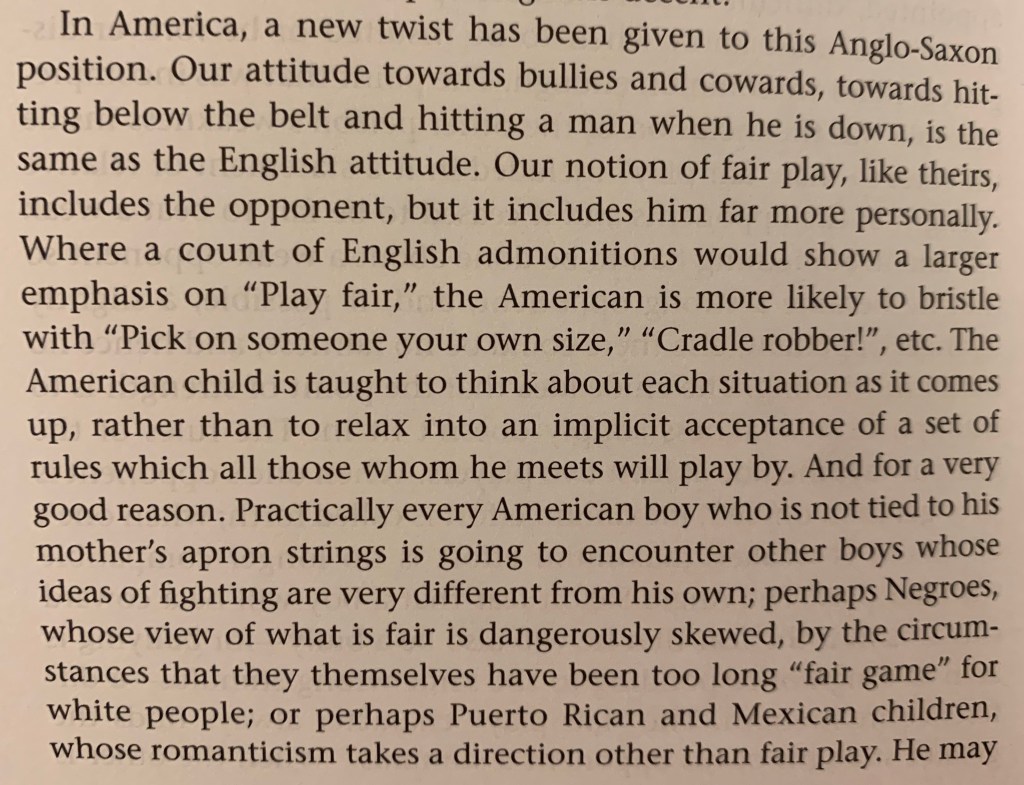
“The American child is taught to think about each situation as it comes up, rather than to relax into an implicit acceptance of a set of rules which all those whom he meets will play by.”
(Berghahn Books 2000)
I wonder again: are we far from where we were, or did Mead miss the severity of the exception she saw to fair play? She espouses the idea that Americans don’t fight until they are pushed to fight, despite the lynchings happening around her. She has the knowledge and wherewithal to acknowledge that black people were fair game for white people and that had dangerous ramifications, but there was not yet the realization that the whole time that white Americans were giving white Americans permission to see black Americans as fair game, they were giving Americans permission to see Americans as fair game.
What happened when racial violence became unacceptable and condemned, but the violence was still entrenched? Americans were taught that certain Americans were fair game for aggression, but then, in a matter of generations, that fair game was deliberately taken from them. Does that mean no one is fair game?



 Recommended Reading for American Voters