
(Berghahn Books 2000)
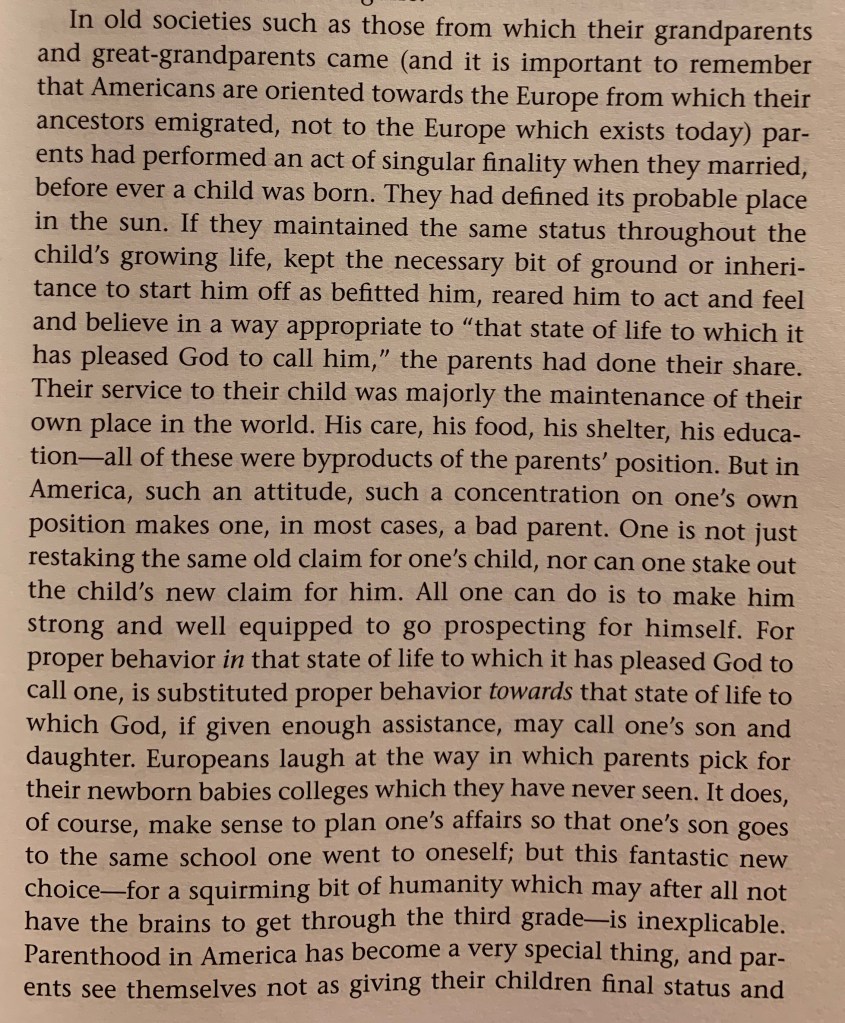
As Margaret Mead continues to share her ideas in Chapter III of And Keep Your Powder Dry, I remind myself that she lived in a different time, and in that time, her words would have been interpreted differently. (I think it’s safe to say that “not have the brains to get through the third grade” (2000) would probably not survive an academic edit today, but is also hilarious.) Mostly, I am captivated by how much of what she says still rings true. “Parenthood in America has become a very special thing” (2000) was probably basically said by a mommy blogger yesterday.
I don’t want to run away from these next thoughts of mine, because I don’t think Mead would either. Just as she acknowledges above that the Europe she is contrasting wasn’t the present-day one, she continually expresses a strong understanding that people and places change. I don’t think it would take her by surprise that America did. Some of the changes we’ve made since 1942 mean that, from here, we can see that this is a very white, Euro-centric view of ourselves. She had her place in the sun, which limits the scope of the book. When she says that Americans are “oriented toward the Europe from which their ancestors emigrated,” (2000) my first thought is, “not all Americans.” There is no interest in the internment of Japanese-Americans happening in her midst, and no direct acknowledgment that some Americans were brought here by force to build this nation. The point she ends up making, though, survives this critique, because it remains true for all or most Americans, regardless of whether their ancestors lived here or came by choice or force from anywhere else in the world (keeping in mind that just as she was taking about a past Europe, I’m talking about a past world).
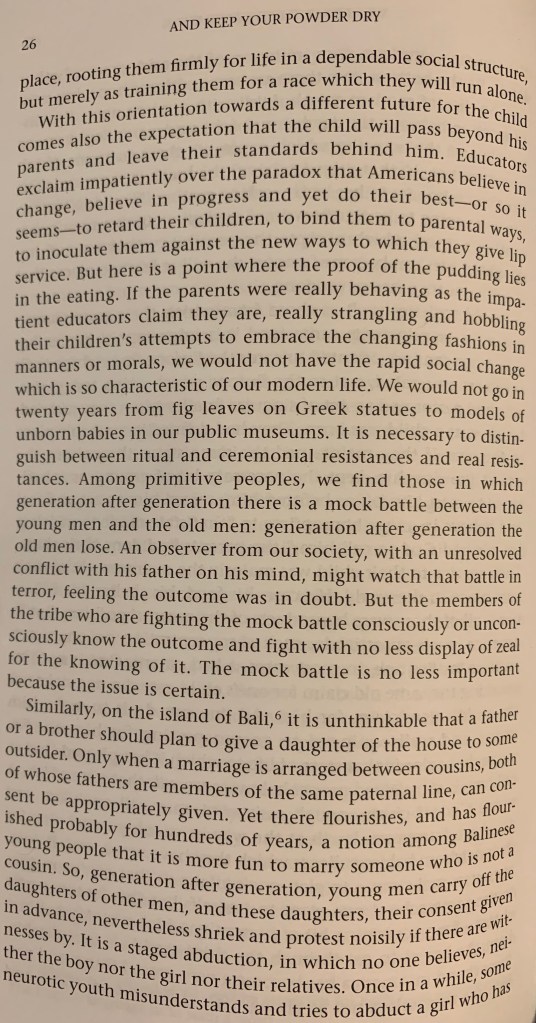
For Americans, their ancestors likely were born into the status where they would remain throughout their entire lives. America is pretty rare (entirely unique?) in being a culture founded explicitly on the idea that you have the right to move on with the hope of moving up. After expressing how Americans begin to impress those hopes upon their babies as soon as they are born, she then introduces the American teacher.
When Mead discusses the schooling of children, even briefly, it’s always a special thing; you really think she’s got her finger on the pulse of today’s America. Her language here may be jarring, though.
(Berghahn Books 2000)
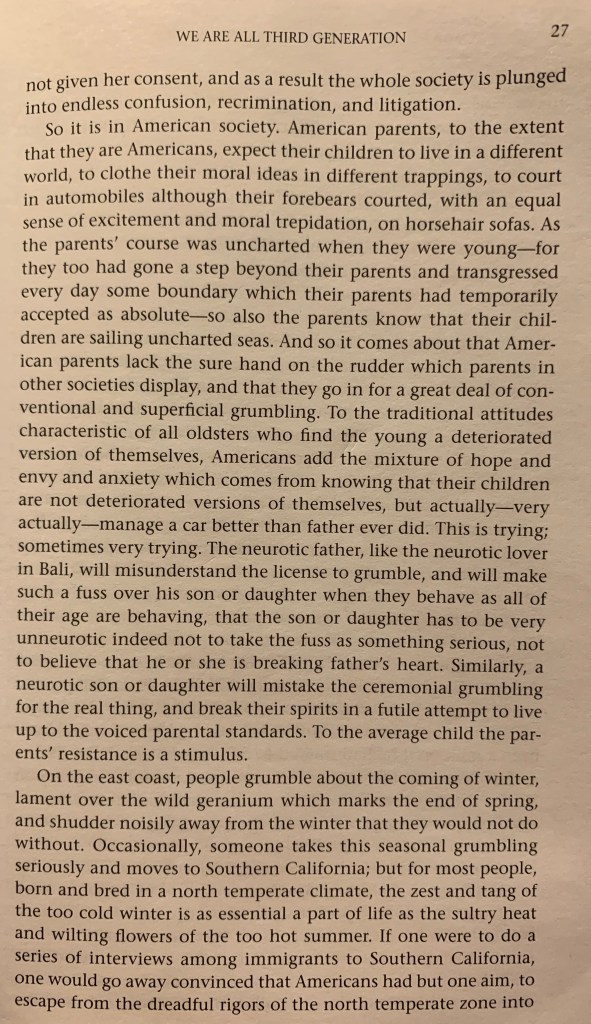
Here, I debated whether or not to include the piece on Bali, because I am lazy and not inclined to research the validity of the perspective of a 1940s’ anthropologist, and I was afraid it might offend. I included it, because I think it strongly demonstrates how she examines, contrasts, and compares cultures to give a picture of what our culture, ever-evolving as it is, is. And, the ever-evolving part is something Mead understood well even if she couldn’t actually see where we were headed. She says it here, “American parents…expect their children…to clothe their moral ideas in different trappings…” (2000).
(Berghahn Books 2000)
Again, there are things that might not sit well with modern readers, but I feel like there is much more that speaks to Mead’s knowledge and insight.
Let’s go back to the theme of American character that Mead sees explained in the third generation American in the last blog “…always moving on, always, in his hopes, moving up, leaving behind him all that was his past and greeting with enthusiasm any echo of that past when he meets in the life of another, represents one typical theme of the American character structure…” (Berghahn Books 2000)
She talks about the “hope and envy and anxiety” (2000) of Americans and how it causes them to want to fly but also does a great job of clipping their wings. There is this push and pull in the American character between the new world and the old world, between progress and its necessary uncertainty, and between rebellion and convention and the stability it brings that she conveys in usually relatable ways.
I know her perspective and education on Americans isn’t complete, but I think it is valuable for all of us to read.
Feel free to challenge me on that, though. You see, an affluent, white woman wrote this blog, too.
Biography of Margaret Mead: http://www.interculturalstudies.org/Mead/biography.html
 Recommended Reading for American Voters