
Today marks Super Tuesday of what promises to be a long, trying election year.
It will be said that November’s election will decide many things, and it probably won’t about innumerable policy issues. It will tell us something, though, of who we think we are. I think a challenge we have, and it’s not new to us, is that we don’t exactly know the answer to “who are we?” We have some impressive documents to guide us, but they don’t change that we have wildly different thoughts on what the answer is or should be.
It’s hard to answer, because our country has changed so dramatically, and has helped dramatically change the world, in the centuries it has existed. We are supposed to innovate, adapt, and chart new courses in unimagined places. In this country, we can look back, know the history books left out the stories of many Americans, and demand a rewrite that takes them into account. Add to that, we are a nation of individuals, so we are not beholden to the perceived shared values of one another. Every election, like this election, our shared values are up for debate.
The difficulty of the question doesn’t mean we can’t answer it, though.
We will and must answer “who are we?” at the polls and in our homes, whether we like it or not, so this blog is my effort to lead a discussion about it, by reading a book about it with you. That book is And Keep Your Powder Dry by Margaret Mead.
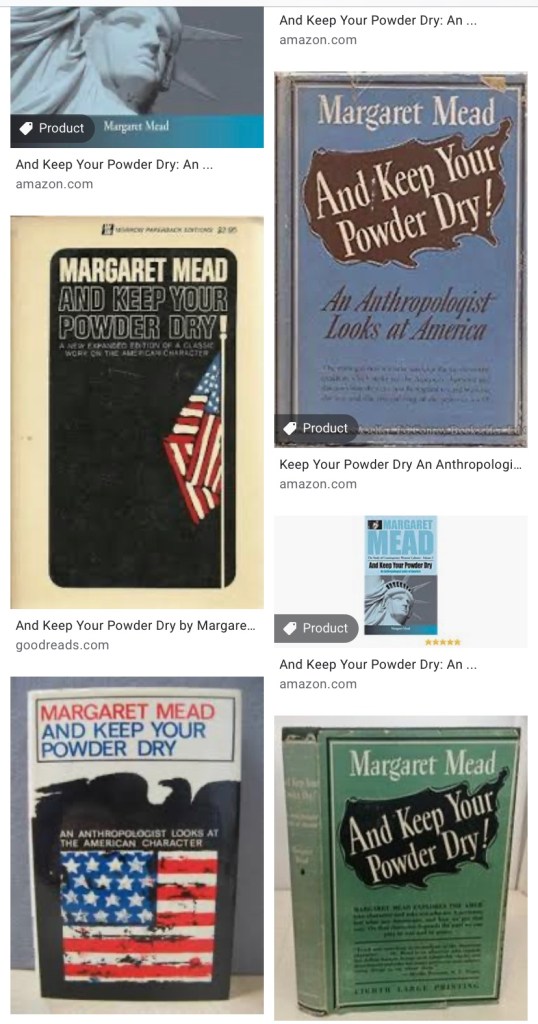
Originally published in 1942 and most recently in 2000 by Berghahn Books, the book was Mead’s attempt to use her skill as a social scientist to help Americans understand their collective strengths and weaknesses in an effort to win the war and the peace. Needless to say, this leaves room for debate and disagreement. I don’t recommend this book as some inarguable truth nor do I claim Mead or her ideas are somehow beyond reproach. I present it, because she thought a lot about the question and wrote one of the most studied, articulate answers to it.
Any American reading And Keep Your Powder Dry in 2020 is likely to see some of it as clearly wrong, misguided, or just plain puzzling. They are also likely to laugh loudly at times, struck by how right she could get it about present day Americans from way back in the 1940s. Mostly, and the reason I’ve been moved to write this blog, I think anyone who reads this book in this election year will think about the American character and our place in the world in a way that they haven’t, and in a way that we haven’t as a nation, in a long time. She will move you.
Please, find a copy or just read along with me. I am so excited to share this book with you now!
(You can learn more about Mead and 1942 in the Background Links page of the website.)
 Recommended Reading for American Voters